
1.8 µm Particle Size - Increase in HPLC Separation Efficiency
10 May 2007MACHEREY-NAGEL, the manufacturer of NUCLEOSIL® and NUCLEODUR®, one of the leading companies for chromatography products, introduces the new NUCLEODUR® 1.8 µm particles!
Miniaturization in HPLC has a long history. With the introduction of the new 1.8 µm NUCLEODUR® particles now researchers have turned over a new leaf in HPLC column technology.
Features of 1.8 µm NUCLEODUR® silica particles:
- Increase of separation efficiency by higher number of theoretical plates (N):
Increase of the plate number by app. 67% offers the possibility of using shorter columns with equal plate numbers resulting in a decrease of analysis time. - Significant improvement in resolution
Use of 1.8 µm instead of 3 µm particles leads to an increase of resolution by a factor 1.29 (29%). - Column back pressure
Due to the smaller particle size the back pressure will increase. Because of the high sphericity of the NUCLEODUR® particles and the very narrow particle size distribution we were able to keep the back pressure on a moderate level. - Higher flow rates and shorter run times
optimal flow rate for 1.8 µm particles is higher than for 3 and 5 µm particles and through this, the analysis time can be reduced.
Currently all NUCLEODUR® premium phases (C18 Gravity, C8 Gravity, C18 Isis, C18 Pyramid, Sphinx RP) are available in 1.8 µm.
Further information can be found on the article webpage.
Related products
Request Quote for All Products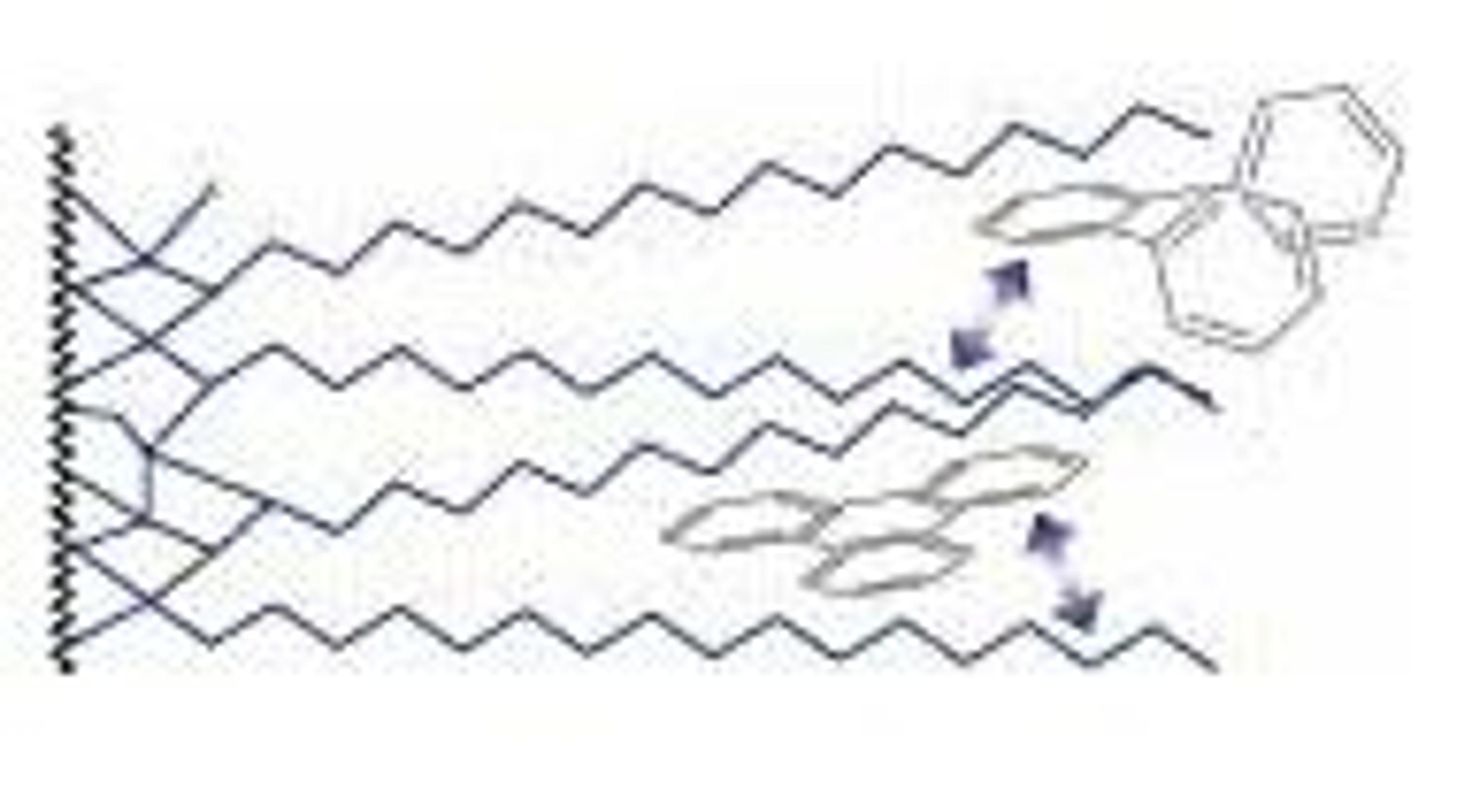
NUCLEODUR® C18 ISIS
MACHEREY-NAGEL GmbH & Co. KGA unique C18 phase with high steric selectivity • C18 phase with special polymeric surface modification • particle sizes 1.8 µm, 3 µm and 5 µm • exceptional steric selectivity • outstanding surface deactivation • pH stability 1 – 10 • broad range of applications: steroids, (o,p,m-) substituted aromatics, fat-soluble vitamins, positional isomers Surface modification By use of specific C18 silanes and appropriate polymeric bonding technologies a dense shield of alkyl chains protects the subjacent silica matrix. Elemental analysis of NUCLEODUR® C18 Isis shows a carbon load of 20%. The target crosslinking of the C18 chains on the surface enables the separation of compounds with similar molecular structure but different stereochemical properties. The separation of o-terphenyl and triphenylene is a concrete example to evaluate the selectivity potential of a reversed phase column in terms of the different shape of two molecules. The phenyl rings of o-terphenyl are twisted out of plane while triphenylene has a planar geometry. Surface deactivation The chromatography of basic analytes requires a high density of surface-bonded C18 silanes combined with a thorough endcapping procedure to keep silanol activity at a minimum. This ensures tailing-free elution of even strongly basic amino-containing compounds. Stability The applied special surface bonding technology also provides improved stability features for the NUCLEODUR® C18 Isis phase. The proof for this was given in a long-term test in which the decrease of plate counts for caffeine at pH 10 and 50 °C has been observed over a period of 200 hours and 2000 sample injections respectively.