ResourceSeparations
HPTLC: Unmatched precision and reproducibility
30 Nov 2023
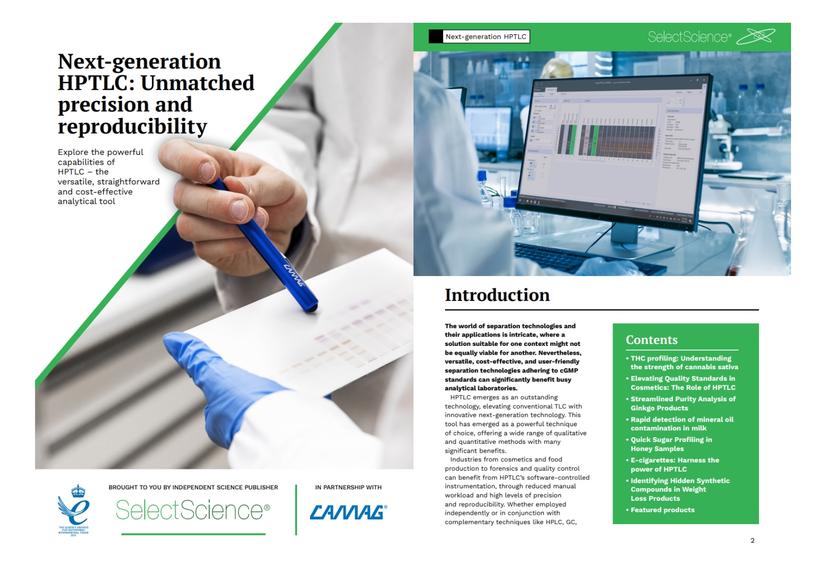
The world of separation technologies and their applications is intricate, where a solution suitable for one context might not be equally viable for another. Nevertheless, versatile, cost-effective, and user-friendly separation technologies adhering to cGMP standards can significantly benefit busy analytical laboratories.
In this expert guide, we delve into the diverse applications of CAMAG’s high-performance thin-layer chromatography (HPTLC) technology, providing you with a comprehensive grasp of its exceptional versatility. This eBook will reveal how this advanced technology delivers speed, simplicity, standardization, and reproducibility, all of which are crucial for the modern analytical laboratory.
This eBook will also explore:
- The capabilities of next-generation HPTLC
- How to quantify cannabinoids in plant tissue and nicotine in e-cigarette liquids
- How to analyze the quality of weight loss products, fragrance allergens, and emulsions
Links
Tags
Capillary ElectrophoresisCapillary electrophoresis (CE) is used to separate molecules based on charge, size and hydrophobicity. Pressure, voltage or a vacuum is used to introduce the sample to fused silica capillaries. Fluorescence, UV/Vis, UV or diode array detectors are used to visualize components. Types of CE systems include capillary electrochromatography (CEC), capillary zone electrophoresis and capillary gel electrophoresis. Find the best capillary electrophoresis equipment in our peer-reviewed product directory: compare products, check customer reviews and receive pricing direct from manufacturers.Flash ChromatographyFlash chromatography is a fast-preparative column chromatography technique used for separation and purification of liquid analytes. Flash chromatography systems use small silica gel particles for separation and a pressurized gas for driving the solvent through the column or pre-packed cartridge. Find the best flash chromatography equipment in our peer-reviewed product directory: compare products, check customer reviews and receive pricing direct from manufacturers.Gas ChromatographyGas chromatography (GC) is an analytical technique used to separate and quantitate mixtures of small and volatile compounds. Gas chromatographs or GC systems include components such as GC columns, detectors, pumps and autosamplers. Choose from packed or capillary GC columns, flame ionization (FID), photoionization (PID) electron capture detectors and selective or non-selective detectors. Find the best gas chromatographs in our peer-reviewed product directory: compare products, check customer reviews and receive pricing direct from manufacturers.UHPLC and HPLCHigh performance liquid chromatography (HPLC) and ultra high performance liquid chromatography (UHPLC), also known as UPLC, are analytical techniques used to separate, identify and quantitate components of complex mixtures including biological samples such as proteins and lipids as well as chemical mixtures of pesticides, drugs and oils. Both techniques are liquid chromatographic methods but differ by operating pressures (HPLC < 6000 psi < UHPLC ). Components of HPLC and UHPLC systems include columns, detectors, pumps, autosamplers and column heaters. Explore a range of UHPLC and HPLC columns for your specific sample needs including reverse phase, normal phase, ion exchange, HILIC, ion exclusion and size exclusion columns. For more specialized HPLC, explore FPLC, countercurrent LC and simulated moving bed systems. Find the best UHPLC and HPLC equipment in our peer reviewed product directory: compare products, check customer reviews and receive pricing direct from manufacturers.Ion ChromatographyIon chromatography, also known as ion exchange chromatography, is a high-performance liquid chromatographic technique used for the separation and identification of ions or polar molecules in a sample, including proteins, nucleotides and amino acids. Equipment includes ion exchange columns, ion exclusion columns, ion chromatography systems, pumps, and detectors. Find the best ion chromatography equipment in our peer-reviewed product directory: compare products, check customer reviews and receive pricing direct from manufacturers.Size Exclusion ChromatographySize exclusion chromatography (SEC) is a liquid chromatographic technique used to separate and identify molecules based on their size, including polymers, proteins, nanoparticles & nucleic acid. SEC is further subdivided into gel filtration chromatography (GFC) and gel permeation chromatography (GPC) when an aqueous or organic mobile phase is used respectively. HPLC-based SEC systems and columns are available for analytical separation alongside SEC spin columns or filters to prep samples for many protocols. Find the best size exclusion chromatography equipment in our peer-reviewed product directory: compare products, check customer reviews and receive pricing direct from manufacturers.LC-MSLC-MS (liquid chromatography-mass spectrometry) systems and equipment are used for separation and quantitative analysis of complex mixtures, combining liquid chromatography and mass spectrometry. Quantify proteins, contaminants, pesticides or screen for drug metabolites with a high level of sensitivity. LC-MS systems and equipment include reverse phase, normal phase and specialized columns integrated with various MS detectors such as time-of-flight (TOF), quadrupole, orbitrap or ion trap mass analyzers. LC-MS/MS instruments equipped with a qTOF or triple quadrupole analyzer give greater sensitivity and resolving power to your analysis. Find the best LC-MS equipment in our peer-reviewed product directory: compare products, check customer reviews and receive pricing direct from manufacturers.Preparative ChromatographyPreparative chromatography equipment is used for purification purposes, separating and collecting compounds eluted from a mixture which can then be subsequently used for further purposes. This can be done in large quantities or small. Preparative chromatography systems are usually low to medium pressure liquid chromatographs that are semi-automated. Explore a range of preparative columns and fraction collectors. Find the best preparative chromatography equipment in our peer-reviewed product directory: compare products, check customer reviews and receive pricing direct from manufacturers.Supercritical Fluid ChromatographySupercritical Fluid Chromatography (SFC) is used for the rapid separation and analysis of complex mixtures. SFC systems require injectors, pumps, columns, ovens and detectors. The SFC retention method uses a supercritical fluid, usually CO2. There are a number of different SFC detector types including UV / VIs, ECD, mass spectrometry and fluorescence.NanoLCNano LC is a nano scale liquid chromatography technique typically used for proteomic applications. The nano refers to the very low flow rate of the mobile phase in the system. The advantage of nanoLC is its high sensitivity. Often the system is integrated with a mass spectrometer in nano LC-MS or nano LC-MS/MS. When using nanoLC equipment consider column choice, software and accurate and precise flow rate control.GC-MS GC-MS (gas chromatography-mass spectrometry) instruments and equipment are used to separate, quantify and identify mixtures of small and volatile compounds, such as polycyclic aromatics, fatty acids and alcohols. Often used in drug detection, forensic investigation and environmental analysis for pesticides and contaminants, GC-MS is a powerful addition to your lab’s analytical capabilities. GC-MS/MS instruments equipped with a qTOF or triple quadrupole analyzers can give greater sensitivity and resolution to your analysis. Find the best GC-MS instruments and equipment in our peer-reviewed product directory: compare products, check customer reviews and receive pricing direct from manufacturers.UltraPerformance Convergence ChromatographyConvergence Chromatography expands the capabilities of reversed phase LC and conventional GC techniques. By varying mobile phase strength, pressure, temperature and stationary phase Convergence Chromatography facilitates the separation, detection and quantification of many compounds and samples. The CO<sub>2< / sub> mobile phase used reduces the need for toxic solvents.Chromatography Method DevelopmentChromatography method development is the process of designing and optimizing chromatographic techniques to separate and analyze complex mixtures. This includes selecting appropriate stationary and mobile phases, determining flow rates, and optimizing detection methods. Successful method development is essential for high-quality results in fields like pharmaceuticals, food safety, and environmental analysis. Explore chromatography method development tools in our peer-reviewed product directory; compare products, check reviews, and get pricing directly from manufacturers.Protein SeparationChromatographyChromatography is a powerful technique used to separate and analyze components of mixtures based on their chemical properties. It is widely used in fields like biochemistry, pharmaceuticals, and environmental analysis. By exploiting differences in the interaction of substances with a stationary phase and a mobile phase, chromatography enables precise purification and quantification of compounds. Whether you're working with complex biological samples or industrial chemicals, chromatography is essential for obtaining high-quality results. Browse our peer-reviewed product directory to find the best chromatography systems, compare products, read customer reviews, and get pricing directly from manufacturers.