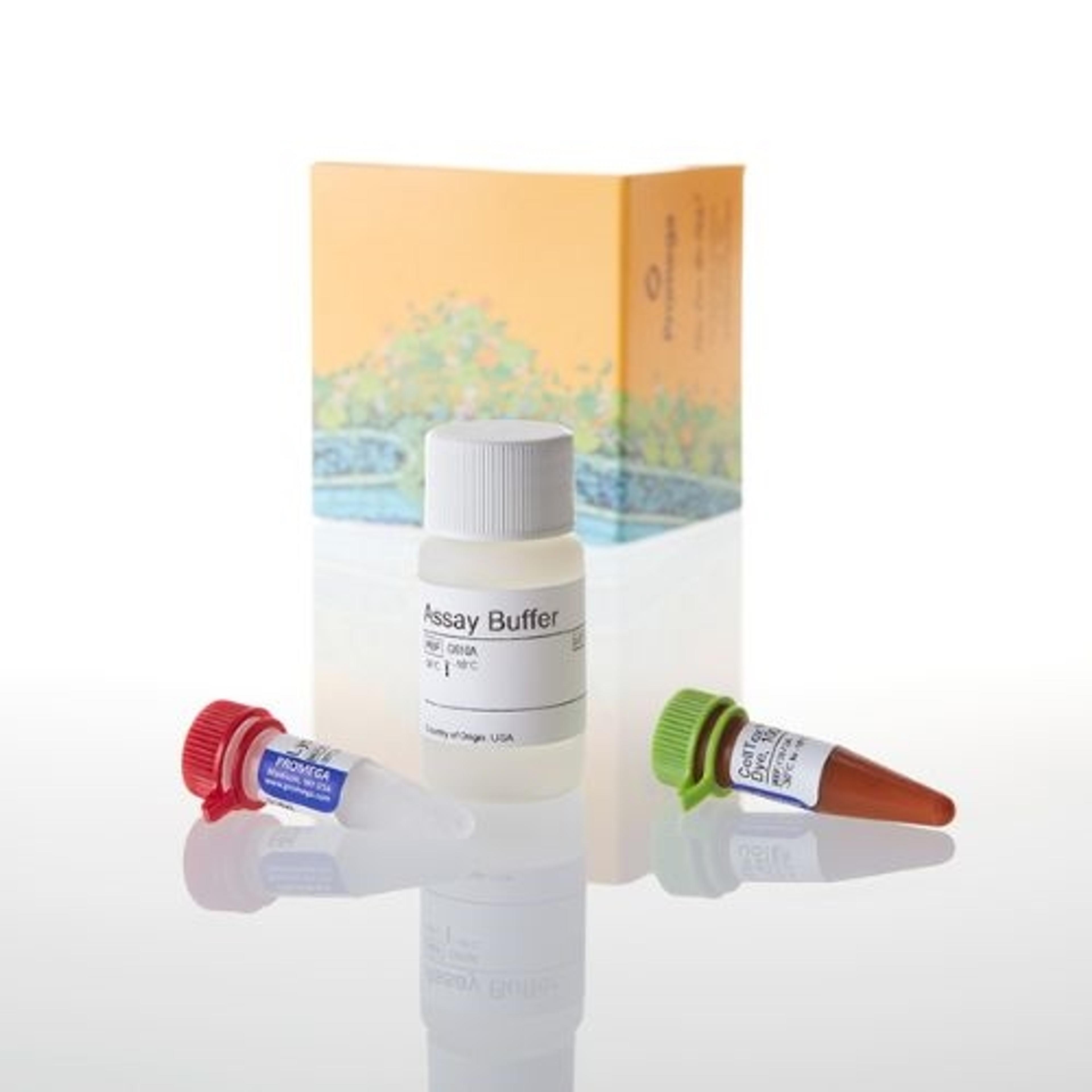
Real-Time Cytotoxicity Analysis Using CellTox™ Green Dye

18 Aug 2013

This application note demonstrates the use of a non-activity-based cytotoxicity probe, CellTox™ Green Dye, which can be added at the beginning of an experiment and employed in real time for the kinetic determination of cytotoxicity. The HP D300 Digital Dispenser, available from Tecan, was used for noncontact dispensing of test compound and the Tecan Infinite® M200 PRO with Gas Control Module (GCM™) for kinetic measurement of cytotoxicity in HepG2 cells over 72 hours.

CellTox™ Green Cytotoxicity Assay

Promega Corp.

The CellTox™ Green Cytotoxicity Assay measures changes in membrane integrity that occur as a result of cell death. The assay is intended to assess cytotoxicity in cell culture after experimental manipulation. The assay system uses a proprietry asymmetric cyanine dye that is excluded from viable cells but preferentially stains the DNA from dead cells. When the dye binds DNA released from cells, its fluorescence properties are substantially enhanced. Viable cells produce no appreciable increases in fluorescence. Therefore, the fluorescence signal produced by the binding interaction with dead cell DNA is proportional to cytotoxicity. The CellTox™ Green Dye is non-toxic to cells, and the signal remains constant after exposure of 72 hours, making it ideal for determining toxic effects of treatments throughout an extended exposure or as an endpoint determination. Features - Benefits • Accurate Cytotoxicity Determination: The CellTox™ Green Dye stably binds DNA of cells that have lost membrane integrity throughout 72-hour exposure and won’t underestimate cytotoxicity. • Kinetic Cytotoxicity Measures: Measure cytotoxicity at convenient time points from the same sample well to detect onset of toxicity with no duplication of plates. • Simple and Flexible Protocols: Add assay reagent directly to cells prior to plating or with dosing media to perform kinetic cytotoxicity measurements, eliminating a reagent dispensing step, or add diluted dye directly to cell culture wells as an endpoint add-mix-measure assay. • Multiplexing-Compatible: Get more informative data per well and reduce cell culture expenses by multiplexing with fluorescent and luminescent cell-based assays in the same well with no sample manipulation. • Easily Automated: Easily scale from 96- to 1536-well plate formats with “no-addition” or “single-addition” protocols. Applications Determine cytotoxic effects of treatments on cells in culture after long-term exposure.

(1)

Links

Tags

ADME-ToxicologyADME-toxicology (ADME-Tox) studies are used in pharmacology and pharmacokinetics to assess the activity/toxicity of drugs <i>in vivo</i> or <i>in vitro</i>. Find bioassays for absorption, distribution, metabolism, and excretion of drug molecules including cytotoxicity, transporter/permeability, metabolism and activity assays as well as hepatocytes and cell lines for ADME. Find the best ADME-toxicology products in our peer-reviewed product directory: compare products, check customer reviews and receive pricing direct from manufacturers.Assay AssemblyAssay Assembly is technique used in drug discovery to develop assays to test the cytotoxicity, genotoxicity, or other activities of a compound on a cell. Assay assembly requires chip assembly, a delivery system and a detection and analysis method. Beneficial features of assay kits or automated systems include high-throughput, high speed and sensitivity and low signal to noise ratio.Cell-Based AssaysCell-based assays are used to monitor the presence, quantity and activities of a desired cellular analyte including drug molecules or biomarkers. This can reveal information on cell health (apoptosis, cytotoxicity, viability and proliferation assays), cell metabolism, cell migration and cell signaling mechanisms. Find the best cell-based assay products, kits and equipment with our peer reviewed product directory: compare products, check customer reviews and receiving pricing direct from manufacturers.Robotic WorkstationsRobotic workstations are automated platforms enabling the user to perform high-throughput, multi-application processes, from sample preparation tasks such as PCR set-up, DNA purification and NGS library preparation, to integrated sample prep and analysis workstations. Automation makes processes consistent, fast, precise and fully walk-away. Find the best robotic workstations in our peer-reviewed product directory: compare products, check customer reviews and receive pricing direct from manufacturers.Automated Liquid HandlingAutomated liquid handling equipment is used to mix, dilute and dispense allotted volumes of liquid into microplates and other vessels automatically. The robotic, liquid handling arms can dispense from single channel to 3456 multichannel as well as operate nanoliter dispensing, enabling high throughput of samples. Find the best automated liquid handlers in our peer-reviewed product directory: compare products, check customer reviews and receive pricing direct from manufacturers.CytotoxicityCytotoxicity assays measure the toxic effects of substances on cells, often used in drug testing and environmental studies. These tests are crucial in determining the safety of chemicals and pharmaceutical compounds. Explore cytotoxicity testing tools in our peer-reviewed product directory; compare products, check reviews, and get pricing directly from manufacturers.Fluorescence Based AssayFluorescence based assays are widely used in life science research and high-throughput screening to measure a broad range of cellular activities.Biomarker DiscoveryClinical biomarkers refer to substances related to known medical conditions that can be accurately measured <i>in vitro</i>. Biomarkers can be used to diagnose presence of a disease and indicate disease severity. The discovery of new biomarkers is incredibly valuable in the field of diagnostics.
Real-Time Cytotoxicity Analysis Using CellTox™ Green Dye