
ResourceSpectroscopy
Absorbance & fluorescence: Your guide to quantification & quality control
24 Apr 2023Fluorescence and UV-vis absorbance are complementary techniques for the quantification and quality control (QC) of samples. Each method has advantages depending on the application and sample being quantified.
This eBook provides a comprehensive guide to absorbance and fluorescence techniques for quantitation and quality assessment of samples, when to implement each method, how to troubleshoot abnormal ratios, and much more.
Download to explore content including:
- Purity ratios
- Quality control of dsDNA for NGS
- Performance data of microvolume nucleic acid
- dsDNA assay concentration limits
- RNA assay performance data
Related products
Request Quote for All Products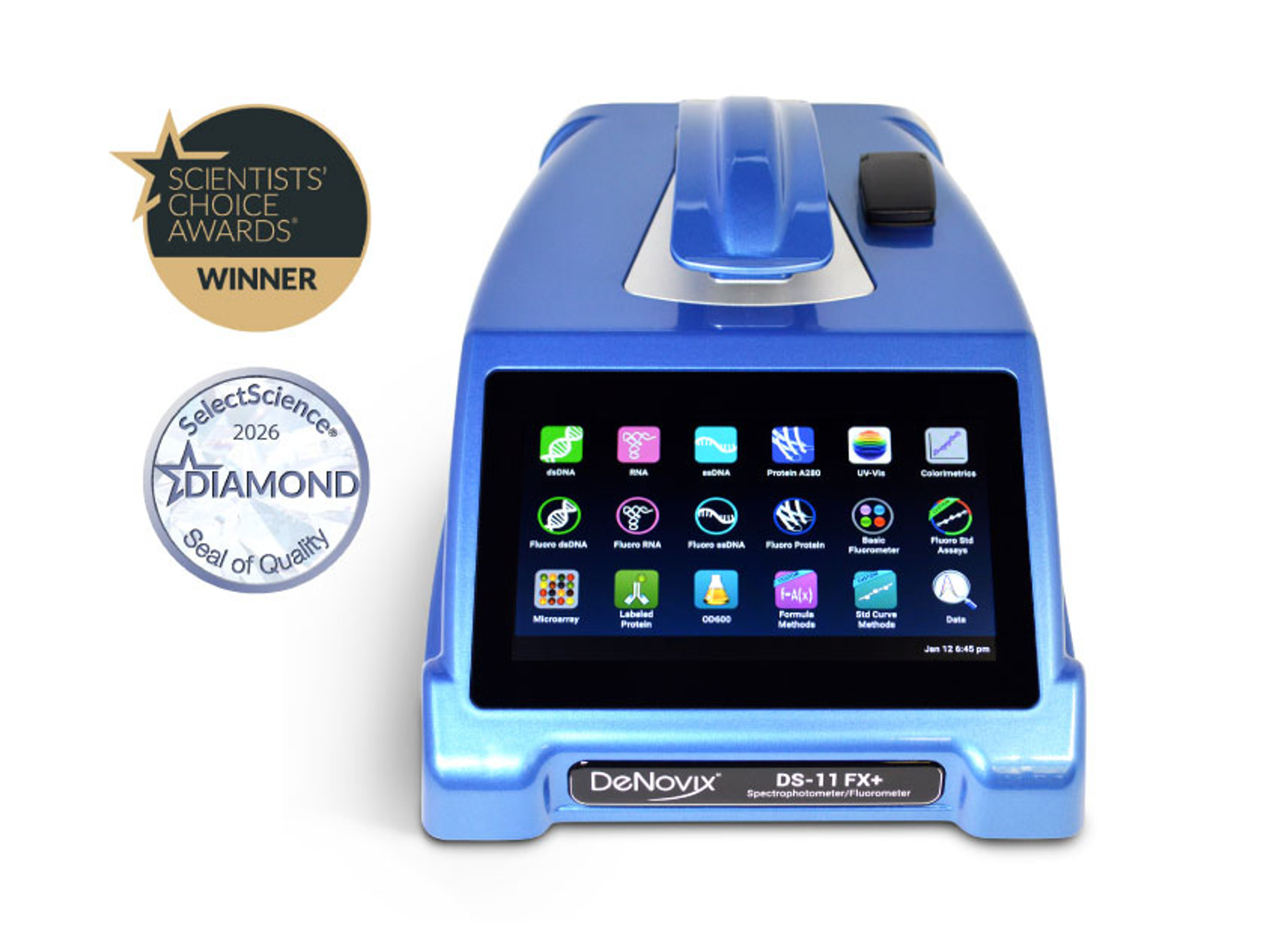
DS-11 Series Spectrophotometer / Fluorometer
DeNovixDeNovix takes spectrophotometry to a whole new level of performance with the DS-11 Series. This easy-to-use, compact spectrophotometer delivers full spectrum UV-Vis analysis and fluorescence capability, making it ideal for rapid nucleic acid and protein quality control.
Links
Tags
Atomic Absorption / Emission SpectroscopyAtomic absorption spectroscopy (AAS) and atomic emission spectroscopy (AES) — also called optical emission spectroscopy (OES) — are used to detect the elemental constituents in samples. Both techniques involve the atomization of a sample. Atomic absorption spectrometers may use a flame or furnace to create an atomic vapor of the sample before irradiation with spectral light. Optical emission spectrometers may use a flame, inductively coupled plasma (ICP), microwave plasma (MP) or spark arcs to atomize and excite the sample. At higher excitation energies, electrons can be emitted instead of photons, which can be useful for samples that can’t be atomized and for surface analysis. Explore electron spectroscopy equipment such as Auger spectrometers and photoelectron spectrometers for surface elemental analysis of samples. Find the best atomic absorption, photoelectron and optical emission spectrometers in our peer-reviewed product directory: compare products, check customer reviews and receive pricing direct from manufacturers.Fluorescence SpectroscopyFluorometers and spectrofluorometers (also called fluorescence spectrometers) are used to measure the intensity and wavelength of fluorescent light emitted from a sample after excitation by illumination. Spectrofluorometers utilize monochromators to select the desired wavelengths, whereas filter fluorometers employ a set of filters. Spectrofluorometers for measuring steady-state fluorescence and lifetime fluorescence (or time-resolved fluorescence) are available, as well as fluorescence microscopes and microplate readers. Find the best fluorescence spectroscopy products in our peer-reviewed product directory: compare products, check customer reviews and receive pricing direct from manufacturers.Data AnalysisData analysis hardware and software is available to make data processing straight-forward yet powerful. Data software can be used for math and stats, technical graphing and image analysis. In addition, software is available for specific data analysis of electrophoresis, densitometry, ELISA and DNA sequencing.DNA / RNA QuantificationDetection and quantification of nucleic acids is important in molecular biology, cloning, expression, forensics and clinical diagnostics. Nucleic acids can be detected by labeling with colorimetric, fluorescent or radio labels and using in situ hybridization kits to identify specific sequences. Multiple nucleic acids can be detected and quantified at once using RNA / DNA detection beads or RNA / DNA microarrays. Find the best DNA / RNA Quantification products in our peer-reviewed product directory: compare products, check customer reviews and receive pricing direct from manufacturers.Absorbance ReaderFluorescenceThe emission of fluorescence occurs when a photon of energy is supplied to a fluorescent chemical compound by an external source, causing it to become excited. Fluorescence can be detected and measured for different purposes using microplate readers, fluorescence microscopes, fluorescence scanners, and flow cytometers.Quality ControlQuality control is needed in all production processes. Quality control is a monitoring procedure or set of procedures that are put in place to ensure that a manufactured product adheres to a defined set of quality criteria. DNA QuantificationDNA quantification is the process of measuring the amount of DNA in a sample. It is vital in genomics, molecular biology, and biotechnology, helping to ensure accurate experiments and data analysis. Explore DNA quantification tools in our peer-reviewed product directory; compare products, check reviews, and get pricing directly from manufacturers.NGSUV-Visible-NIRUV-Visible-NIR spectroscopy is used to analyze a wide range of samples based on their absorption of ultraviolet, visible, and near-infrared light. It is commonly applied in chemical analysis, material science, and quality control. Browse our peer-reviewed product directory to find the best UV-Visible-NIR spectroscopy systems, compare products, check reviews, and get pricing directly from manufacturers.Sample ProcessingSample processing is required to prepare samples prior to analysis. Technologies used for sample processing include homogenizers, grinders, mills and mixers.Protein Quantification