
A Bi-functional Fluorescent Assay for the Assessment of Cytotoxicity and Proliferation
8 Sept 2014This poster demonstrates the development of a cell-impermeant probe which labels the DNA from cells with compromised membranes.
Related products
Request Quote for All Products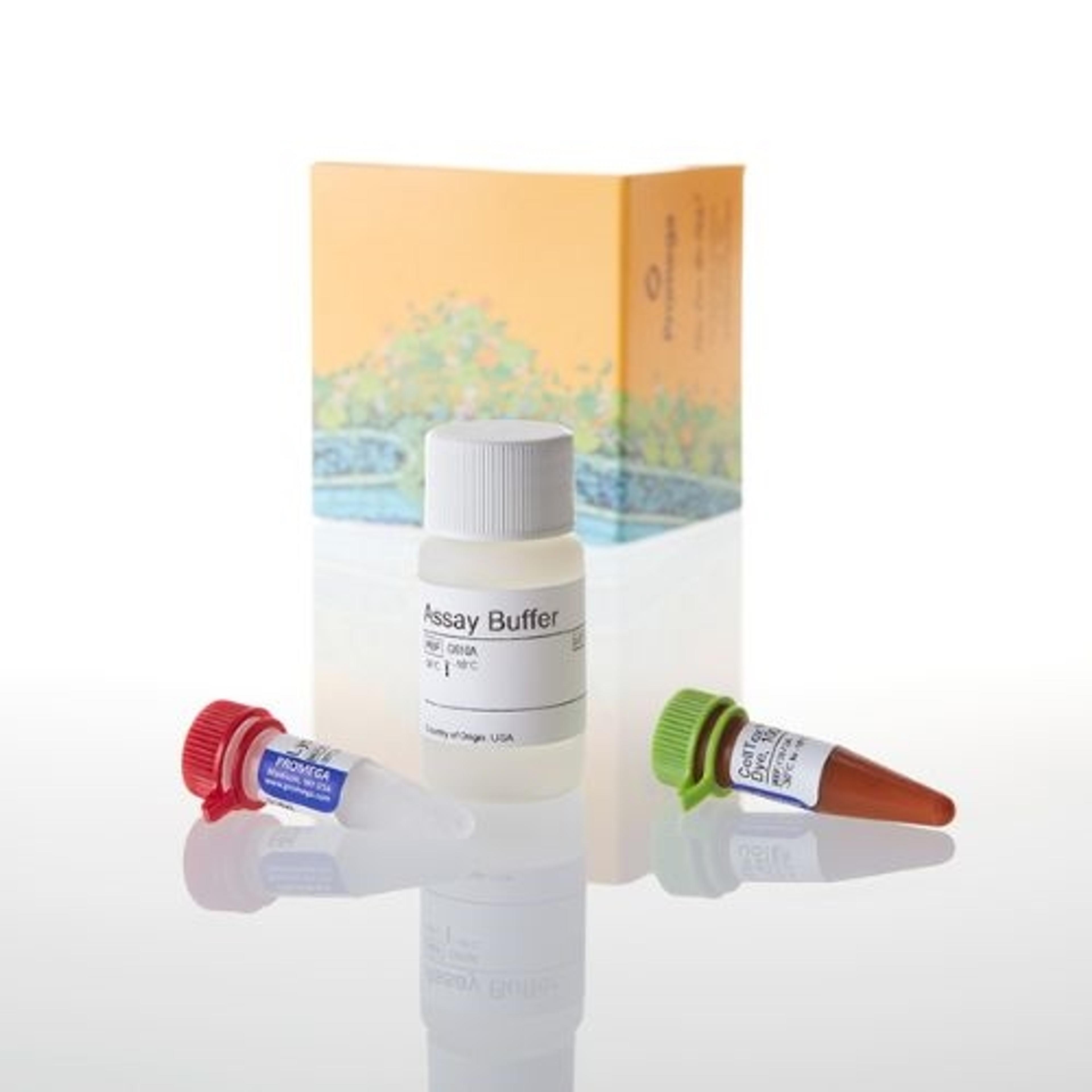
CellTox™ Green Cytotoxicity Assay
Promega Corp.The CellTox™ Green Cytotoxicity Assay measures changes in membrane integrity that occur as a result of cell death. The assay is intended to assess cytotoxicity in cell culture after experimental manipulation. The assay system uses a proprietry asymmetric cyanine dye that is excluded from viable cells but preferentially stains the DNA from dead cells. When the dye binds DNA released from cells, its fluorescence properties are substantially enhanced. Viable cells produce no appreciable increases in fluorescence. Therefore, the fluorescence signal produced by the binding interaction with dead cell DNA is proportional to cytotoxicity. The CellTox™ Green Dye is non-toxic to cells, and the signal remains constant after exposure of 72 hours, making it ideal for determining toxic effects of treatments throughout an extended exposure or as an endpoint determination. Features - Benefits • Accurate Cytotoxicity Determination: The CellTox™ Green Dye stably binds DNA of cells that have lost membrane integrity throughout 72-hour exposure and won’t underestimate cytotoxicity. • Kinetic Cytotoxicity Measures: Measure cytotoxicity at convenient time points from the same sample well to detect onset of toxicity with no duplication of plates. • Simple and Flexible Protocols: Add assay reagent directly to cells prior to plating or with dosing media to perform kinetic cytotoxicity measurements, eliminating a reagent dispensing step, or add diluted dye directly to cell culture wells as an endpoint add-mix-measure assay. • Multiplexing-Compatible: Get more informative data per well and reduce cell culture expenses by multiplexing with fluorescent and luminescent cell-based assays in the same well with no sample manipulation. • Easily Automated: Easily scale from 96- to 1536-well plate formats with “no-addition” or “single-addition” protocols. Applications Determine cytotoxic effects of treatments on cells in culture after long-term exposure.