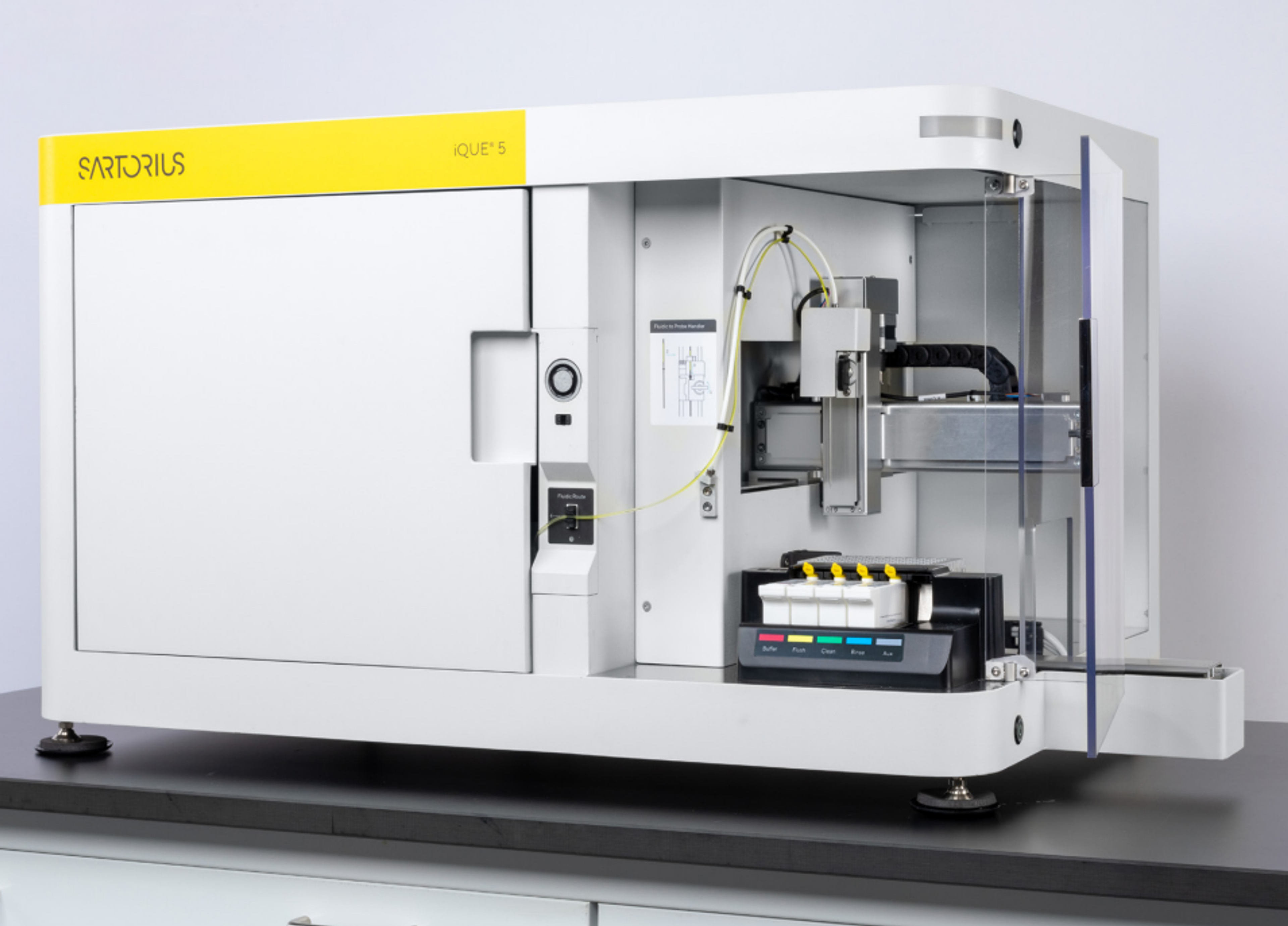
iQue® Cell Cycle Kit
Cell Based Assays


Receive your quote directly from the manufacturer.
The iQue® Cell Cycle Kit utilizes a DNA binding dye to enable the creation of a cell cycle profile and the quantification of the relative percentage of cells in each phase of the cell cycle.
Key Benefits:
- Uses a DNA-specific dye so there is no need to use RNase.
- The dye crosses membranes so there is no need to permeabilize or fix the cells. This also means you can use live cells.
- No wash needed, simply add and read for fast, easily automated workflow.
- Multiplex with other iQue® kits like Cell Membrane Integrity for richer content.

High Throughput Screening of Compounds Affecting Distinct Phases of the Cell Cycle Using Mix-and-Read Assays
In this application note, it is demonstrated how the MultiCyt Cell Cycle Screening Kit and the iQue® Screener can be employed for high throughput assays that accurately determine cell cycle perturbations across of wide variety of known cell cycle inhibitors. These compounds were selected for their diverse mechanisms of action, including DNA polymerase inhibitors, topoisomerase inhibitors, and compounds that alter microtubule structure. Using both a hand-picked set of eight compounds and a larger, randomly selected 320-compound subset of the NCI Mechanistic Diversity Set library, strong cell cycle blocks in G0/G1, S, and G2/M phases were observed.
High Throughput Flow Assays using the MultiCyt Cell Proliferation Reagent Dye Panel: Multiplexing with Membrane Integrity, Cell Cycle, and Immunophenotyping Endpoints
This application note explains the principles behind the MultiCyt Cell Proliferation dyes. Their key advantages are demonstrated, including several examples that illustrate the value of multiplexing with other endpoints.
Advancing Therapeutic Antibody Discovery with Multiplexed Screening
Antibody-based therapeutics are the fastest growing and most successful therapeutic modality for treating diseases such as cancer, cardiovascular disease, autoimmune disorders and infectious disease.This whitepaper describes how the iQue Screener is used to perform multiplexed screens for antibody binding to either cell surface or to circulating target antigens. The whitepaper also discusses the use of the same platform to carry out high content assays to evaluate the effects of lead candidates in multiplexed cell based and secreted protein assays.

How to Accelerate Nanobody Discovery Workflows with High-Throughput Flow Cytometry
Watch this on-demand webinar to learn how solutions from Sartorius are designed to increase the throughput of nanobody screening and discovery

How to Accelerate Nanobody Discovery with High-Throughput Flow Cytometry
Join this webinar to learn more about the new generation of therapeutic antibodies and find out how solutions from Sartorius can be used to accelerate their identification