
Why bioassay validation is no longer the finish line for biologics
A validated bioassay that worked yesterday is not guaranteed to work tomorrow, and CRO Prolytix is urging the industry to rethink what ‘validated’ really means
24 Sept 2026

Dr. Ryan Dorfman, Chief Operating Officer, Prolytix
For decades, bioassay validation has functioned as a kind of graduation ceremony. A bioassay is developed, qualified, tested against defined criteria, and once it clears that bar, transferred into a regulated laboratory for routine use. The assumption is simple: if assay performance is proven during validation, it will remain fit for purpose throughout the lifecycle of a biologic. Increasingly, however, scientists are discovering that long-term assay performance cannot be taken for granted.
That assumption is increasingly being challenged, according to Dr. Ryan Dorfman, Chief Operating Officer (COO) at Prolytix, a large-molecule-focused contract research organization (CRO). Speaking during a SelectScience® webinar titled ‘Move beyond static validation with lifecycle bioassay management’, Dorfman argued that the industry's traditional approach to validation is struggling to keep pace with the molecules it is meant to support, and that a more dynamic, continuous model is taking its place.
Dorfman brings more than 25 years of experience in bioanalytical sciences to the conversation, including a doctorate in biochemistry and a career that began in thrombosis and hemostasis research. At Prolytix, he oversees analytical services, reagent manufacturing and laboratory operations for pharmaceutical and biotechnology clients spanning early discovery through commercial release. He was joined for a live question-and-answer session by three Prolytix colleagues: Matthew Whelihan, Associate Director of Research and Development; Vera Bretton, Associate Director of Research and Development; and Richard Pouliot, Director of Quality Control.
Why bioassay validation is shifting from a one-time event to a lifecycle approach
Static validation, as Dorfman described it, follows a familiar five-step arc: assay development, qualification, validation, launch into commercial use, and then reactive troubleshooting when something goes wrong. He called the last stage "the approach, what I call, run it till it breaks."
That model treats validation as a one-time event rather than an ongoing responsibility. "It's where the bioanalytical method development folks wipe their hands clean and throw it over the fence to the regulated lab," Dorfman said, describing validation's traditional role as a milestone tied to invoicing rather than a foundation for what comes next.
Lifecycle bioassay management takes a forward-looking approach from the outset, incorporating future performance monitoring, trending, and optimization into assay development and validation. Validation is not treated as an endpoint, but as the foundation for ongoing performance assessment, adaptability, and continuous improvement throughout the assay lifecycle. As Dorfman put it, the guiding question shifts from "Did the assay pass validation?" to "How do we ensure the assay remains fit-for-purpose throughout the entire product life cycle?"
Validation is the foundation and not the finish line.
Dr. Ryan Dorfman Chief Operating Officer, Prolytix
How complex biologics are challenging traditional bioassay validation
Much of the pressure on static validation, Dorfman said, comes from the molecules themselves. "You have molecules that fundamentally, in some cases, don't even exist in nature or are not physiologically present," he said, pointing to bivalent and trivalent monoclonal antibodies (mAbs) and engineered protein fusions with complex post-translational modifications. "These higher order structures have differences in glycosylation and charge variants, and that creates lot-to-lot heterogeneity."
He also flagged reagent and cell-line instability, sensitivity drift in complex matrices such as plasma, and manufacturing changes that ripple downstream. "It could be as simple as changing a PS 80 manufacturer, a buffer change, or incubation times," he said, "all can have a profound impact, especially if the molecule is very complex."
The cost of missing those shifts is steep. "The consequence of the static validation or the one-time validation increases result variability and out-of-trend data," Dorfman said. "You have a higher risk for false trends and missed shifts. You have more investigations and retesting delayed decisions, and then ultimately, a loss of confidence in the assay performance and the data integrity."
How regulatory expectations for bioassay lifecycle management are evolving
The shift is not just an internal preference among CROs, contract development and manufacturing organizations (CDMOs) and pharmaceutical companies running their own bioanalytical labs. Regulatory guidance is heading the same direction, Dorfman said, citing the international council for harmonization guideline (ICH) Q14 on analytical procedure lifecycle management, ICH Q2(R2) on validation of analytical procedures, and USP general chapters <1032> and <1033> on biological assay design and verification. "All these suggested by the regulators for change," he said, describing an industry "going from that static to dynamic model."
Dorfman said the takeaway applies to everyone in the chain. "The shift is fundamentally clear that validation is the foundation and not the finish line," he said, "and that's true for all stakeholders in the industry, CROs, CDMOs, pharma, as well as the regulators."
Case study: Identifying a hidden source of assay variability
To show how lifecycle thinking plays out in a working lab, Dorfman walked through a real example from Prolytix involving an ELISA-based assay for host cell protein, or HCP, analysis. Large batches of frozen plates were prepared identically during validation, and QC acceptance limits were set across 20 runs. "Validation demonstrated acceptable assay performance," he said.
Then a new plate lot was introduced for release testing, and results drifted outside those limits. "Investigation showed that the original QC limits did not capture normal lot-to-lot variability," Dorfman said. Limits were updated, testing resumed, and then a third plate lot arrived with far greater variability, "with approximately every other run failing QC acceptance criteria."
Root cause analysis eventually pointed away from the assay itself. "The observed results remain within the inherent analytical variability of the method," Dorfman said, "but each new frozen plate batch required re-qualification of the QC acceptance criteria limits, making routine testing costly and operationally inefficient."
The fix was to abandon frozen plates altogether in favor of plates prepared fresh each day. "QC trending demonstrated that the issue was not the analytical method, but the frozen plate preparation process," he said. "Redesigning the method eliminated the source of variability and created a robust, sustainable release assay."
How leading biopharma companies maintain long-term assay performance
Dorfman outlined several practices separating organizations that have genuinely embraced lifecycle management from those that simply react when problems arise, including strong governance, routine trending, bridging plans for when reagents run out, and cross-functional ownership. "I can't say this enough," he said. "Between departments, you need communication, communication and communication."
At Prolytix, he said, three changes made the biggest difference: treating assay transfer as a shared responsibility rather than a handoff, holding a ‘validation defence’ resembling a thesis review before a method moves forward, and running weekly cross-functional project meetings. "We used to work dramatically in silos," Dorfman said. "People would throw those assays over the fence, wipe their hands clean and say, 'Have fun with that.'" The payoff, he said, is that Prolytix now "averages less than a 5% re-test rate in our laboratories."
Key lessons for sustaining bioassay performance beyond validation
That same proactive posture ran through the Q&A. Bretton said organizations that adopt lifecycle management "typically do experience fewer investigations" and "more robust assay performances," adding that "the idea is to protect the investment we've already put in" rather than risk re-doing a validation. When asked how do you know whether a lifecycle strategy is truly working, she said, "the ultimate measure of success is not that the assay did pass validation, it's that it actually continues to deliver reliable, reproducible, and defensible results throughout its life cycle."
Pouliot said warning signs of a struggling program usually show up in the data submitted by the development team. "We ask that they defend their validation and the robustness of the method before we bring it into the regulated space," he said, adding that once an assay is live, "you have to continually monitor that performance to ensure that you're seeing subtle changes." For teams with limited time, he pointed to training as the most accessible starting point: "Making sure that people understand the processes before they go into the validation."
Whelihan added a validated assay stops being enough "when the product fundamentally changes that picture," whether through a manufacturing tweak, a clinical shift or a reagent robustness issue. "We need to look at the data and always take that data-driven approach," he said, "because if you don't, you start deviating down this rabbit hole that is going to be tough to get out of regulatory-wise."
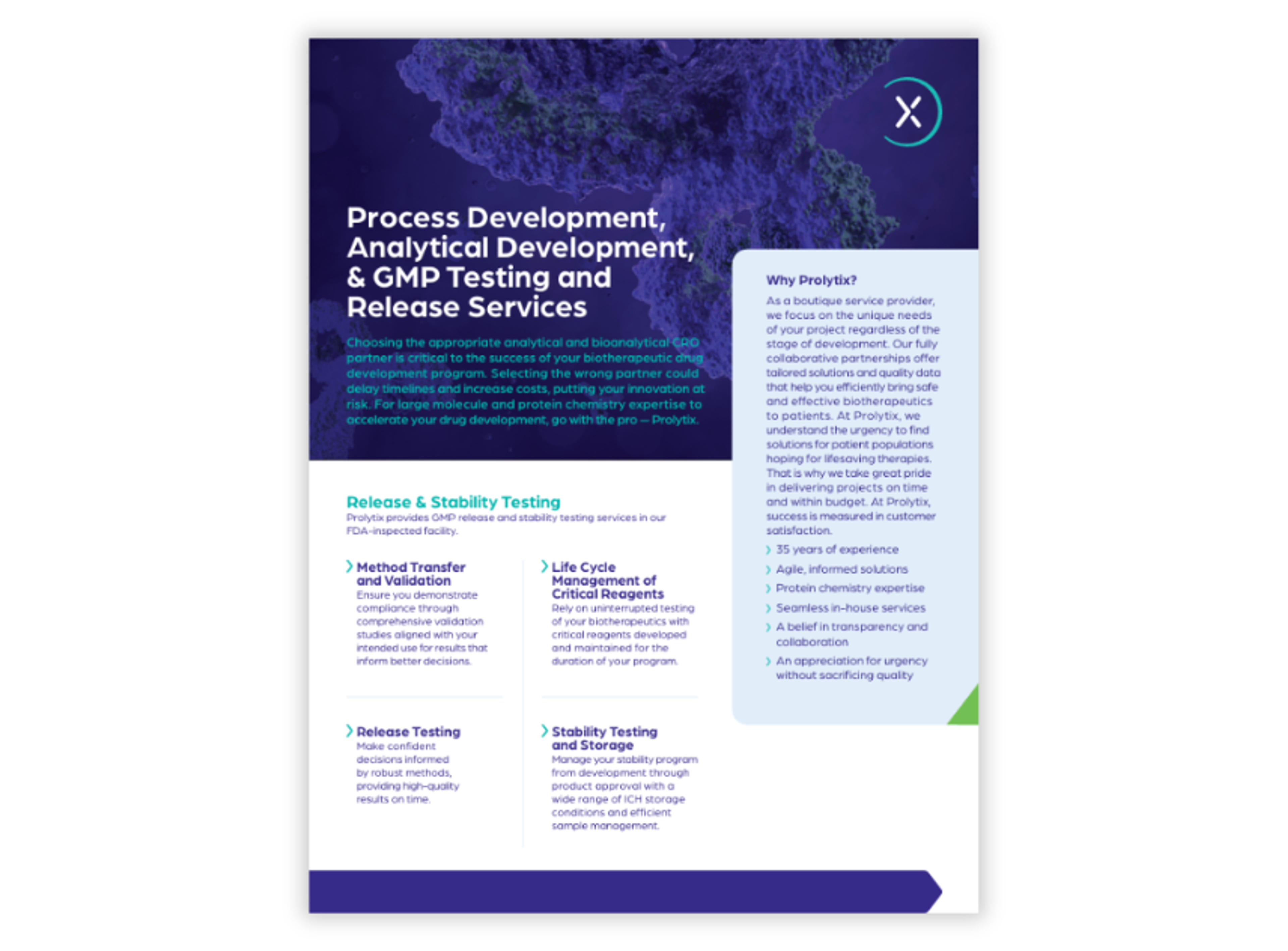
That same lifecycle discipline underpins Prolytix's own GMP release and stability testing services, which support drug substances and products from early development through commercial release, detailed further in this service overview. As Dorfman put it, closing his presentation, "Validation is the foundation and not the finish line," a starting point for a much longer, more attentive relationship with every assay a lab depends on.
Learn more about Prolytix's GMP release testing and GMP stability testing and storage services and watch the webinar on demand here.
Related products
Request Quote for All Products
GMP Release Testing
ProlytixGMP release testing is a critical quality control process that ensures manufactured therapeutics meet predetermined specifications before release. Prolytix provides GMP release testing for clinical and commercial drug substances and drug products.
GMP Stability Testing & Storage
ProlytixGMP stability testing determines how a drug product performs under routine and stressed conditions. Prolytix performs GMP‑compliant stability testing and provides ICH‑compliant storage to support clinical and commercial drug products.
Links
Related content

Tags
Frequently asked questions
Show frequently asked questions
Why is bioassay validation shifting to lifecycle bioassay management?
Static validation confirms performance at one point in time but may miss later changes. Lifecycle bioassay management uses continuous monitoring, trending, optimization, and cross-functional oversight to keep assays fit for purpose throughout a biologic’s lifecycle.
How do complex biologics affect long-term bioassay performance?
Bivalent and trivalent monoclonal antibodies, engineered protein fusions, glycosylation differences, charge variants, unstable reagents, cell-line changes, and complex matrices can create variability. Manufacturing changes involving PS 80, buffers, or incubation times may also affect assay performance.
Which practices help Prolytix sustain reliable bioassay performance?
Prolytix treats assay transfer as a shared responsibility, conducts a “validation defence” before regulated use, and holds weekly cross-functional meetings. Routine trending, reagent bridging plans, strong governance, and continuous monitoring also support reliable, reproducible, and defensible results; Prolytix reports a laboratory retest rate below 5%.