
When workflows can’t change: Rethinking hybrid capture design in clinical NGS
In this guest editorial, Dr. Wubin Qu, CSO and Co-Founder of iGeneTech, offers perspective on changing NGS workflows vs changing capture kit reagents
28 Jan 2026
As next-generation sequencing (NGS) moves deeper into clinical and applied genomics, laboratories are increasingly finding that workflow design — not sequencing throughput — is becoming the primary constraint on innovation. In many high-throughput environments, hybrid capture workflows were validated years ago and have since become operationally locked in. While reagents may be replaced, workflows often cannot.
This reality is already reflected in the structure of the NGS supply chain. Over the past decade, shifts in product portfolios and business priorities have led to the discontinuation of certain hybrid capture offerings, even as the associated panels and workflows remained in active use. In several cases, existing designs and production pipelines were preserved by transitioning capture reagent design and manufacturing responsibilities to alternative providers operating under ODM-based models. In practice, this allowed laboratories to maintain established processes while reagent origin and manufacturing execution changed behind the scenes — highlighting a growing decoupling between workflow continuity and reagent provenance.
Similar dynamics are now emerging across a broad range of custom panel and production-scale sequencing projects. Rather than replacing entire workflows, laboratories are increasingly asking a different question: if the workflow must remain fixed, can capture reagents themselves be redesigned to fit that workflow?
Find the latest 3D cell culture news in our Accelerating Science Feature exploring how scientists are uncovering the mechanisms behind disease and driving breakthroughs in treatment.
Visit resourceStandardization versus workflow reality
Commercial hybrid capture kits are typically optimized for broadly defined applications and generalized laboratory assumptions. These standardized solutions perform reliably for many use cases, particularly during early-stage development. However, as panels become more customized — driven by application-specific gene content, coverage requirements, or throughput demands — laboratories may observe limitations related to capture efficiency, coverage uniformity, or flexibility in probe design.
In production environments such as independent clinical laboratories (ICLs) and genomics service providers, addressing these limitations is rarely straightforward. Changes to hybridization conditions, automation steps, or downstream processing can trigger revalidation requirements, introduce operational risk, and disrupt established quality control systems. As a result, laboratories may seek optimization strategies that preserve workflow continuity while addressing performance constraints.
An ODM-based framework for custom hybrid capture
One approach increasingly applied in such scenarios is an ODM-based (original design manufacturer) framework for hybrid capture reagent development. In this context, ODM does not describe a specific commercial product, but rather a design philosophy in which capture reagents are engineered around an existing workflow instead of forcing the workflow to adapt to a fixed reagent design.
This framework has been applied by solution providers such as iGeneTech, which works with genomics laboratories to develop custom hybrid capture reagents designed to integrate into established NGS workflows without requiring process modification. Key characteristics of this approach include:
- Probe and chemistry design informed by project-specific target characteristics
- Compatibility with predefined hybridization, wash, and amplification protocols
- Manufacturing consistency suitable for repeated, production-scale use
By treating workflow preservation as a primary design constraint, this model allows customization without disrupting validated processes.
Case-informed evaluation under production constraints
A representative example of this approach comes from a high-throughput independent clinical laboratory operating a custom NGS panel within a fully established production workflow. The laboratory had implemented a standardized hybrid capture reagent set and completed internal validation. Ongoing performance monitoring, however, suggested opportunities for improvement in capture-related metrics.
Crucially, the laboratory required that any optimization effort maintain complete process continuity. Instrumentation, automation, and protocol steps could not be modified; only reagent substitution was permitted. This constraint enabled a controlled evaluation of reagent design under identical workflow conditions.
Observed performance metrics
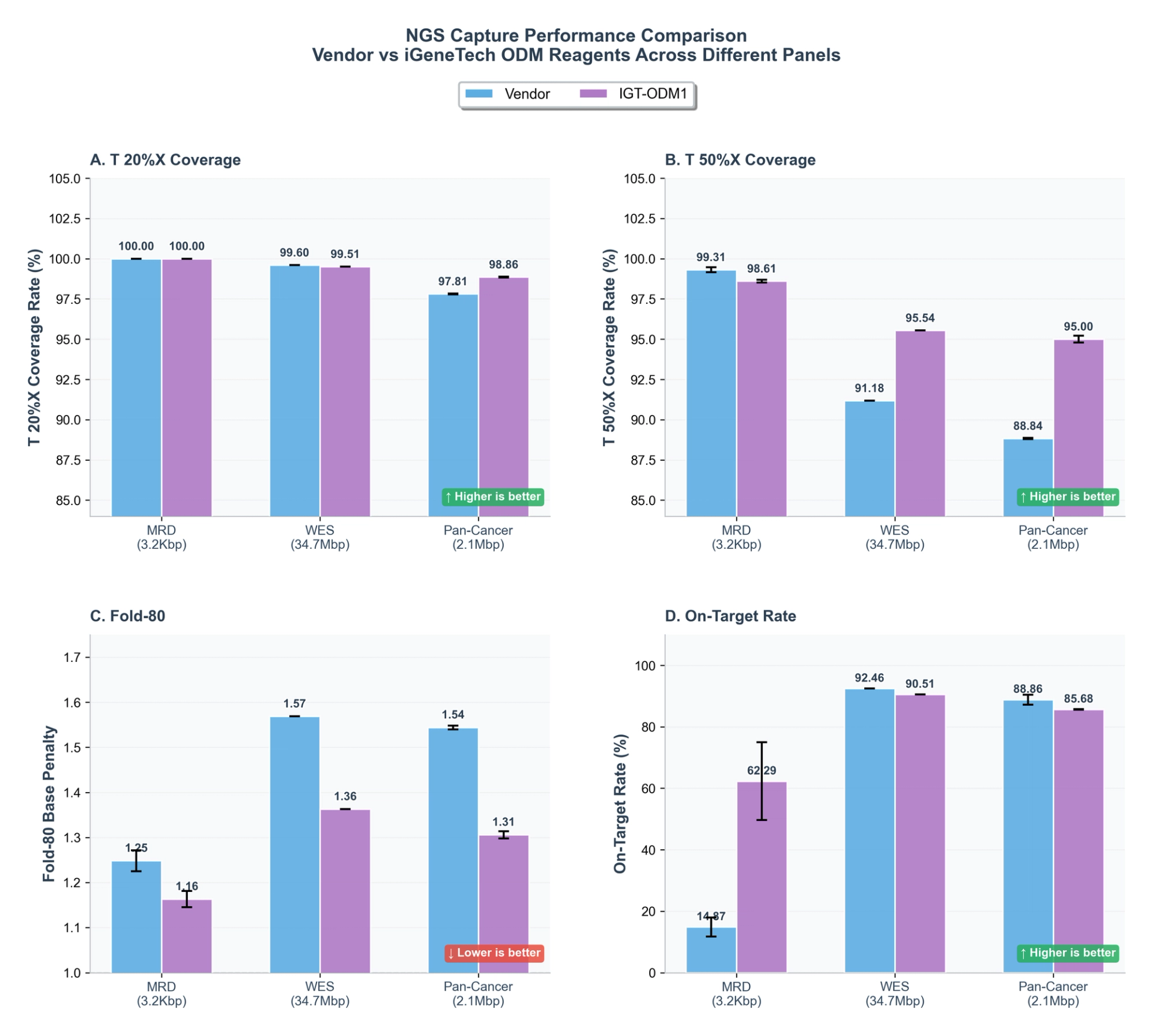
Using an ODM-based design framework, a customized hybrid capture reagent was developed and evaluated alongside the previously used standardized reagent. Performance was assessed using commonly reported capture metrics, including target read capture rate, flank read capture rate, percentage of selected bases, coverage depth distribution, and Fold 80 base penalty.
Across multiple panels, the customized reagent showed higher observed target and flank capture rates under the same workflow conditions. The percentage of selected bases also increased, indicating a greater proportion of sequencing reads mapping to intended target regions.
Coverage depth metrics indicated that both reagent sets achieved high T20× coverage rates, reflecting sufficient overall depth. However, the customized reagent demonstrated higher T50× coverage rates in several panels, suggesting improved depth consistency across targets. Fold 80 values were comparable or lower for the customized reagent, indicating a more uniform distribution of sequencing coverage without increasing sequencing depth or altering workflow parameters.
Importantly, these observations were made without any modification to the laboratory’s established production workflow, isolating the impact of reagent-level customization.
From overnight hybridization to minute-scale capture
Traditionally, hybrid capture has been associated with long hybridization times — often overnight — to achieve acceptable coverage and uniformity, particularly for large or complex panels. Even so-called “rapid” hybridization protocols typically require one to two hours and frequently involve measurable performance trade-offs.
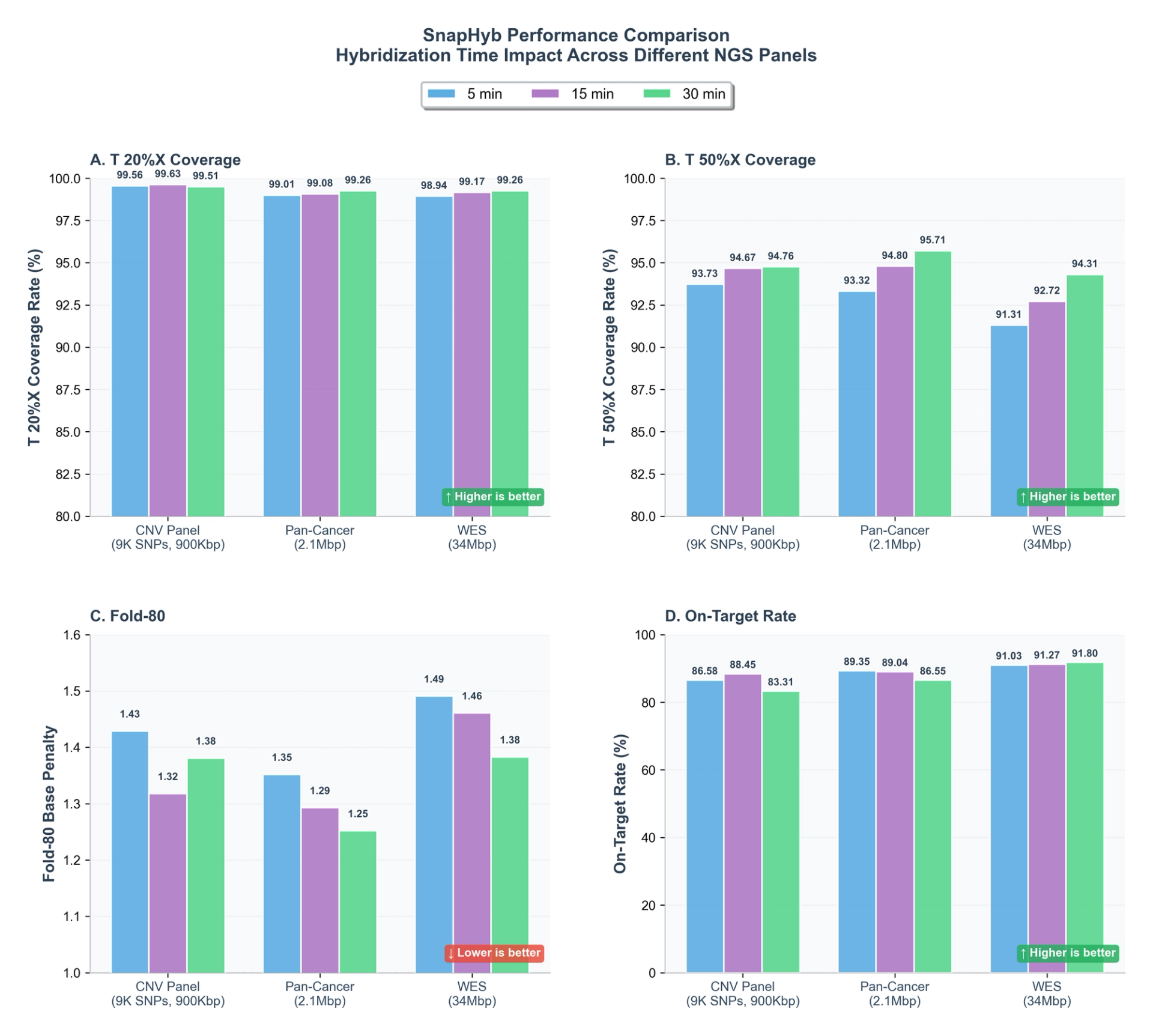
Recent advances in probe design and hybrid capture chemistry are challenging this assumption. Under an ODM framework that treats hybridization time as a tunable design parameter rather than a fixed requirement, hybridization can be compressed from hours to minutes without sacrificing core performance metrics.
In controlled evaluations, hybridization times as short as 5 minutes were assessed alongside 15- and 30-minute conditions under identical workflows. Across panel sizes, minute-scale hybridization demonstrated:
Redefining the role of hybridization time
These observations suggest that hybridization time, long treated as a fixed bottleneck in capture workflows, is in fact a design variable—provided that probe architecture, chemistry, and target complexity are addressed holistically. Within a workflow-preserving ODM framework, minute-scale hybridization is not a compromise, but a deliberate outcome of reagent-level optimization.
For production laboratories, the implications extend beyond turnaround time. Shortened hybridization enables higher daily throughput, improved instrument utilization, and greater scheduling flexibility—without triggering revalidation or workflow disruption. In this sense, ultra-fast hybrid capture represents not only a technical advance, but an operational one.
Designing reagents around workflows, not the other way around
Standard hybrid capture kits remain an effective choice for many sequencing applications, and their role in enabling widespread NGS adoption should not be understated. Custom hybrid capture approaches are best viewed as an extension of these solutions, providing additional flexibility for laboratories whose projects exceed the assumptions built into catalog-based designs.
As NGS workflows continue to mature and stabilize, reagent design models that adapt to fixed processes — rather than forcing processes to adapt — may play an increasingly important role in balancing performance optimization, operational stability, and long-term scalability.
Disclosure: The author is affiliated with iGeneTech, a genomics technology company specializing in NGS target enrichment and hybrid capture solutions for research and applied genomics.