What every laboratory leader can learn from the NHS pathology transformation review
IBMS Chief Executive David Wells shares valuable insights on workforce, automation, and sustainable transformation
23 Sept 2026
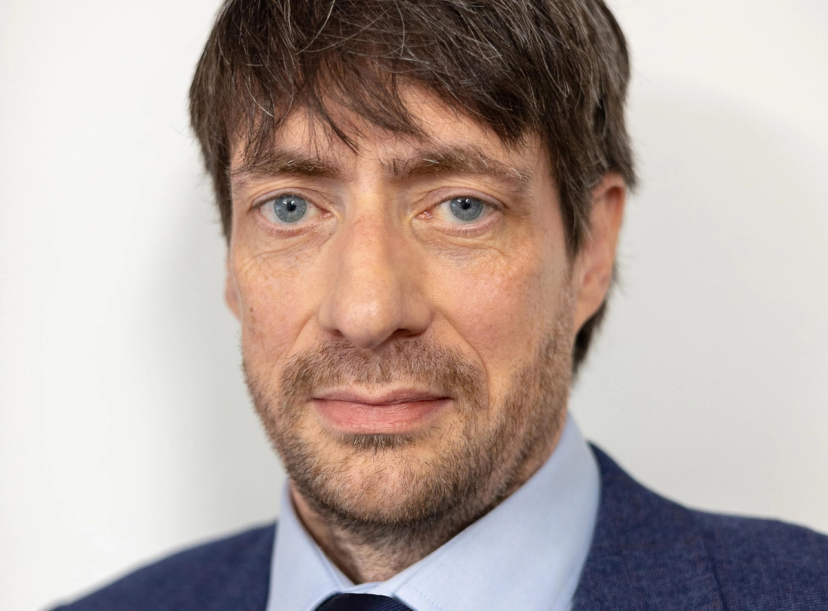
IBMS Chief Executive David Wells
Every year, clinicians across the UK order more than 2 billion pathology tests. Pathology supports roughly 95% of patient pathways1, informing everything from a GP confirming a diagnosis to an oncologist adjusting chemotherapy. Yet few patients could say what happens between the blood draw and the diagnosis. That gap sits at the heart of the Pathology Transformation Review 2026, an independent review commissioned by the Institute of Biomedical Science (IBMS) and chaired by Lord Carter of Coles. Its findings are quite sobering: fewer than half of NHS trusts meet acute turnaround standards in blood sciences, and fewer than one in 10 meet histopathology turnaround targets1.
Yet its central argument, as SelectScience® covered in its earlier report on the review's NHS lessons for global lab managers, is not that pathology needs another reorganization. It is that the integration already underway needs finishing, with an estimated £450 million annual efficiency opportunity that could be released for reinvestment in England alone, rising to a cumulative £1.4 billion by 2029–301.
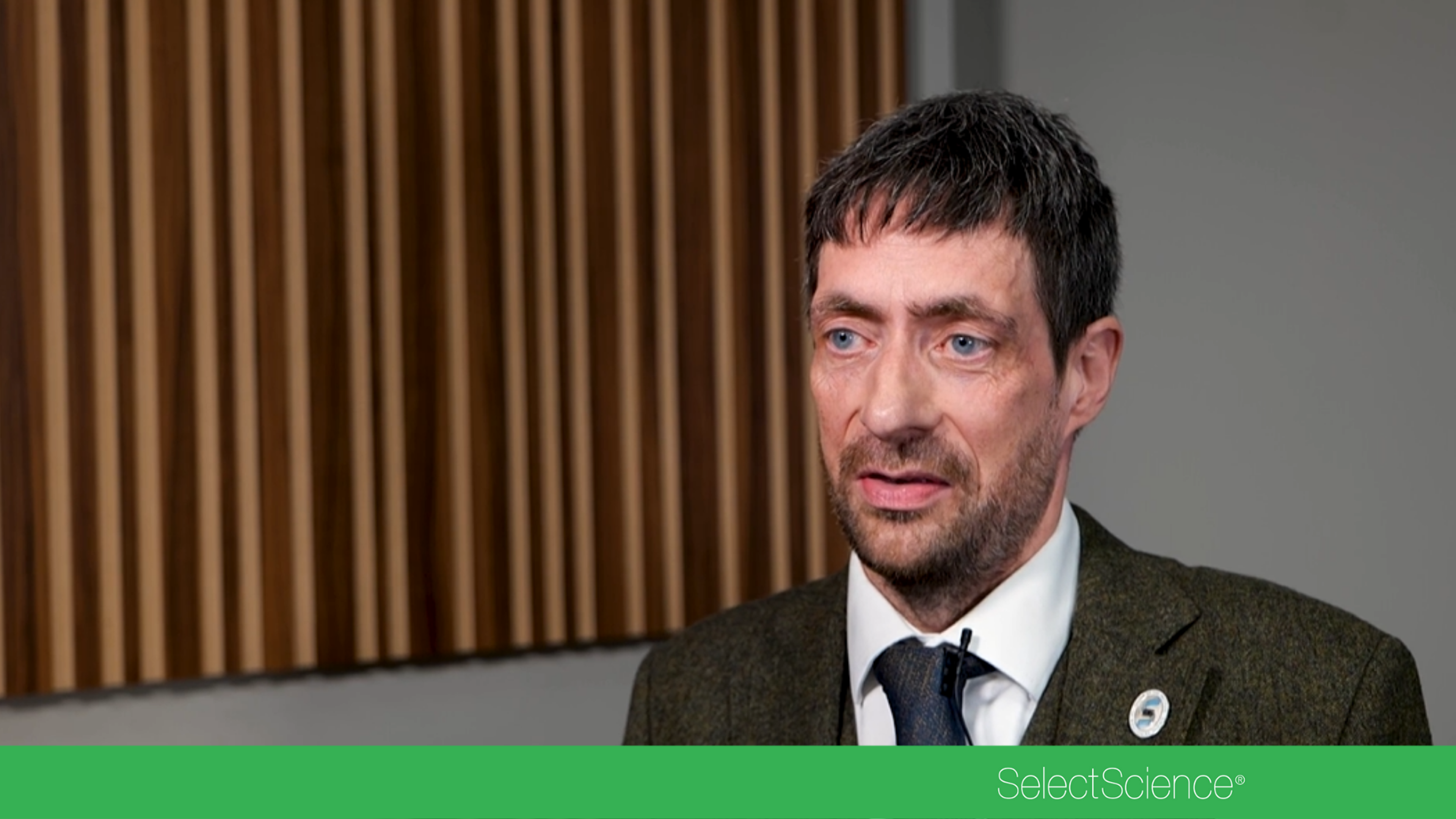
To explore what this transformation means for the scientists and laboratory leaders delivering it, and the lessons global lab managers can apply, SelectScience speaks with David Wells, chief executive of the IBMS, the professional body representing the UK’s biomedical science workforce and commissioner of the review.
Invisible because it works
Asked why a service responsible for 95% of patient pathways remains so poorly understood, Wells refers to the nature of the work itself. "We don't have many points of direct contact with patients," he says, "but also we've actually got very high-quality services that deliver efficiently and regularly for our patients." Pathology's reliability works against its visibility. "Quite often people don't ask the question about how do my diagnostics work?" The result, he says, is that the challenges involved in improving the service "get missed because they're not headline items." The lesson for laboratory leaders: the case for investment cannot rely on the service speaking for itself.
A workforce running hot
Workforce sustainability runs through both the review and the IBMS's response, and it is where Wells sounds most concerned. "We do not have a sustainable workforce within pathology," he says. Medical colleagues, "are in short supply and that situation is going to get worse," while training posts for biomedical and clinical scientists remain limited even as demand climbs by roughly 4% a year, producing "a disconnect between the volume of scientists and medics we need within the system." Wells singles out pediatric pathology as "a current critical issue," alongside blood transfusion and other areas struggling to attract trainees.
The IBMS' response has two strands: "we need more medics, we need more consultants working within pathology," and a push for expanding what the existing scientific workforce can do, through "Consultant level practice and advanced roles and more specialist training in particular areas that doesn't replace the medical workforce, but adds to the capability of services."
Where automation has changed the lab, and its limits
Technology's contribution so far is real, particularly in histopathology. "We're seeing great parts of the total pathway within histopathology being automated, and that is a real game changer," Wells says, describing laboratories that, compared to a decade ago, "you'd now mistake for a biochemistry laboratory in terms of the level of automation." Its value lies in freeing up scientists' time. "There is more hands-off time so our workforce can be focused on the areas where they really add value," rather than repetitive tasks automation "can do for them."
But Wells resists framing technology as a complete answer. "You have to look at pathology services in their totality," he says. "There's workforce, there's quality, there's access, there's logistics. Technology is just one of the levers." The same caution applies to artificial intelligence. New tools "have to be used in collaboration with the workforce," he says. "We cannot see AI tools as a replacement to the workforce. It's an adjunct," one introduced "within that very careful, quality controlled, accredited environment led by the experts who are our workforce."
Reinvesting the value released by transformation
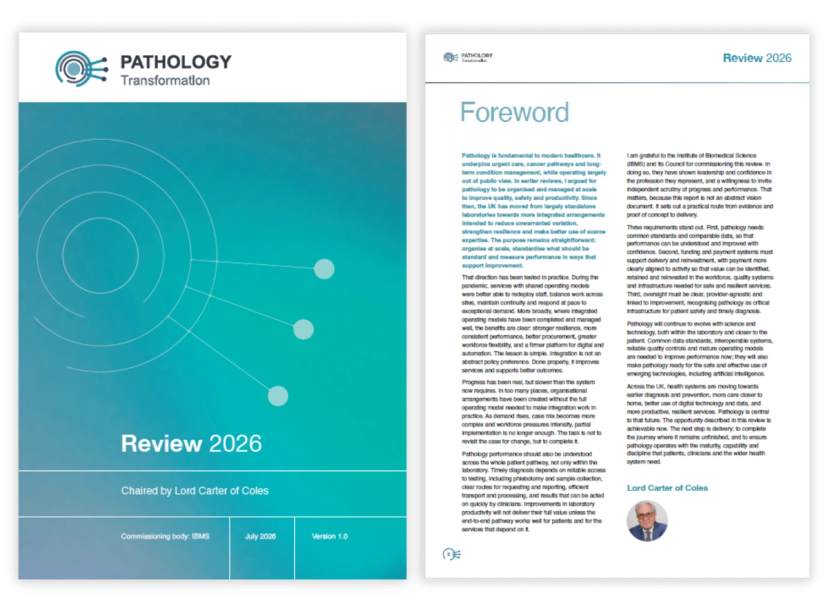
The Pathology Transformation Review 2026 is an independent review commissioned by the Institute of Biomedical Science (IBMS) and chaired by Lord Carter of Coles
The report's funding logic may be its most striking element. Rather than lobbying for fresh spending, it argues that moving services to a genuinely integrated, standardized operating model releases the money needed to modernize. "There is a potential within England for a £450 million efficiency opportunity from delivering this is," Wells says, spanning procurement, workforce deployment and estates, with this sum recommended for reinvestment, "to pay for the automation, integration and standardization of our services," as well as, "for training, for trainers, and for protecting our fragile services."
Wells frames this as the report doing two jobs at once, "There is a problem, but we as a profession have to come forward with the solution, and I think the report does both," he says. "We're not asking for central government to pay more money. We're saying let us keep the money we drive out of the system through the removal of the inefficiencies to pay for the innovation and the future states of our pathology services."
Lessons for worldwide laboratories
Asked what laboratory leaders outside the UK might learn from this journey, Wells points to what services can do themselves. "We do not need to have permission or intervention from government to drive forward some innovations," he says, pointing to the fully integrated services in England already operating the way the review envisages. "15% of our services are working in that way," he says, and if the whole country matches that standard, "we will have a world leading pathology service within England," a model he believes should work elsewhere in the world.
He also points to funding design as a global lesson: pathology services "only work if they're paid for the work they do," with unit-price funding covering not just reagents and equipment, but "the workforce and the training of the workforce." And he is candid about an advantage worth naming, "we are very lucky. We have a very highly trained, competent, regulated workforce," one whose capacity for advanced practice offers lessons for systems managing complex diagnostic work, including in cancer care, where faster testing cannot mean longer waits for patients.
That is the essential IBMS message for laboratory managers, directors, and scientists reading the review from outside the UK. It is not a call to rebuild pathology from scratch, and not primarily a technology story, even as automation and digital tools take on a larger role. It is an argument that the sector already knows what good looks like, that a meaningful share of services are delivering it, and that spreading that standard depends on workforce investment, disciplined data, and reinvested efficiency, applied consistently and at scale. As Wells put it, the task now is simple to state, if not to deliver: "We just need to all get to the same place."
Read SelectScience's earlier coverage, Pathology Transformation Review 2026: NHS learnings for global lab managers, for more on the review's key findings and the IBMS' full response.
References
Frequently asked questions
Show frequently asked questions
What is the Pathology Transformation Review 2026?
The independent review, commissioned by the Institute of Biomedical Science and chaired by Lord Carter of Coles, examines how pathology services in England can improve integration, efficiency, workforce sustainability and patient outcomes.
What are the main challenges facing NHS pathology services?
The review highlights inconsistent turnaround times, workforce shortages, fragile specialist services and incomplete integration across pathology networks, alongside rising demand for testing.
How can laboratories address workforce shortages?
David Wells argues for more medical consultants and expanded advanced and consultant-level roles for biomedical and clinical scientists, supported by specialist training and sufficient training posts.
What role can automation and AI play in pathology transformation?
Automation can reduce repetitive work and allow scientists to focus on higher-value tasks. AI should be introduced as an adjunct to the workforce within quality-controlled, accredited services rather than treated as a replacement for laboratory professionals.
How could pathology transformation be funded?
The review estimates an annual efficiency opportunity of £450 million in England. It recommends retaining and reinvesting these savings in automation, integration, standardization, training and the protection of fragile services.
What can laboratory leaders outside the UK learn from the review?
The central lessons are to complete service integration, standardize operating models, invest in workforce capability, use data consistently and reinvest efficiency gains in sustainable improvement.