
Thermo Fisher Scientific Publishes New Poster Demonstrating the Reduction of Matrix Effects in LC-MS/MS Analysis for Drug Discovery and Development
30 Aug 2007
Thermo Fisher Scientific Inc., the world leader in serving science, today announced the publication of a new technical poster titled “Ion Suppression and Matrix Effects.” The poster shows how Thermo Scientific TurboFlow™ technology in combination with the TSQ Quantum™ family of triple quadrupole mass spectrometers can reduce matrix effects in liquid chromatography coupled with tandem mass spectrometry (LC-MS/MS) analysis. The new technical poster and a companion CD, titled "LC-MS/MS Solutions for Drug Discovery and Development," are available free-of-charge from the article webpage.
The poster discusses ion suppression relative to various sample clean-up procedures, and shows data from the same experiment performed on samples prepared by Solid Phase Extraction (SPE) and Protein Precipitation (PPT). Samples run on the Thermo Scientific Aria™ TLX-1 system with TurboFlow technology and analyzed on the TSQ Quantum Ultra™ mass spectrometer showed the least ion suppression and required the fewest sample preparation steps. TurboFlow technology can assist pharmaceutical researchers in complying with U.S. FDA/CDER Bioanalytical Method Validation Guidance that states: "In the case of LC-MS-MS-based procedures, appropriate steps should be taken to ensure the lack of matrix effects throughout the application of the method, especially if the nature of the matrix changes from the matrix used during method validation." When configured to the Thermo Scientific TSQ Quantum, TurboFlow technology delivers fast and efficient quantitative results with the lowest ion suppression and chemical noise, resulting in highly sensitive, robust bioanalytical methods and reduced analysis failures.
This unique solution allows scientists to reduce matrix effects by minimizing sample preparation for LC-MS/MS analysis in drug discovery, development and clinical research applications. TurboFlow technology can be used as an online sample preparation technique or for direct injection.
The companion CD includes several animations, including demonstrations of how FAIMS (High-Field Asymmetric Ion Mobility Mass Spectrometry) lowers chemical noise and enhances sensitivity during quantitation experiments, how TurboFlow technology allows direct injection of biological samples into an MS/MS system and how a heated electrospray ionization (H-ESI) probe enhances LC-MS/MS assay sensitivity up to eight times.
Related products
Request Quote for All Products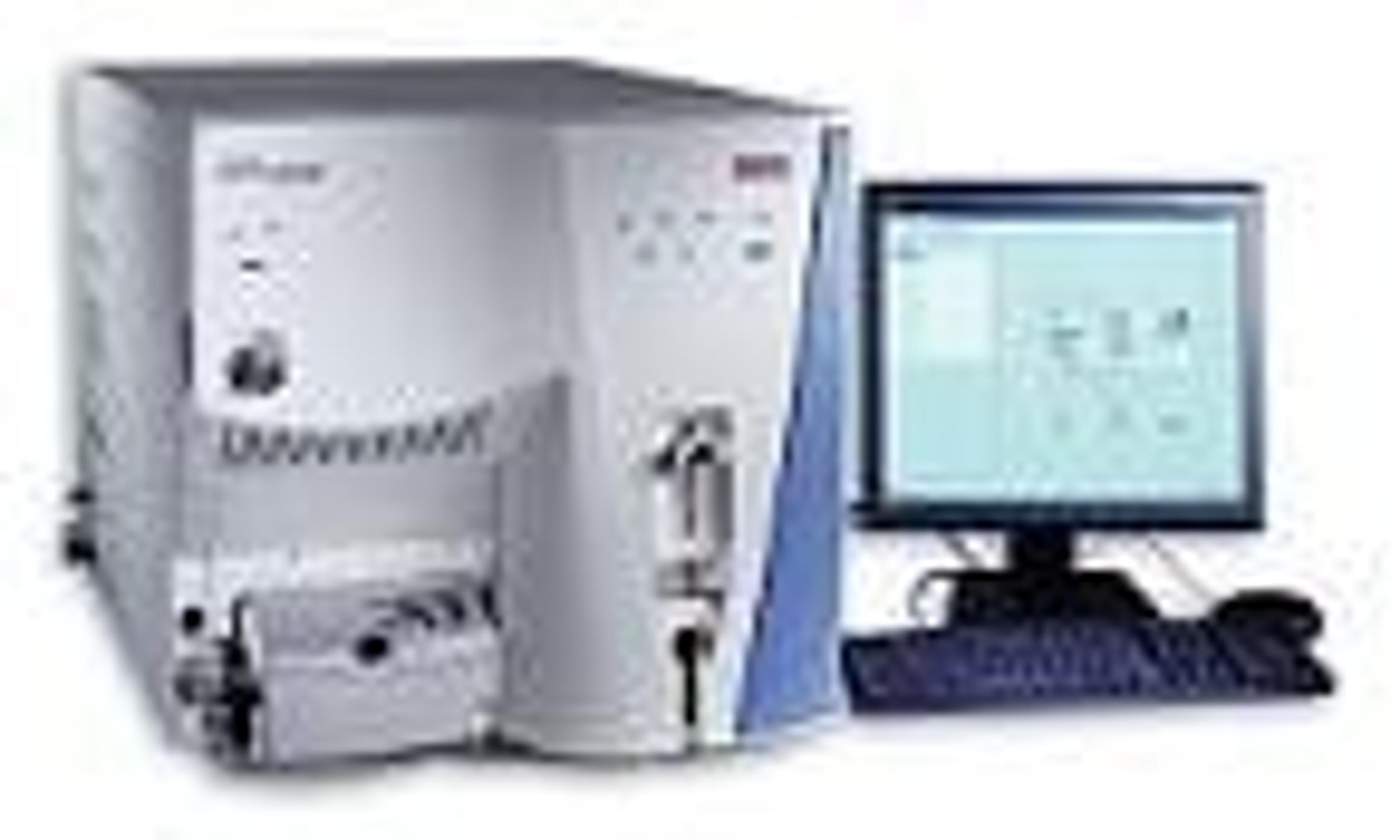
Finnigan TSQ Quantum Series
Thermo Fisher ScientificThe Finnigan TSQ Quantum Series of mass spectrometers are the most advanced and powerful triple quadrupole mass spectrometers available. The Quantum Series mass spectrometers feature the patented HyperQuad™ mass analyzer technology, a rugged orthogonal source, and a completely redesigned analyzer geometry for maximum sensitivity, precision, and reliability. The Quantum Series triple quads are the only commercial triple quads available today capable of performing H-SRM. Thanks to H-SRM, co-eluters with nominal masses that vary by 0.1 amu are no longer interfering ions. Product detail: The NEW Finnigan TSQ Quantum Discovery MAX: Extraordinary Value The high-performance, ultra compact benchtop Finnigan TSQ Quantum Discovery MAX incorporates innovative new technology for increased sensitivity, precision, ruggedness, and reliability. It is principally designed for high-productivity environments such as environmental, clinical and drug discovery laboratories. With the Ion Max source, the Finnigan TSQ Quantum Discovery MAX addresses the need of these laboratories for more rugged and dependable LC/MS/MS to enable around-the-clock productivity. The combination of our patented HyperQuad™ mass analyzer system, high efficiency ion transfer optics, and outstanding ion source roboustness provides precise accurate quantitation even at the lowest levels. The Finnigan TSQ Quantum Ultra EMR™: Peerless Versatility Thermo introduces the newest addition to its Finnigan TSQ Quantum Ultra series of triple quadrupole mass spectrometers, already established and recognized for its standard of excellence in mass spectral quantitation. The Finnigan TSQ Quantum Ultra EMR™ offers higher resolution and an Extended Mass Range of up to 3000 Daltons. This extended mass range capability allows high-resolution analysis of a whole new class of biopolymers including peptides, polysaccharides, and oligonucleotides. It combines all the benefits of the Finnigan TSQ Quantum Ultra, including constant neutral loss, parent scanning, high-resolution precursor ion selectivity, and Selected Reaction Monitoring, to deliver a complete solution for the proteomics and large molecule research community. The Finnigan TSQ Quantum Ultra™: Definitive Performance The Finnigan TSQ Quantum Ultra defines a new standard of excellence in bioanalytical and environmental analysis. It features the revolutionary Ion Max source with interchangeable ESI and APCI probes and a wide aperture titanium skimmer for increased robustness and sensitivity. Its large volume ion transfer tube provides enhanced ion transmission, resulting in increased sensitivity. The Ion Max source allows probe adjustment in the x, y, and z directions, for optimum sensitivity and robustness. The Finnigan TSQ Quantum Ultra’s new, ultra-high temperature APCI probe with ceramic heater technology, virtually eliminates sample carryover. Its innovative technology provides the widest linear dynamic range and highest sensitivity of any triple quadrupole mass spectrometer. The Finnigan TSQ Quantum Ultra AM™: Unrivaled Capabilities The Finnigan TSQ Quantum Ultra AM has the additional capability of routine accurate mass measurement on the chromatographic timescale, to facilitate compound identification. It contains a meticulously redesigned analyzer control board, which takes full advantage of the HyperQuads™, and permits accurate mass measurements to within ±5 ppm. This innovation imparts accurate mass measurement performance that is easier to use and have a greater dynamic range than those of instruments based on hybrid quadrupole/time-of-flight technology.