Thermo Fisher Scientific acquires programmable dye platform pioneer Phitonex

The acquisition will offer greater flow cytometry and imaging multiplexing capabilities to meet needs in protein and cell analysis research

4 Jan 2021

Diane Li
Assistant Editor

Industry news

Thermo Fisher Scientific, the world leader in serving science, has announced it has completed the acquisition of Phitonex, Inc., a Durham, North Carolina-based company that has pioneered a spectral dye platform for high-resolution biology applications designed to accelerate research and development in cell therapy, immuno-oncology and immunology research. Phitonex's product offering will enable Thermo Fisher to offer greater flow cytometry and imaging multiplexing capabilities to meet evolving customer needs in protein and cell analysis research.

The innovative platform, called the "Phiton," acts as a structure that can maintain a higher number of fluorescent dyes in very specific ways, allowing researchers the ability to analyze single cells in high resolution. Consequently, it enables researchers to achieve deeper biological insights and more comprehensive data from their cell samples. With the ability to rapidly create a multitude of different dye labels, research teams can significantly increase the number of proteins and cell populations that can be identified in a single flow cytometry experiment.

"Phitonex's platform is a natural extension of Thermo Fisher's existing tools for protein and cell analysis applications," said Peter Silvester, senior vice president and president life sciences solutions at Thermo Fisher Scientific. "Combining this new technology with our existing portfolio and expertise in this space will unlock the Phiton platform's great potential and deliver unparalleled flow cytometry performance so our customers can gain more valuable insights from a single cell and expedite discovery."

Do you use Thermo Fisher Scientific products in your lab? Write a review today for your chance to win a $400 Amazon gift card>>

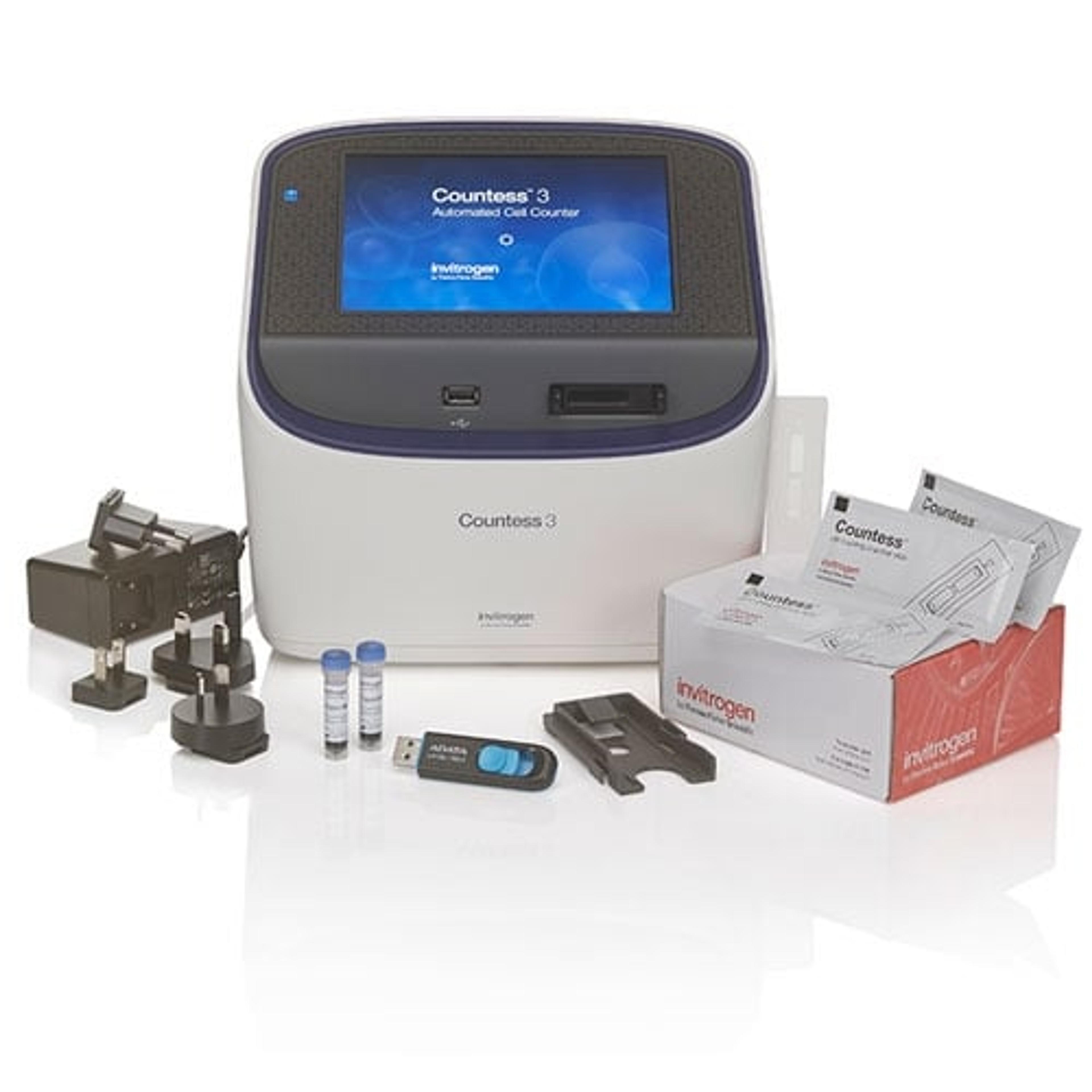
Invitrogen™ Countess™ 3 Automated Cell Counter

Thermo Fisher Scientific

The Countess 3 Automated Cell Counter uses advanced machine-learning image analysis algorithms to deliver accurate cell counts and viability in seconds with the convenience of fully automated lighting, focus, capturing, counting, and saving thereby reducing the time and variability associated with manual cell counting.

(23)

Links

Tags

Flow Cytometry / Cell CountingFlow cytometers are used to count, sort and examine multiple characteristics of cells. Other cell analysis equipment includes image cytometers, cell counters, fluorescence-activated cell sorters (FACS), magnetic-activated cell sorters (MACS), and a range of flow cytometry assay kits. Flow cytometers can reveal information on cell viability, cell proliferation, apoptosis and cell cycle progression, as well as identify cell populations and intracellular or cell-surface molecules. Additionally, some flow cytometers, known as FACS, have an additional sorting function after analysis. Cell counters and image cytometers count live and dead cell populations and can also conduct cell proliferation assays. Find the best flow cytometers, cell counters and cell sorters in our peer-reviewed product directory: compare products, check customer reviews and receive pricing direct from manufacturers.Protein QuantificationThe detection and quantification of proteins in a sample is vital across life sciences, pharmaceutical research and clinical diagnostics, and a variety of equipment is available to scientists to simplify the workflow. Proteins of interest can be easily labeled and detected on light-based detection instruments. Immunoassay kits allow you to identify a specific protein of interest and protein detection beads or antibody microarrays allow you to identify multiple specific proteins at once. Protein interactions and enzyme activity can also be monitored with protein-protein interaction assays. Additionally, the biophysical characterization of proteins is made easy with biokinetic analyzers. Find the best protein detection and quantification products in our peer-reviewed product directory: compare products, check customer reviews and receive pricing direct from manufacturers.Protein ExpressionProtein expression is the utilization of cell machinery for the synthesis of proteins and has become a critical tool in biotherapeutic, genomic, and proteomic research. Produce recombinant proteins with expression vectors in combination with a host cell suitable for high-level protein expression. For production of toxic proteins, consider cell-free expression vectors. Create and monitor post-translational modifications with protein modification kits. Find the best protein expression products in our peer-reviewed product directory: compare products, check customer reviews and receive pricing direct from manufacturers.MultiplexCell ImagingCell imaging can be achieved using a number of techniques including confocal microscopy, transmission electron microscopy, atomic force microscopy, and light sheet microscopy.Cell AnalysisThe analysis of cells allows researchers to understand the factors which contribute to cell health and function. These influencing processes can then be predicted and altered, leading to the development of medication and disease treatments.ImagingImaging techniques are essential for obtaining visual representations of samples to understand structures, processes, and function in biological, chemical, and physical research. These tools range from traditional light microscopy to advanced imaging modalities like MRI and electron microscopy, providing researchers with valuable data for diagnostics, drug discovery, and material analysis. Explore imaging solutions in our peer-reviewed product directory to compare products, check reviews, and get pricing directly from manufacturers.Flow CytometryDyesProtein Biology
Thermo Fisher Scientific acquires programmable dye platform pioneer Phitonex