
The PFAS data gap: Navigating the transition from targeted to total measurement
New analytical insights reveal why targeted testing misses the 'iceberg' of contamination and how next-generation standards are redefining regulatory compliance
31 Mar 2026
For decades, environmental labs have relied on targeted methods to monitor per- and polyfluoroalkyl substances (PFAS). However, as regulatory scrutiny intensifies in 2026, the question is no longer just whether PFAS are present, but whether we are measuring them comprehensively. While traditional methods like EPA 1633 are clinical cornerstones, they often capture only the ‘tip of the iceberg’, potentially missing over 80% of the total PFAS load in complex samples.
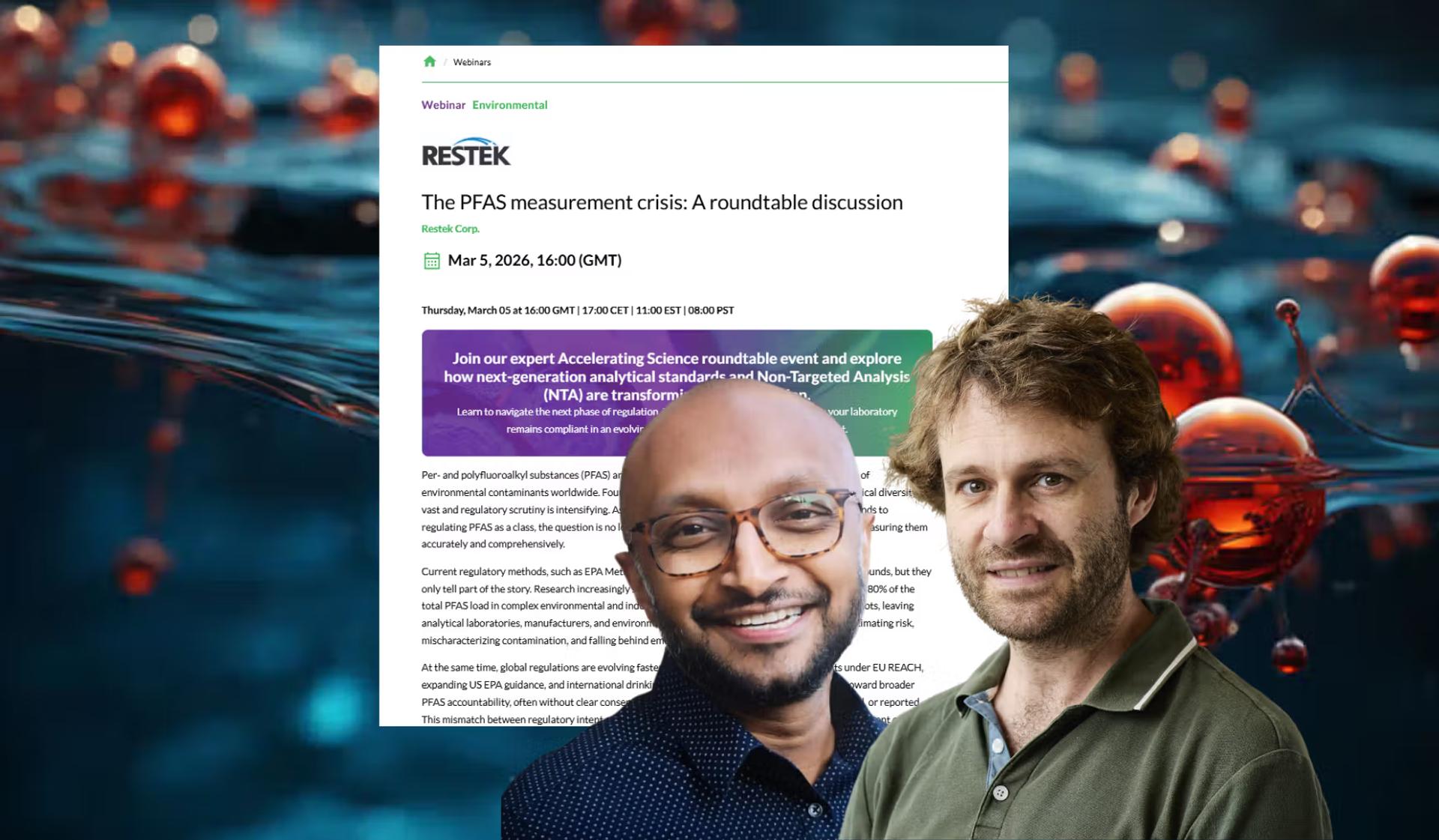
In a recent SelectScience® roundtable discussion, held in partnership with Restek, experts Dr. David Megson and Dr. Bharat Chandramouli provided a comprehensive overview of the "PFAS measurement crisis." Drawing on forensic case studies and decades of analytical experience, the panel highlighted how non-targeted analysis (NTA) and next-generation standards are poised to redefine industry standards, particularly for early detection, forensic tracing, and preparing for class-based regulations.
The iceberg problem
Why 2026 is the tipping point
The term ‘measurement crisis’ reflects a stark reality: the industry has ‘lifted the lid’ on a family of thousands of chemicals, yet most labs only target a handful of compounds.
"We’ve gone from needing lower detection levels for specific PFAS to realizing there are potentially thousands in the environment," Dr. Megson explained. This discrepancy creates a ‘messy’ global landscape where regulations evolve faster than analytical tools. Dr. Chandramouli added that while hardware is better than ever, the complexity of these ‘missing’ compounds leaves organizations vulnerable to underestimating environmental risk.
The standardization gap
Barriers to commercial NTA
If the hardware exists to identify these missing fractions, why isn't NTA routine? The panel identified a significant lack of standardized protocols as the primary bottleneck. Current NTA workflows are often highly individualized and exploratory, presenting a challenge for commercial labs that require validated, reproducible methods.
For commercial labs, the barrier is twofold: a lack of standardized reference libraries and the difficulty of communicating ‘confidence levels’ to clients used to simple numerical values. "With non-target, it starts with the basic uncertainty of we think it is this," Chandramouli said. "Coalescing around a standard for QA/QC—focused on rates of false positives and negatives—is the only way to ensure reported data is legally defensible."
Ultra-short chains and the GC knowledge gap
A standout technical challenge discussed was the mobility of ultra-short chain PFAS, such as TFA. These compounds are notoriously difficult to retain on standard C18 chromatography columns, often "whipping through" the system before they can be measured.
The panel emphasized the need to look beyond Liquid Chromatography (LC). "Doing non-target by Gas Chromatography (GC) will help identify a massive unknown space of PFAS," Megson noted. By adjusting stationary phase choices and embracing GC-MS for volatile compounds, labs can capture the fraction of the ‘iceberg’ that traditional LC-based methods simply cannot see.
Total PFAS
Choosing the right tool for the job
The roundtable addressed the ongoing debate between the Total Oxidizable Precursor (TOP) assay and Combustion Ion Chromatography (CIC). The consensus? There is no ‘one-size-fits-all’ method; the choice depends on the specific clinical or environmental question.
The TOP Assay remains instrumental for risk assessment and biosolid analysis, as it converts precursors into their most stable, toxic forms—essentially simulating a ‘worst-case scenario’ for environmental aging. Conversely, CIC and Total Organic Fluorine (TOF) measurements provide a broad mass balance, offering a high-point screening tool to identify any organic fluorine before moving to more specific investigations.
"We recommend a basket of measurement techniques," Chandramouli advised. "If you are looking for regulated PFAS, you need targeted; if you want to know what may transform in the environment in the future, you need TOP."
Forensic signatures and the power of collaboration
Beyond simple detection, the ability to distinguish between linear and branched isomers is transforming forensic tracing. These ‘isomer profiles’ act as diagnostic fingerprints, allowing researchers to trace contamination back to specific manufacturers or historical spills.
"You don't know what that key information is until you embrace a wider method," Megson said. Both experts agreed that the most powerful tool for 2027 isn't a machine, but collaboration. By linking academic research with commercial lab scale, the industry can bridge the gap between academic exploration and commercial viability.
You can watch the full webinar on demand here.
Expert Insight FAQs
Q: Can non-targeted analysis (NTA) replace targeted methods?
Dr. Megson: Not yet. NTA is a powerful discovery tool, but targeted methods remain the standard for accuracy and precision. Used together, they provide a much fuller understanding of the total PFAS load.
Q: How do global labs harmonize different geographical regulations?
Dr. Chandramouli: We don't harmonize on specific methods; it's impossible because rules vary too much between jurisdictions. Instead, we harmonize on best practices, shared consumables, and analytical principles.
Q: What is the ROI of high-res mass spec (HRMS) for a commercial lab?
Dr. Megson: It provides a much more powerful answer to complex problems. It has uncovered contaminants I would never have found otherwise, often saving clients from repeated, unsuccessful targeted testing.