
µPAC™ Micro-Chip Chromatography — Better by Design
16 Feb 2018
The boundaries of technology can be pushed significantly when insights from different fields are brought together to compound. PharmaFluidics has combined expertise from the analytical chromatography and semiconductor chip manufacturing industries to create a new type of nano-LC column.
Conventional LC columns contain randomly packed beads as their stationary phase. In contrast, PharmaFluidics uses a lithographic etching process to create a perfectly ordered separation bed on a silicon chip. These new types of micro-chip based chromatography columns were named micro Pillar Array Columns or µPAC™.
The low ‘on-column’ dispersion, obtained thanks to the perfect order, virtually eliminates axial peak dispersion, resulting in higher column plate numbers with sharper peaks and higher concentration of compounds. The freestanding nature of the pillars also leads to much lower backpressure allowing the use of very long columns. These exceptional properties result in excellent chromatographic performance with high-resolution and high sensitivity. This new approach significantly improves LC analysis in complex mixtures of biological samples.
Furthermore, the micromachined separation bed in the µPAC™ forms a rigid structure that is perfectly symmetrical allowing bidirectional operation without any risk of stationary phase compression, column deterioration or stationary phase leakage. Finally, each micro-chip is identical due to the lithographic production process. Therefore, the µPAC™ column is experienced as a very robust high-resolution separation tool.
A new LC approach for biomarker discovery
Because of these advantages, µPAC™ is ideally suited for applications in fields that need ultra-high resolution to analyze small volumes of highly complex samples. Furthermore, high sensitivity is ensured, as the compounds remain more concentrated in narrower elution peaks. µPACTM thus allows detecting individual compounds across wide dynamic concentration ranges.
An example is the application of bottom-up proteomics for limited sample amounts. A study has shown that the µPAC™ column in combination with high-resolution MS is suitable for proteomics experiments where the sample amount is limited to a small number of cells. Injecting a dilution series of 1µg, 100 ng and 10 ng Hela cell digest, a high protein coverage has been obtained from both the highest concentration as well as from the 10 ng HeLa cell digest, corresponding to the content of about 50 cells. As a consequence, the µPAC™ column opens up a new tool for limited sample proteomics.
PharmaFluidics’ μPAC™ technology (micro Pillar Array Column) is unique in its kind as it is built upon the precise micromachining of designed pillar array separation beds into silicon. Due to its smart design, data productivity and robustness is no longer a concern in nano-LC.
Related products
Request Quote for All Products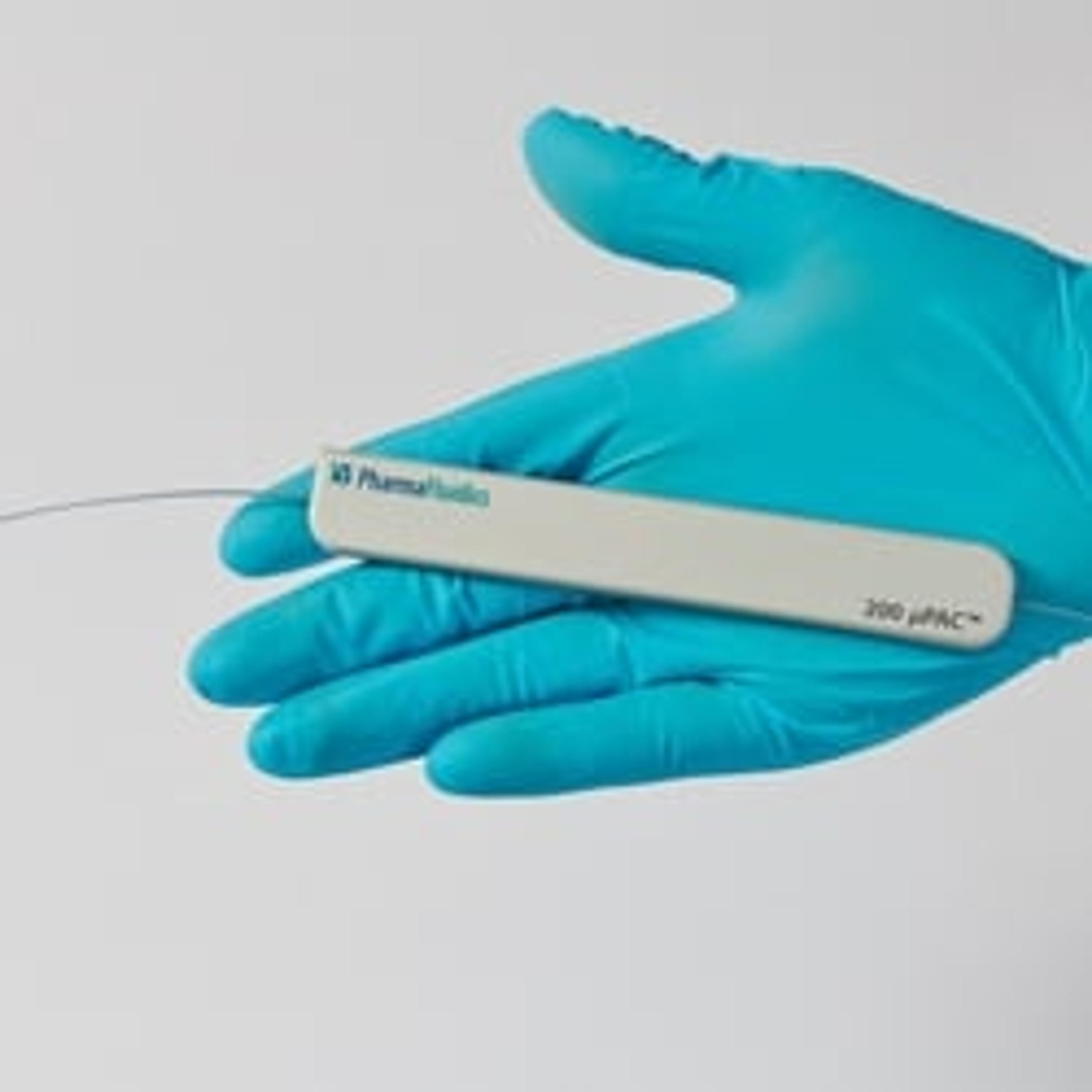
200 cm µPAC™ column
PharmaFluidicsAs an alternative to conventional columns, PharmaFluidics offers micromachined nano-LC columns or micro Pillar Array Columns (µPAC™). These µPAC™ columns display exceptional separation properties with unprecedented peak capacity and narrow peak shapes at low operating back-pressure. µPAC™ column, 200 cm length, with pillar array backbone at interpillar distance of 2.5µm, C18.
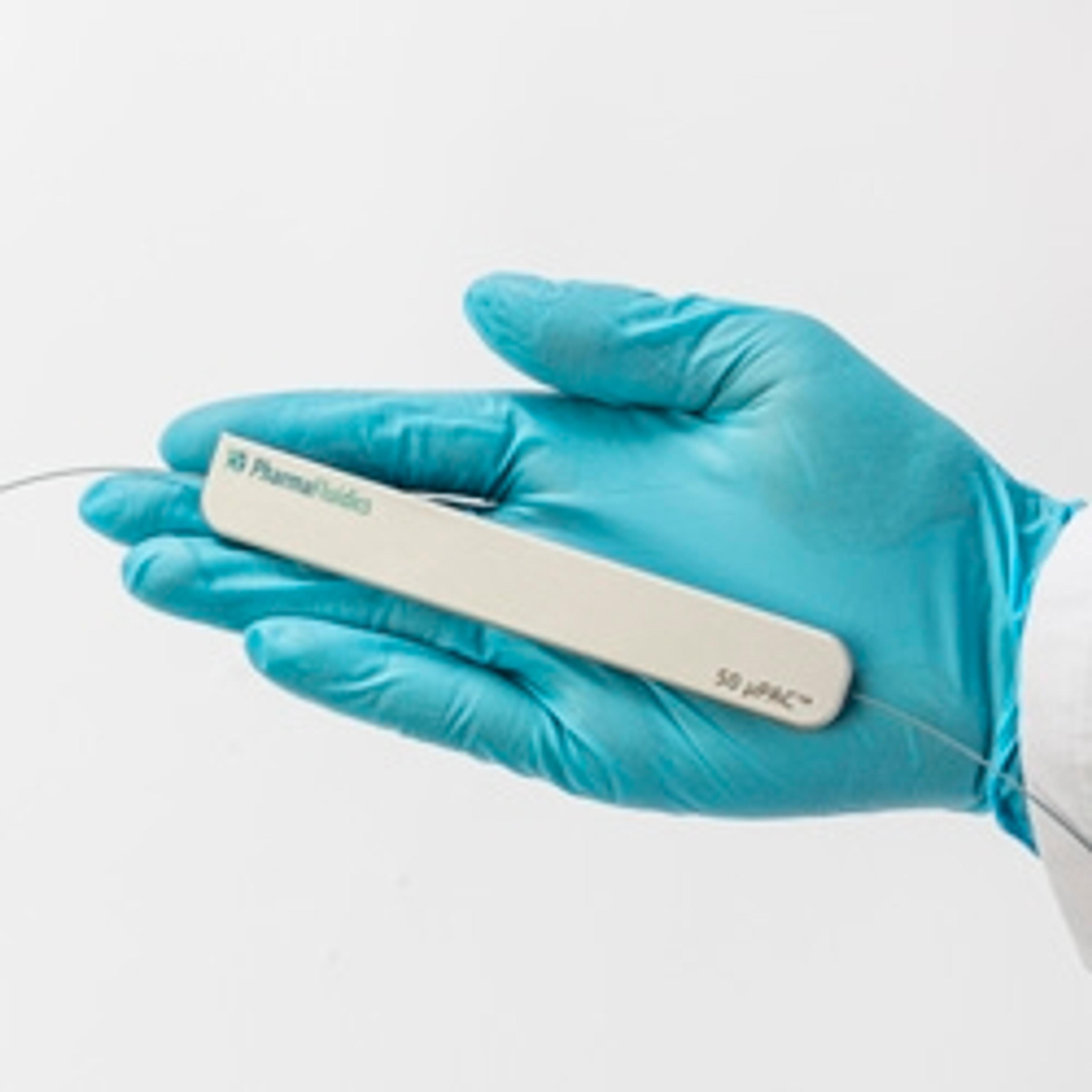
50 cm µPAC™ column
PharmaFluidicsWith an internal volume of 3µL, this 50 cm long RP-C18 µPAC™ column is perfectly suited to perform high throughput analyses with shorter gradient solvent times (30, 60 and 90-minute gradients) and it can be used over a wide range of flow rates, between 100 and 2000 nL/min. µPAC™ column, 50 cm length, with pillar array backbone at interpillar distance of 2.5µm, C18.