
New Standard Test Method to Assess Water Safety
24 Jan 2017Researchers investigating nutrient runoff, and water quality and wastewater treatment operators can now benefit from a new American Society for Testing and Materials (ASTM) standard that utilizes the powerful separation capabilities of ion chromatography for the simultaneous determination of total nitrogen and phosphorous concentrations.
Developed in conjunction with the ASTM, the “D8001 Test Method for Determination of Total Nitrogen, Total Kjeldahl Nitrogen by Calculation, and Total Phosphorus in Water and Waste Water by Ion Chromatography” allows users to concurrently monitor total nitrogen (organic nitrogen, ammonia, nitrate and nitrite) as nitrate and total phosphorus as orthophosphate in unfiltered water samples.
“Thermo Fisher’s method provides a single, reliable instrumental method for the determination of the target analytes in water, in place of traditional multiple and complex wet chemical methods, with the opportunity for accumulative errors,” said Robert Joyce, chairman of the ASTM International Subcommittee D19.06. “We expect the method should deliver labor savings, as well as improved sensitivity and accuracy.”
Currently, laboratories use two methods to determine total kjeldahl nitrogen (TKN) and total phosphate. The new test method can be incorporated into existing ion chromatography protocols with the addition of a single sample digestion and analysis step to determine total nitrogen and total phosphate simultaneously. By comparing digested and undigested samples using this method, the tedious TKN digestion method can be eliminated—ultimately saving time, disposal costs of acidic reagents and reducing some of the known false positives from TKN that occur with the use of acidic reagents.
“Excess amounts of essential nutrients such as nitrogen and phosphorous can cause algal blooms, leading to the generation of toxic microcystins,” said Richard Jack, senior director, Environmental and Industrial marketing, Chromatography and Mass Spectrometry, Thermo Fisher Scientific and ASTM member. “With this new method, scientists should be able to identify excess nutrients in waterways from water treatment and agricultural runoffs.”
The new method involves a simple two-step process, sample digestion and analysis. During the digestion step, a water sample is digested with alkaline persulfate, which results in oxidation of nitrogen compounds to nitrate and hydrolysis of phosphorus to orthophosphate. Following this, the sample can be analyzed using an ion chromatography platform, such as the Thermo Scientific™ Dionex Integrion HPIC system coupled with the Thermo Scientific™ Dionex™ Chromeleon™ 7.2 Chromatography Data System (CDS) software, to produce accurate and reproducible determination of nutrients at high throughputs.
Related products
Request Quote for All Products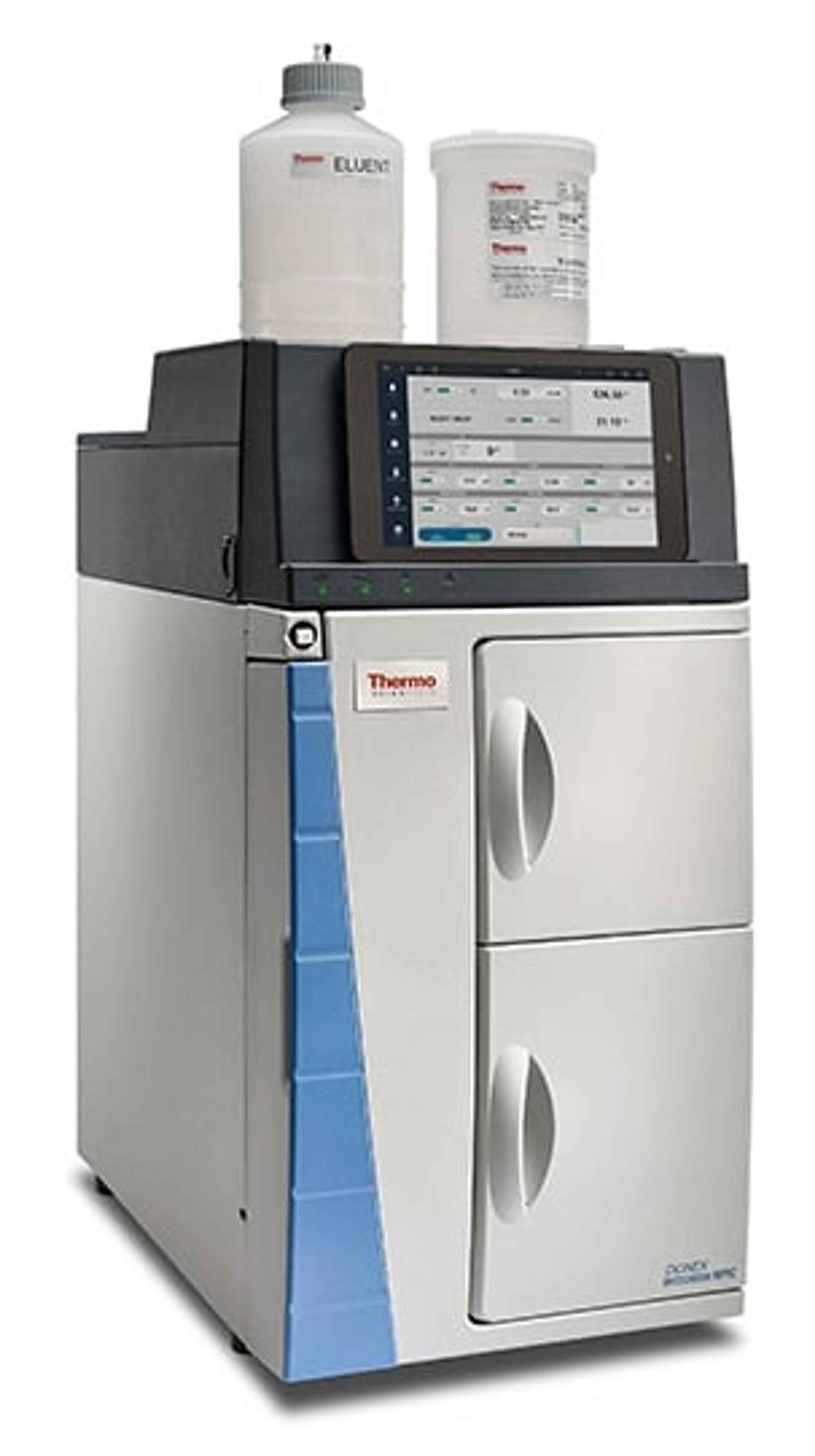
Thermo Scientific™ Dionex™ Integrion™ HPIC™ System
Thermo Fisher ScientificAs an ion chromatographer, the routine IC applications you run give the rest of us the peace of mind to use everyday resources like water, food and beverages, biofuels and pharmaceuticals without a second thought. Using this high-pressure-capable IC system to separate and quantify common ionic pollutants in municipal drinking water and wastewater can provide faster, more cost-effective methods for regulatory compliance testing. Nothing supports you in this role more than your laboratory instruments. The Thermo Scientific™ Dionex™ Integrion™ HPIC™ system is designed to be your reliable lab partner. Features: Simplified plumbing layout with integrated architecture - Layout based on logical flow-path for easy component access in a compact platform with a small physical footprint. Consumables Device Monitor - Provides positive identification of a consumable's performance metrics, preventing consumable installation errors and mismatches by automatically logging consumable use and performance. Detachable tablet with local language support - Flexible access to IC controls that speak your language Upgradeable features - In a fluid market with changing demands, the Dionex Integrion IC system offers a wide range of upgradable components, so it can grow with your needs over time. These include electrolytic sample preparation and electrolytic water purification Automated Eluent Generation (EG™) - Eliminate human errors associated with manual eluent preparation and improve method reproducibility from operator-to-operator and lab-to-lab. The Dionex Integrion IC system brings consistent results to all your applications. In this case, 100 injections of a simple sugar mixture are highly reproducible. Wide range of column support - Choose the column sizes you need for your applications, including smaller-particle-size 4 µm columns that provide faster run times and better resolution. Flexibility – two different models to choose from and option to choose right detector or column format for your application

Thermo Scientific™ Chromeleon™ 7.3.2 Chromatography Data System (CDS)
Thermo Fisher ScientificBuilt for Stability. Built for Performance. Why Compromise? Deliver efficiency, assurance and compliance with one software platform that integrates seamlessly with your laboratory's IT infrastructure now and the future.