
INRAE traces the Mediterranean invasion of tomato leaf curl New Delhi virus with Genome Detective
Genome Detective and Oxford Nanopore sequencing used to track the spread and evolution of tomato leaf curl New Delhi virus in France, enabling scalable plant-virus surveillance and epidemiological insights
15 Oct 2026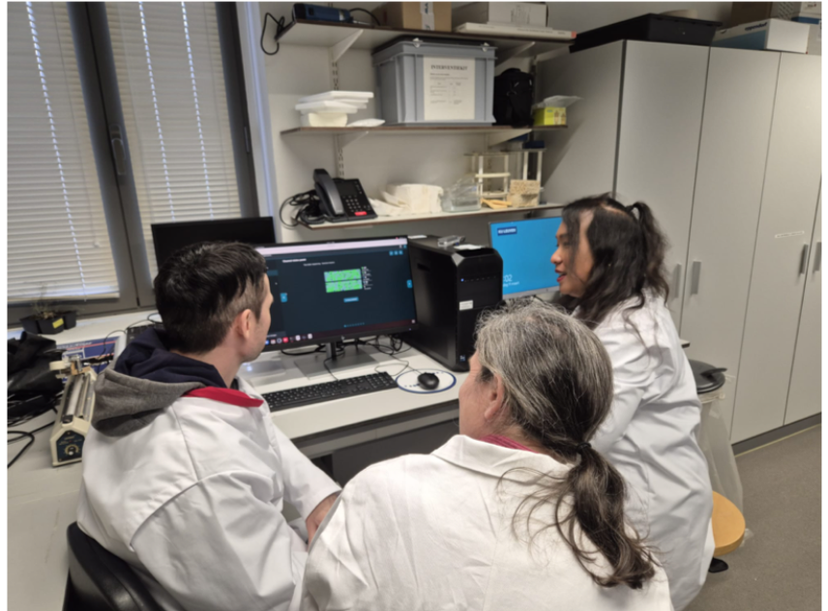
A. Patthamapornsirikul, V. Golyaev and C. Desbiez performing long read sequencing of ToLCNDV
Dr. Cécile Desbiez, Plant Virologist at INRAE (French National Research Institute for Agriculture, Food and Environment), has used the Genome Detective platform to reconstruct and analyse the genomes of emerging plant viruses.
By combining Oxford Nanopore long-read sequencing with Genome Detective's cloud-based pipeline, her team unravelled the introduction routes and evolutionary dynamics of tomato leaf curl New Delhi virus, Mediterranean strain (ToLCNDV-ES), in southeastern France. They succeeded in turning a laborious cloning-based workflow into a rapid, browser-native surveillance tool for circular DNA plant viruses.
Confronting an emerging threat to Mediterranean agriculture
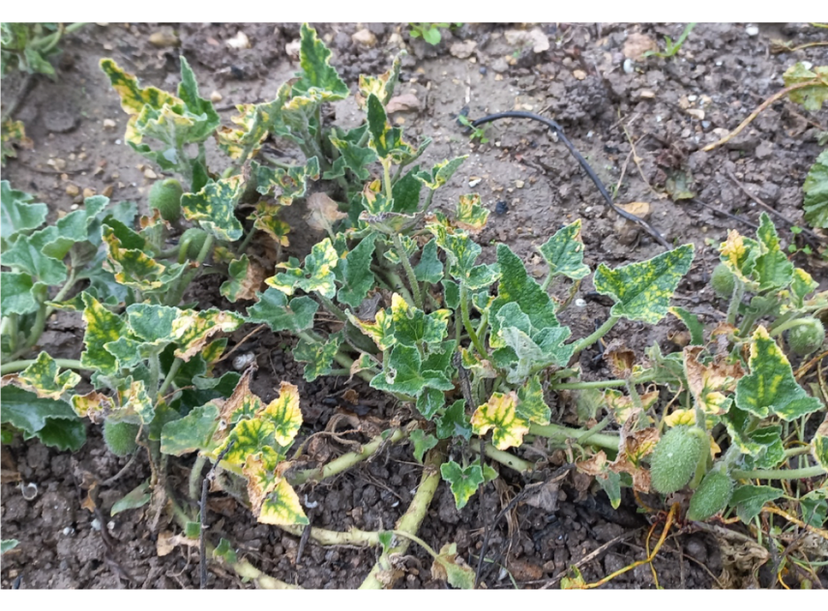
Wild perennial cucurbit Ecballium elaterium (squirting cucumber) with yellowing symptoms infected with ToLCNDV

Stunted and yellowing zucchini plant infected with ToLCNDV
At INRAE's Pathologie Végétale unit in Montfavet, Cécile Desbiez leads research on the viruses that threaten France's cucurbit and solanaceous crops. Since ToLCNDV-ES was first detected in southeastern France in 2020 and re-emerged in 2022, the pressure to understand its origin, host range and evolutionary trajectory has only grown.
Operating across production regions in Gard, Bouches-du-Rhône and Vaucluse, and working alongside European partners under the EU Horizon 2020 Virtigation project, Desbiez's team needed a way to move beyond fragmentary Sanger data toward complete, population-level genome reconstructions.
"Bipartite begomoviruses like ToLCNDV-ES don't invade alone. Samples often carry mixed haplotypes and reassortant genome combinations," Desbiez explains. "To understand the invasion, we needed a workflow that could actually see that diversity."
Overcoming the cloning bottleneck for circular DNA viruses
Historically, characterizing the intra-host diversity of circular single-stranded DNA viruses required laborious cloning of individual genome components, followed by Sanger sequencing of many colonies per sample. The approach is slow, expensive and prone to artefactual recombination signals.
By pairing rolling-circle amplification with Oxford Nanopore long-read sequencing and processing the resulting reads on the Genome Detective platform, the INRAE team, including Dr. Eric Verdin and Dr. Adriana (Atiwich) Patthamapornsirikul, was able to reconstruct full-length DNA-A and DNA-B segments – and their co-circulating haplotypes – directly from field samples.
The sequencing protocol was originally developed at KU Leuven University, including researchers Victor Golyaev and Hervé Vanderschuren. The sequencings mentioned in this article were performed by Victor Golyaev in the laboratory of Hervé Vanderschuren.
In preparation, the INRAE team discussed with them about the choice of isolates to sequence and sent them the DNAs, and afterwards, executed the analyses of the sequencing results.
"The Genome Detective platform allow us to go from raw Nanopore reads to a curated consensus and a haplotype map in one place, without hand-crafting a cloning pipeline for every sample," Desbiez notes. "That changes what is realistic to sequence at surveillance scale."
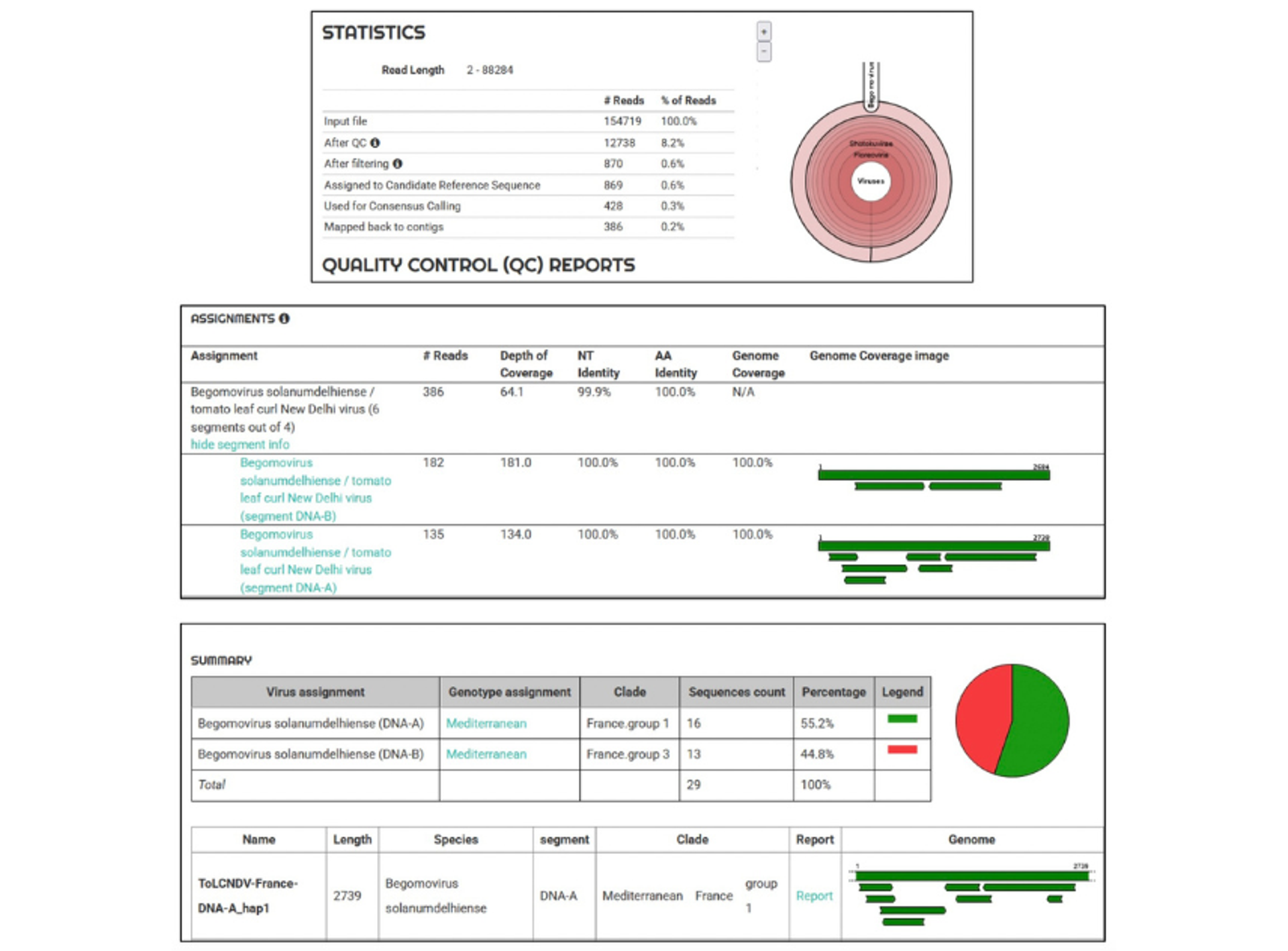
Examples of Genome Detective results reconstructing ToLCNDV haplotypes and assigning them at the species (top) or subtype (bottom) level
Reconstructing invasion history with long-read genomics
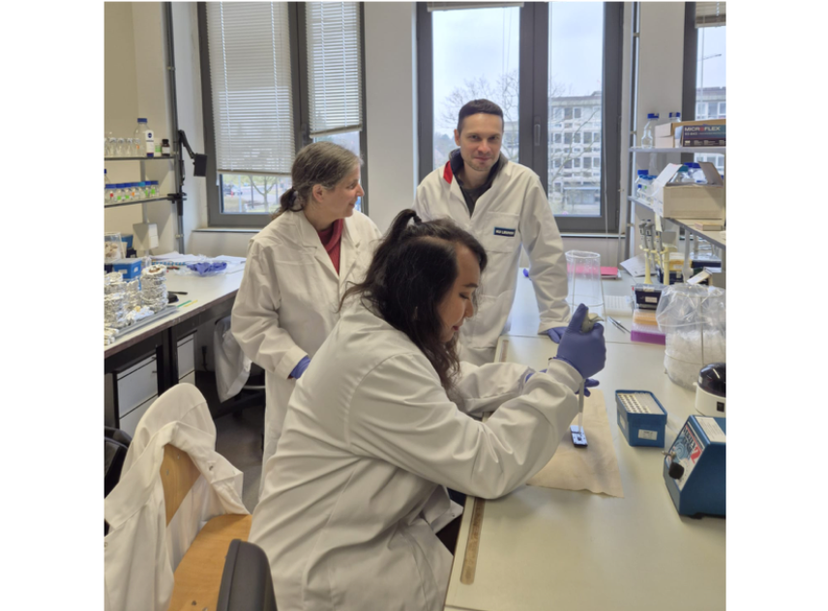
A. Patthamapornsirikul, V. Golyaev and C. Desbiez performing long read sequencing of ToLCNDV
Applied to 48 French isolates collected between 2020 and 2024 and benchmarked against 110 Mediterranean references, the workflow revealed that French isolates are polyphyletic within the Mediterranean clade. They split into two DNA-A and four DNA-B subgroups consistent with multiple independent introduction events between 2018 and 2021.
The ancestral nodes dated in 2010-2013, at the time of emergence in southern Spain, are an indication of diversification (in Spain or elsewhere in the Mediterranean Basin) before the introduction in France. The same molecular ToLCNDV groups found in France between 2020 and 2024, suggests local persistence.
Since the populations in weeds were the same as in crops, the persistence was supposedly in these weeds, from weed reservoirs such as Datura stramonium and Ecballium elaterium.
Bayesian analyses showed DNA-B evolving roughly twice as fast as DNA-A, and a single positively selected codon (position 147) in the coat protein – uniformly encoding serine in French isolates – hinted at ongoing adaptive change.
A scalable framework for plant-virus surveillance
The visual outputs and structured reports provided by Genome Detective cover maps, phylogenies, haplotype summaries and copiable consensus sequences. They proved as valuable for downstream epidemiological interpretation as for the underlying genome reconstruction.
The findings, published in PLOS Pathogens (Desbiez et al., 2026), now inform quarantine measures, weed-management practice and resistance-breeding priorities for Mediterranean cucurbit and tomato production. As Desbiez and colleagues conclude in their paper, "Long-read sequencing paired with a cloud analysis pipeline offers a scalable framework for surveillance of circular DNA plant viruses. The approach provide insights broadly relevant for understanding evolutionary trajectories of emerging viral pathogens."
The research has led to the ToLCNDV subtyping tool, integrated into the Genome Detective platform.
Want the latest science news straight to your inbox? Become a SelectScience member for free today>>
Tags
Frequently asked questions
Show frequently asked questions
How did Oxford Nanopore sequencing and Genome Detective improve ToLCNDV-ES surveillance?
The workflow combined rolling-circle amplification, Oxford Nanopore long-read sequencing and Genome Detective’s cloud pipeline. It reconstructed full-length DNA-A and DNA-B segments, consensus genomes and co-circulating haplotypes directly from field samples, replacing slow, expensive cloning and Sanger sequencing.
What did genomic analysis reveal about ToLCNDV-ES introductions into southeastern France?
Analysis of 48 French isolates collected from 2020 to 2024, benchmarked against 110 Mediterranean references, found two DNA-A and four DNA-B subgroups. Their polyphyletic pattern indicated multiple independent introductions between 2018 and 2021, followed by local persistence.
Which weeds may act as reservoirs for tomato leaf curl New Delhi virus in France?
The same ToLCNDV molecular groups occurred in weeds and crops, suggesting that Datura stramonium and Ecballium elaterium may support local persistence. These potential weed reservoirs influence quarantine measures, weed-management practices and resistance-breeding priorities for Mediterranean cucurbit and tomato production.