
Hamamatsu Introduces New ORCA-Flash4.0 V2 sCMOS Camera
7 Feb 2013Hamamatsu Photonics has released the ORCA-Flash4.0 V2, a 4-megapixel scientific CMOS camera that offers unrivalled flexibility across a wide range of microscopy applications. The ORCA-Flash4.0 V2 has many new features such as two scan speeds, a readout mode for light sheet microscopy, and USB 3.0 and Camera Link interfaces.
Camera users have the option of running the ORCA-Flash4.0 V2 in a blazing fast scan mode or a virtually noiseless slow scan mode. The fast scan (standard) produces a low read noise of only 1.9 electrons rms (1.3 electrons median), which is suitable for most experiments. The slow scan with read noise of 1.5 electrons rms (0.9 electrons median) is designed for experiments where lower noise is more important than raw speed.
Another new feature is the Lightsheet Readout Mode™, which allows seamless integration of the ORCA-Flash4.0 V2 with light sheet microscopy systems. In this readout method, the Gen II sCMOS sensor is read out in one sweep across the sensor from top to bottom or bottom to top. This enables the best speeds and synchronization for light sheet microscopy.
A third new feature is ImageConductor connectivity™, which enables the ORCA-Flash4.0 V2 for both USB 3.0 (default) and Camera Link connectivity. The default USB 3.0 camera configuration is perfect for 30 frames/s imaging at the full 4-megapixel resolution. If a faster frame rate is needed now or later, adding our high-speed Camera Link board and cable is easy to do, allowing the camera to achieve 100 frames/s at full resolution.
Other features of the ORCA-Flash4.0 V2 include high quantum efficiency (over 70% at 600 nm and 50% at 750 nm) and a global reset function. The global reset allows camera users to acquire global exposures and choose to have either an external source or the camera be master of the timing.
The ORCA-Flash4.0 V2 is an excellent camera for super-resolution microscopy, TIRF microscopy, ratio imaging, light sheet microscopy, FRET, high-speed calcium ion imaging, real-time confocal microscopy, and other imaging applications.
Related products
Request Quote for All Products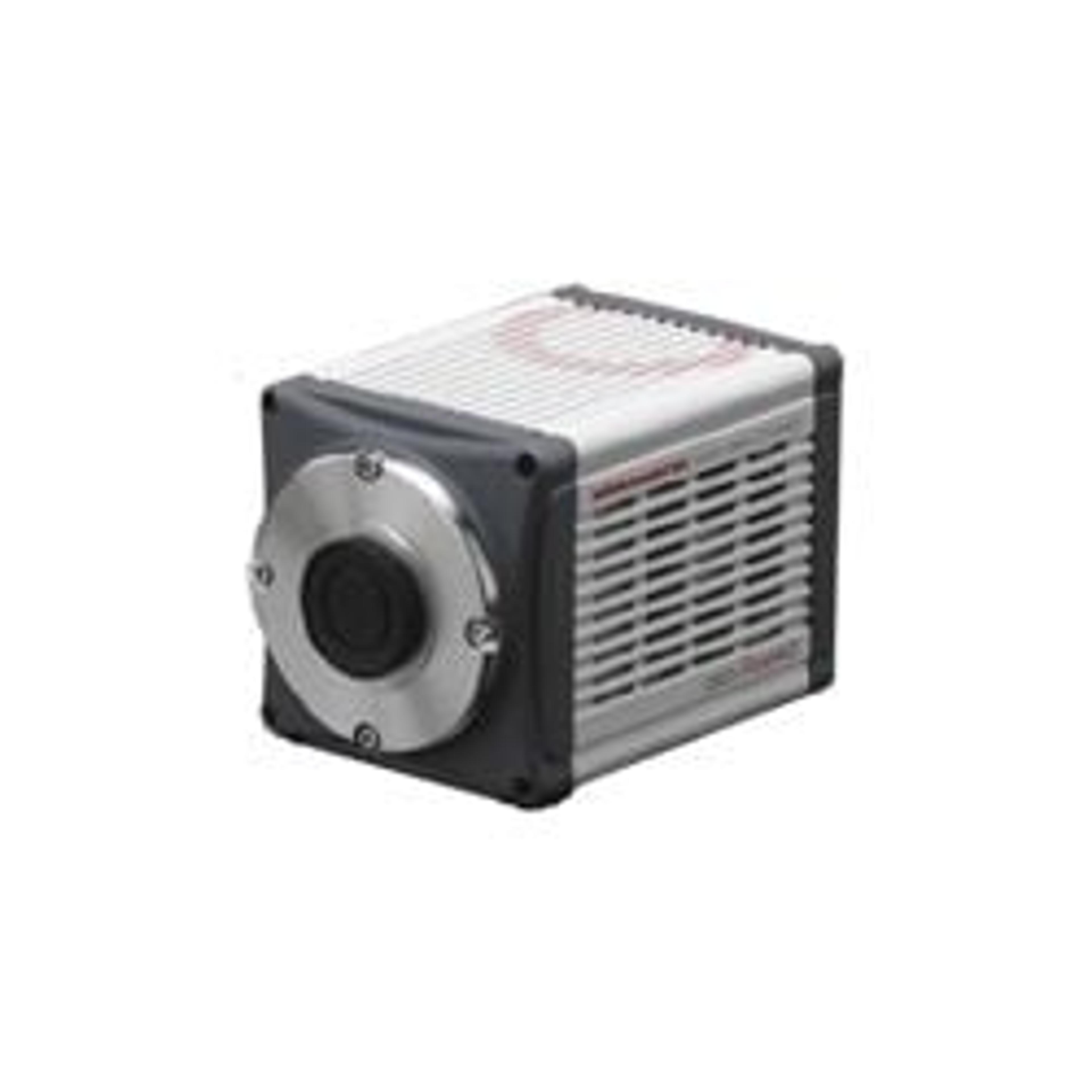
ORCA-Flash4.0 Camera v2
Hamamatsu Corporation Camera Products GroupChanging the Game The ORCA-Flash4.0 V2 offers unrivaled flexibility across a wide range of imaging applications. Easily change from USB 3.0 to Camera Link connectivity. Switch from a blazing fast scan to a virtually noiseless slow scan by a simple click in software. Use our Lightsheet Readout Mode™ for seamless integration with light sheet microscopy systems. Robust triggering allows the ORCA-Flash4.0 V2 to drive other devices or be driven by them. And then there’s the highest quantum efficiency (QE) of any sCMOS camera on the market. • Learn more, read the Life Science Cameras - Spring 2013, the new camera playbook (5.83 MB). • Additional recommended reading materials are available. ORCA-Flash4.0 V2 features: • Standard scan mode with 1.9 electrons rms (1.3 electrons median) read noise • Slow scan mode with 1.5 electrons rms (0.9 electrons median) read noise • Lightsheet Readout Mode™ for light sheet microscopy • 4.0 megapixels with 6.5 x 6.5 µm pixel size • Frame rates - 100 frames/s at full resolution with Camera Link - 30 frames/s at full resolution with USB 3.0 • Over 70% QE at 600 nm Two scan speeds The ORCA-Flash4.0 V2 features two scan modes: a blazing fast scan (standard) or a virtually noiseless slow scan. The fast standard scan produces a read noise of 1.9 electrons rms (1.3 electrons median), which is suitable for most experiments. The slow scan with read noise of 1.5 electrons rms (0.9 electrons median) is designed for experiments where lower noise is more important than raw speed. Both the USB 3.0 and Camera Link configurations of the camera have this low noise capability. Lightsheet Readout Mode™ To enable the best speeds and synchronization for light sheet microscopy, the ORCA-Flash4.0 V2 configured with the Camera Link interface can be read out using the Lightsheet Readout Mode™ feature. In this mode, the camera’s Gen II sCMOS sensor is read out in one sweep across the sensor from top to bottom or bottom to top. Conduct your research with ImageConductor Connectivity™ Every ORCA-Flash4.0 V2 includes ImageConductor Connectivity™, so that it’s enabled for both USB 3.0 (default) and high-speed Camera Link. If your imaging tempo is 30 frames/s, then the default configuration with USB 3.0 is right for you. If you need faster speed, just add a Camera Link board now or later to achieve 100 frames/s at full resolution. Both options deliver the same low noise, high QE imaging for unprecedented sensitivity. Global exposure flexibility The ORCA-Flash4.0 V2 has an added Global Reset function, so you can acquire global exposures and choose to have either an external source or the camera be master of the timing. High sensitivity means extreme versatility Thanks to its low noise and high QE values across a wide range of wavelengths, the ORCA-Flash4.0 V2 has the sensitivity required for many fluorescence microscopy techniques. These imaging techniques include super-resolution microscopy, ratio imaging, FRET, high-speed calcium ion imaging, TIRF microscopy, real-time confocal microscopy, and light sheet microscopy. Wide field of view and high resolution With 4.0 megapixels at 6.5 µm x 6.5 µm each, the ORCA-Flash4.0 V2 offers a field of view 2.5 times larger than a standard EM-CCD. In addition, this camera’s small pixels can resolve much finer details than the larger pixels of an EM-CCD camera. Individualized documentation Knowing as much as possible about your camera helps increase confidence in the results it produces, especially under demanding experimental conditions. Every ORCA-Flash4.0 V2 is individually characterized at the factory before it ships, and the results of these tests are included with each camera. A measured noise histogram, photon transfer curve, rms noise value and conversion factor (electron/count) are provided along with simple formulas to make use of this information. Applications • Super-resolution microscopy • TIRF microscopy • Ratio imaging • FRET • High-speed calcium ion imaging • Real-time confocal microscopy • Light sheet microscopy