
Flow cytometry helps solve previously unsolvable criminal cases
Professor Bram Bekaert and Kristina Fokias of KU Leuven explain how the MA900 Cell Sorter powers SpermFACS, a technique that recovers DNA evidence from the most degraded and delayed forensic samples
21 Oct 2026
When a criminal case hinges on biological evidence collected days after an incident, standard forensic testing often cannot help. Swabs collected after 48 hours typically contain so few sperm cells among a majority of other cellular material that conventional DNA extraction returns a mixed, uninterpretable profile, and the case stalls before it reaches court.
At KU Leuven's Laboratory of Forensic Biomedical Sciences, Professor Bram Bekaert and Research Associate Kristina Fokias have spent several years closing that gap. Their technique, SpermFACS, uses fluorescence-activated cell sorting on the MA900 Cell Sorter from Sony Biotechnology to isolate sperm cells from complex forensic samples with a sensitivity and purity that older methods cannot match, and it has already been validated and published as a route to DNA profiles even five days after an incident.
In this SelectScience® interview, Bekaert and Fokias discuss how SpermFACS was developed, how the MA900 achieves the purity that delayed and multi-contributor cases demand, and what it will take to bring flow cytometry into routine forensic casework.

The team at the Laboratory of Forensic Biomedical Sciences, Department of Imaging & Pathology, UZ Leuven - KU Leuven
A flow cytometry technique born from an evidentiary gap
Bekaert's laboratory is unusually positioned, combining forensic casework and academic research under one roof. This lets the team identify a problem in casework, develop a solution in the lab, and evaluate it against real samples far faster than in most academic settings. Any new method still has to clear extensive validation and accreditation before it can be used in a live case, but the two sides of the lab work in close step.
Forensic samples are inherently complex, containing epithelial cells, blood cells, bacteria, yeast cells, mucus, debris, and a large amount of cell-free DNA, all sitting on top of the few sperm cells the team actually needs to recover.
What we see in the lab is that when we have swabs collected days after the fact in criminal cases, they consist of a majority of other cellular material and a minority of sperm cells. Our current technologies are just not sensitive enough or specific enough to separate out these two different cell types, because if it's not one hundred percent efficient, you'll end up with a mixed DNA profile.
Professor Bram Bekaert KU Leuven
Separating sperm cells from a complex mixture
“Because there is such a large overload of background DNA, what happens with traditional methods is that the profile of interest becomes completely overshadowed,” Fokias says. “Even though that DNA is present, we still can't distinguish the profile. That's why we need very high-purity sorting. We can completely separate the two fractions and focus on the profile of interest without interference.”
The same sensitivity matters again in multi-contributor cases, where more than one individual may have contributed biological material to a sample. Standard profiling of a mixed sample like this produces DNA profiles too complex to interpret, and the evidence loses its value in court.
SpermFACS labels sperm cells with fluorescent antibodies, then sorts them out even when only a handful remain. This is a gamechanger as Bekaert's team has shown that the technique can still return a usable DNA profile from samples collected five days after an incident, a scenario in which routine methods usually fail.

The MA900 Cell Sorter and SpermFACS help KU Leuven scientists recover DNA profiles from degraded, delayed criminal casework evidence.
How the MA900 isolates individual sperm cells
The MA900 Cell Sorter is a critical component of their operation, with the ability not only to perform bulk separation of sperm from epithelial cells but also to sort single sperm cells into individual tubes, allowing the team to generate a separate DNA profile from each one.
“We can then collect DNA profiles from individual sperm cells and compare those profiles with each other and, if available, with a reference DNA profile from a person of interest,” Fokias explains. For a multi-contributor sample that would otherwise be unreadable, that single-cell resolution can be the difference between a case that stalls and one that reaches a jury.
Meeting the accreditation criteria for forensic casework
Before SpermFACS could be used in a live investigation, it had to meet ISO 17025, the accreditation standard for testing and calibration laboratories. Fokias' team ran the assay through a full validation program: a sensitivity study using decreasing numbers of sperm cells against a fixed background cell population, a concordance study against the lab's existing methods on forensic samples collected up to five days after an incident, repeatability and reproducibility testing across multiple operators, specificity testing to confirm the sorted cells were genuinely sperm rather than off-target material, and a contamination study to rule out cross-contamination between samples.
“We validated and accredited SpermFACS last year, and it took us quite a while to develop this technology and have it accredited,” Bekaert says. “The results that we've seen in the validation study are just incredible. We've been using it in casework now for about ten months, and we've had quite a few successes in casework that we wouldn't have been able to achieve with our routine technologies.”
What it will take to broaden forensic use
Flow cytometry is well established in biomedical research, but KU Leuven remains among a small number of forensic laboratories using it routinely in casework. Bekaert points to several reasons why. Forensic samples are typically degraded, mixed, and contain very few target cells, the opposite of the high-cell-count samples flow sorting is usually built for. The instruments themselves demand real investment, maintenance, and specialist operator training that many forensic labs do not yet have. And because forensic results are tested in court, every new method has to clear the same rigorous validation and accreditation process SpermFACS went through.
SpermFACS is also the scientific foundation for the lab's next project. CapCell, a newly funded EU initiative, builds directly on the validation work behind SpermFACS, aiming to miniaturize the same sensitive cell-sorting approach onto a microchip and extend it to other types of forensic evidence, such as contact traces on clothing or objects.
“The overall mission of the lab is to develop new and innovative technologies for forensic DNA casework, to assist the courts in helping solve criminal cases,” Bekaert says. For Fokias, the goal is more personal still. “We hope that it has an impact on the most complex cases that we're struggling with at the moment, and that it will help contribute to solving these cases,” she says. “Especially for the people affected. That's the most important part of all this research. We're trying to help them, and that's part of our journey.”
Watch Bekaert and Fokias explain how the MA900 Cell Sorter separates sperm cells from real casework samples and hear the full story behind SpermFACS in their own words.
Related products
Request Quote for All Products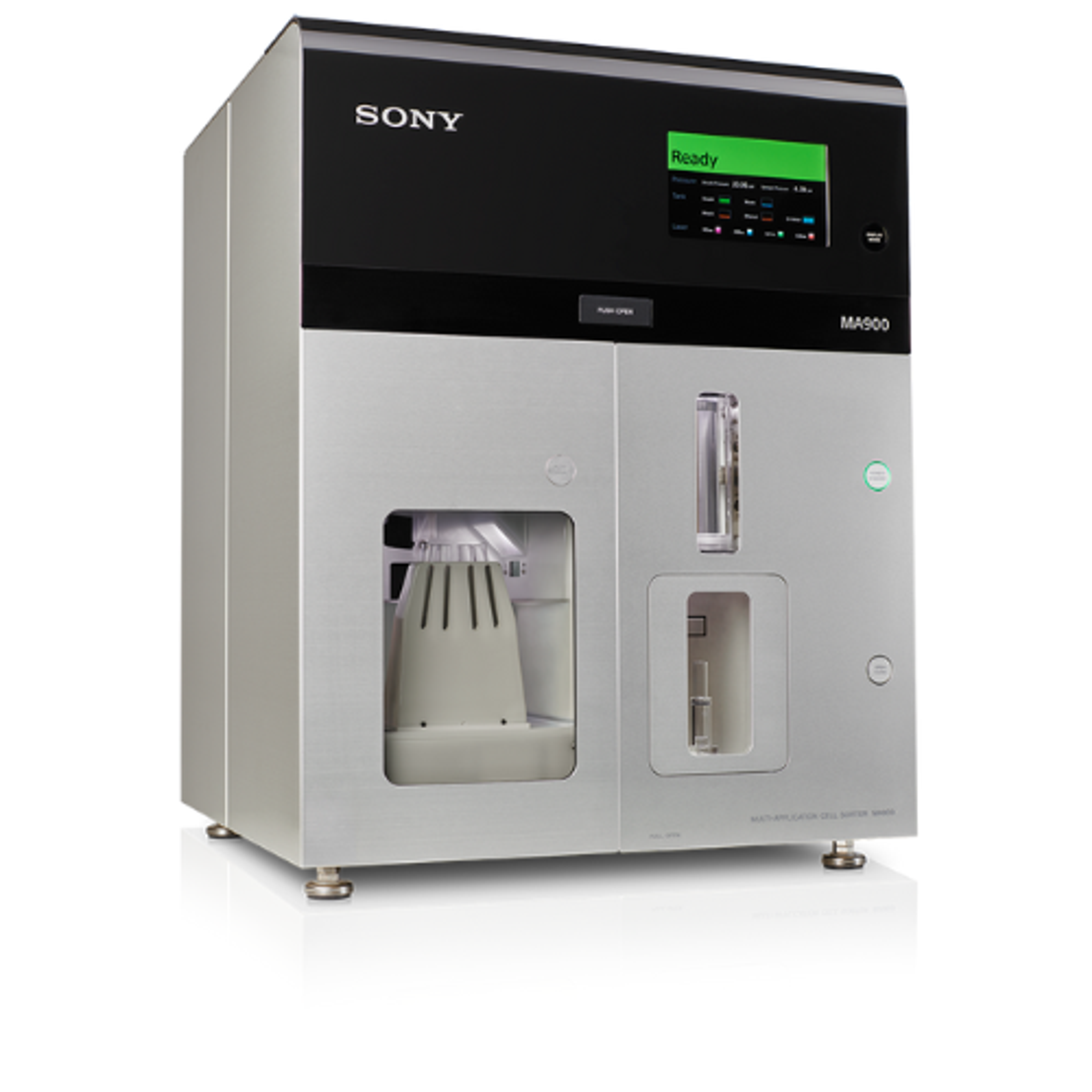
MA900 Multi-Application Cell Sorter
Sony BiotechnologyThe MA900 from Sony meets the needs of most sorting applications, supporting 12 fluorescence parameters and 4-way sorting. Powerful, modern technologies built into the MA900 system include a patented micro fluidic chip-based design, comprehensive fluidic controls, and advanced automation that dramatically simplifies operation to make sorting less subjective and improve reliability.
Links
Tags
Frequently asked questions
Show frequently asked questions
How does the SpermFACS technique improve DNA profiling in delayed sexual assault cases?
SpermFACS, developed at KU Leuven’s Laboratory of Forensic Biomedical Sciences, uses fluorescence-activated cell sorting on the Sony MA900 Cell Sorter to isolate sperm from complex vaginal samples. By labeling sperm with fluorescent antibodies and achieving very high-purity sorting, it can generate interpretable male DNA profiles even up to five days after an assault, where traditional forensic methods usually fail.
What role does the Sony MA900 Cell Sorter play in multi-perpetrator forensic DNA analysis?
The Sony MA900 Cell Sorter enables both bulk separation of sperm from epithelial cells and single-sperm sorting into individual tubes. This allows KU Leuven scientists to obtain separate DNA profiles from individual sperm cells and compare them with each other and with reference profiles. In multi-perpetrator or mixed-consent cases, this single-cell resolution can turn otherwise unreadable DNA mixtures into evidence usable in court.
How was SpermFACS validated to meet ISO 17025 forensic accreditation standards?
To meet ISO 17025, the KU Leuven team performed a full validation of SpermFACS: sensitivity studies with decreasing sperm counts, concordance studies against existing methods on post-coital samples up to five days old, repeatability and reproducibility across operators, specificity testing to confirm only sperm were sorted, and contamination studies. Successful validation led to accreditation, and SpermFACS has since delivered casework results unattainable with routine technologies.