
EMD Millipore's New SNAP i.d.® 2.0 System for Immunohistochemistry Minimizes Slide Handling
4 Nov 2014
At the annual ASCB/FIB meeting in Philadelphia, December 7-9 2014, EMD Millipore will introduce the new SNAP i.d.® 2.0 Protein Detection System for Immunohistochemistry (IHC), which streamlines immunohistochemistry workflows and significantly decreases slide handling time. The system enables parallel processing of up to 24 tissue slides at a time, making it easier to apply consistent conditions and reduce potential process variability inherent in manual IHC methods.
The system's intuitive format reduces slide handling and speeds wash steps during blocking, washing, antibody incubation and labeling. A controlled vacuum force removes solutions evenly from all slides at once, in seconds. This approach systemizes the handling of multiple slides, reducing slide-to-slide process variation without incurring the costs of automation. The protocol produces robust and consistent staining, without causing tissue degradation or the blotchy artifacts that sometimes plague autostainers. This system is compatible with standard IHC slides and protocols, as well as diverse tissue preparations, including formalin-fixed or fresh frozen samples.
The system's vacuum-driven technology has already been proven to facilitate immunodetection workflows. The SNAP i.d.® 2.0 System for Western Blotting has long helped customers optimize their Western blotting experiments, reducing membrane handling and producing faster results. Using the new system, Western blots and IHC experiments can be performed in parallel.
"Immunodetection, which has multiple steps and many variables, can be subject to process variability, leading to costly repeats," said Patrick Schneider, Ph.D., Head of Bioscience. "Because this vacuum-driven system minimizes slide handling, it saves researchers time and resources by reducing process variability and conserving valuable samples and reagents."
To conserve precious antibodies, the SNAP i.d.® 2.0 system enables the manual addition, as well as the removal and recovery, of small volumes of antibodies. Recovered antibodies can be used multiple times, as application studies have already shown.
Related products
Request Quote for All Products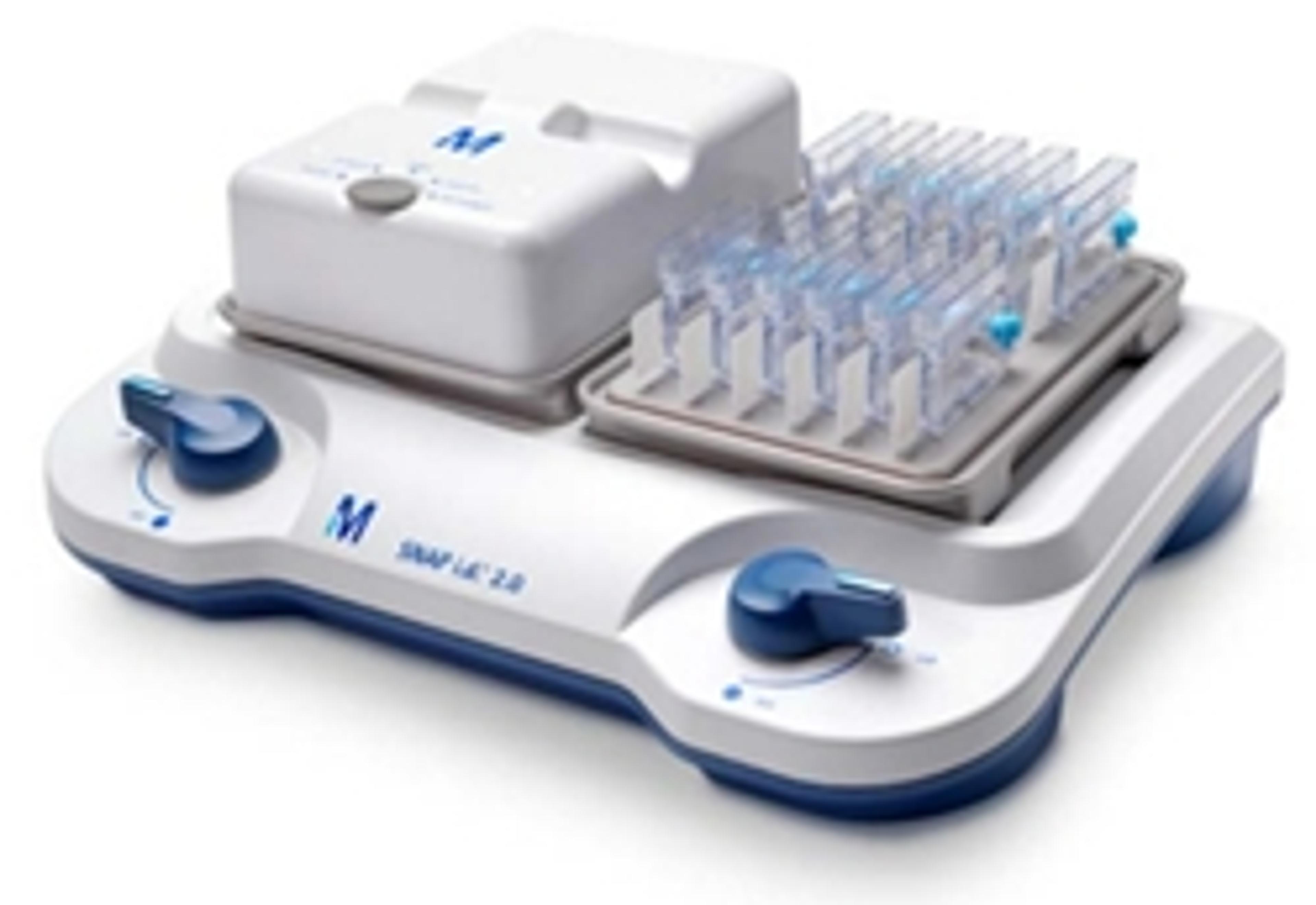
SNAP i.d. 2.0 IHC System
MerckIssues with Your Tissues? Process all Your Slides in a SNAP for Streamlined IHC. The SNAP i.d.® 2.0 Protein Detection System for Immunohistochemistry (IHC) introduces a new capability to the innovative, vacuum-driven SNAP i.d.® 2.0 system. The IHC slide holders allow you to block, probe, and stain up to 12 tissue slides per side (24 slides if both sides are used). Reduced handling time and multiple-slide processing make this system ideal for when you are optimizing antibody conditions and protocols.With two individually controlled sides, the system base allows for independent, vacuum-driven processing of either one or two IHC frames. Each of the IHC frames can process between 1 to 12 glass slides through independent vacuum ports.Each slide holder has an injection/recovery port that enables the manual addition, as well as the removal and recovery, of small volumes of antibodies or reagents; reagents can also be flushed using the vacuum feature if conservation is not a priority.Benefits: Eliminates the need for pap pens Antibodies can be collected and reused Slide handling time is significantly decreased Less time spent on wash steps Parallel processing of multiple slides Features: Flexibility of multiple slide configurations enables the processing of 1 to 24 slides at a time Compatible with standard IHC slides and protocols Compatible with diverse tissue preparations including formalin-fixed or fresh frozen samples Intuitive format Incorporates blocking, washing, and antibody incubation and labelling steps Systematizes handling multiple slides without the cost of automation Test tracker feature on frame cover helps keep track of IHC steps