
Droplet Digital PCR Facilitates Pioneering Lung Cancer Research at the Dana-Farber Cancer Institute
Find out how oncologists are using Droplet Digital PCR to improve the treatment and monitoring of lung cancer patients
31 Jul 2017

Dr. Geoffrey Oxnard, Thoracic Oncologist, Dana-Farber Cancer Institute
Liquid biopsies offer huge potential, not just as non-invasive diagnostic tests, but also for guiding treatment and monitoring patient care. Oncologists at the Dana-Farber Cancer Institute, Boston, Massachusetts, are using Droplet Digital PCR to help inform key treatment decisions. SelectScience® speaks to Dr. Geoffrey Oxnard, Thoracic Oncologist at the Dana-Farber Cancer Institute, and Assistant Professor at the Harvard School of Medicine, USA, to learn more.
SS: Could you describe your job role and your current research interests?
GO: I see lung cancer patients two half days a week; I also run clinical trials and engage in clinical research activity. I work on a wide range of projects involving cancer genomics, drug development and drug resistance. One of my major areas of interest is genomic analysis of plasma cell-free DNA, because as an oncologist, I need access to more immediately available DNA specimens.
Developing customized assays
SS: You use Droplet Digital PCR (ddPCR) in your research; can you explain how you use this particular technology?
GO: We developed ddPCR assays for the most common driver mutations in lung cancer, EGFR and KRAS mutations, using the QX100™ Droplet Digital™ PCR System. These assays have proven to be rapid and very reliable, and as such are a very convenient way of getting at fundamental genotypes that help to guide patient care. After much work in the lab, we worked with collaborators at Brigham and Women’s Hospital to launch ddPCR as a clinical assay, meaning that at Dana-Farber we are now able to offer plasma EGFR genotyping as a liquid biopsy.
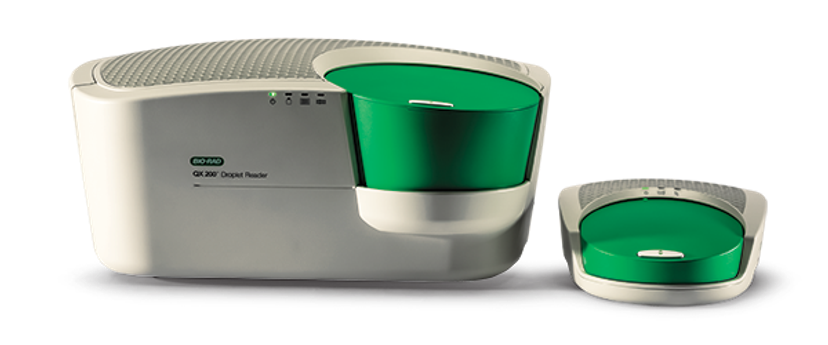
My research in ddPCR is carried out in close collaboration with the Belfer Centre for Applied Cancer Science at Dana-Farber. We use blood taken from EDTA tubes which are widely available in every laboratory. We spin the blood samples, ideally within four hours of being taken, although we’ve found ddPCR to be quite forgiving if delays do occur. We extract the DNA and emulsify it with PCR reagents into droplets. Each droplet is about the size of a cell and carries a cell’s worth of DNA. There are 20,000 droplets created per test that then undergo the ddPCR reaction, filling each droplet with the variant of interest. The droplets are then analyzed in a droplet reader.
SS: What are the advantages of using ddPCR?
If you are looking for a PCR-based focused assay, then ddPCR is perfect
Dr. Geoffrey Oxnard Dana-Farber Cancer Institute
GO: ddPRC is not the solution to all biomarker problems. It is a focused assay that is highly effective if you know the key mutations you are looking for, but more comprehensive and multiplex assays at times are needed. For tumor biopsies, we increasingly need broad sequencing assays for key mutations as well as rare, complex variants. We want to use our validated ddPCR assay as a benchmark for developing those more comprehensive alternative assays.
If you are looking for a PCR-based focused assay, then ddPCR is perfect. It’s faster and cheaper, and it is the most robust method of achieving an answer. ddPCR is the ‘best in class’, because it is quantitative, extremely sensitive, and shows very high specificity. This is why the technology has become our ‘go-to’ PCR assay for both plasma cell-free DNA and tumor DNA genotyping.
The high sensitivity does mean that it can become contaminated easily, so you need very clean procedures. You also need to know what investigations you want to run on each patient sample, as testing volume requirements limit you to about five PCR tests per specimen. It does take time and effort to validate our new ddPCR assays, however, the resulting tests are extremely versatile and hugely beneficial to our laboratory.
Improving patient care
SS: What is the future of lung cancer research and how will this directly impact on patient care?
GO: One opportunity for liquid biopsies and lung cancer research that has not yet been fully leveraged is the monitoring of a patient while they are on therapy. This monitoring approach is difficult for a number of reasons. Oncology involves a number of discrete decision points, and for a patient who is doing well on therapy, we don’t tend to ask, ‘are they doing well enough?’
It is challenging to develop new tools that integrate into decision points about treatment, but the opportunity is clear. We have been able to show that certain treatments in patients with KRAS and EGFR mutations result in a complete clearance of tumor plasma DNA, and this is an extremely favorable sign that the treatment is having a durable response. If patients still have detectable plasma mutations after treatment, then we know that these patients are likely to relapse sooner and have earlier development of resistance.
The idea that we would use non-invasive genotyping not only before treatment to inform therapy decisions, but also during treatment of a patient to inform continued management decisions, is a notion that hasn’t been comprehensively studied, yet deserves further prospective analysis.
Related products
Request Quote for All Products
QX200™ Droplet Digital PCR System
Bio-RadDroplet Digital PCR System, includes droplet generator, droplet reader, laptop computer, software, associated component consumables, for EvaGreen or probe-based digital PCR applications