
DNA design brings predictability to polymer gels

Simulations have led to the fabrication of a polymer-DNA gel that could be used in tissue regeneration and robotics.

16 Feb 2022

Rory Shadbolt
Publishing / Media

Industry news

Scientists in Japan have made a tuneable, elastic, and temperature-sensitive gel by using complementary DNA strands to connect star-shaped polymer molecules together. The gel, and the method used to develop it, could lead to advances in tissue regeneration, drug delivery, and soft robotics. Xiang Li at Hokkaido University led the team of researchers who reported their findings in the journal Polymer Science.
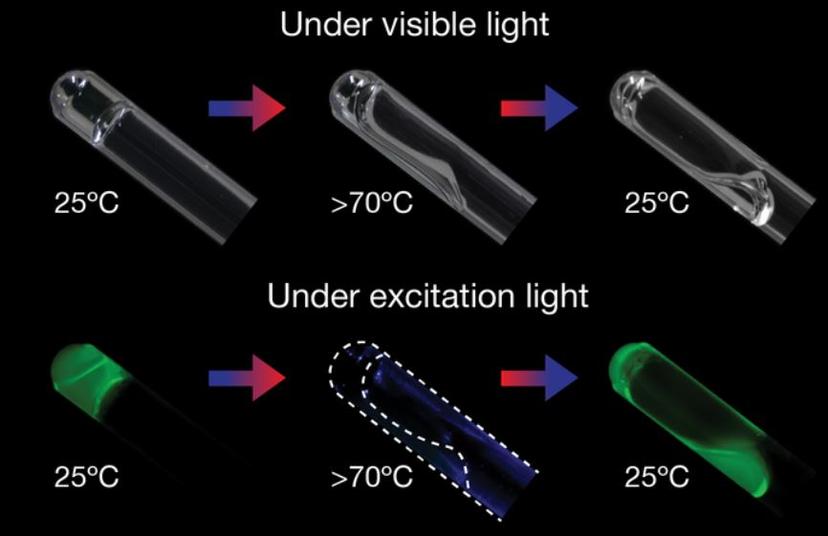
Hokkaido DNA
Liquefaction and gelling of the star-polymer DNA gel © Xiang Li

Scientists have long been looking for better ways to develop gels that can be used in a variety of applications, including in the fields of medicine and engineering. Ideally, such gels need to be predictable in their behavior, self-healing, and durable enough for the rigorous jobs they are intended for.

“Gels are made by using bonds to link polymer molecules together,” explains Li. “When the bonds are connected, the material is more solid, and when they break in response to stress, the material turns to liquid.”

Owing to their high biocompatibility, water solubility, and temperature sensitivity, DNA strands would be highly suitable for linking polymer molecules by taking advantage of their ability to form complementary bonds. However, scientists have so far found it difficult to use DNA links to develop homogeneous gels with on-demand elastic properties.

Looking to solve this problem, Li and his colleagues used software programs to simulate the formation of different DNA sequences and their complementary strands and to determine how these double strands respond to changes in temperature. Their aim was to identify complementary DNA sequences that would only disconnect above 63°C in order to ensure a potential gel’s stability in the human body.

Based on the software simulations, they chose a pair of complementary DNA sequences to link four-armed molecules of polyethylene glycol (PEG). They prepared the gel by dissolving DNA strands and PEG separately in buffer solutions before mixing them in a test tube immersed in a hot water bath that was then cooled to ambient temperature. Finally, they conducted a series of experiments and analyses to evaluate the resulting gel’s properties.

The gel performed as predicted by the simulations, remaining elastic, self-repairing and solid until its melting temperature of 63°C over multiple testing cycles. The experiments also showed that the PEG molecules were homogeneously linked together by the DNA double strands and that liquid formation happened when the strands separated.

“Our findings suggest that we will be able to fabricate DNA gels with on-demand viscoelastic properties by making use of already available data on DNA thermodynamics and kinetics,” says Li. “The aim will be to improve the understanding and applications of this class of gel.”

Want the latest science news straight to your inbox? Become a SelectScience member for free today>>

Links

Tags

ElectrophoresisElectrophoresis equipment is used to separate mixtures of protein, DNA or RNA, based on their electric charge, size and other physical characteristics, by passing them through a medium such as a polyacrylamide gel, an agarose gel or a capillary tube. Electrophoresis equipment includes horizontal and vertical gel electrophoresis chambers, isoelectric focusing systems, 2D electrophoresis and capillary electrophoresis instruments. Precast gels with a gradient can be used or gels can be hand cast. Samples are run alongside ladders or markers to identify the approximate size of a molecule. Separated proteins and nucleic acids in the gel can be stained or probed with fluorescent markers and then imaged and detected using gel documentation instruments, transilluminators, densitometers and scanners. Find the best electrophoresis equipment in our peer-reviewed product directory: compare products, check customer reviews and receive pricing direct from manufacturers.NanotechnologyNanotechnology, or nanotech, is an engineering technique using molecular scale functional systems. Applications of nanotechnology include medicine and medical devices, electronics, air and water purification, food science and energy production.Particle CharacterizationParticle characterization instruments are used to determine particle size distribution, shape, surface area, zeta potential, density and porosity of particles and materials. Multiple tecchniques are available for determining particle size, shape and count including dynamic light scattering (DLS), laser diffraction, electrozone (Coulter technique), imaging particle analysis and single particle optical sensing. Determine the density of your material with a gas pycnometer or examine its surface area and porosity with gas adsorption analyzers and mercury porosimeters. Find the best particle characterization instruments in our peer-reviewed product directory: compare products, check customer reviews and receive pricing direct from manufacturers.Mechanical TestingMechanical testing explores the elastic and inelastic nature of a material when force is applied. A mechanical test shows whether a material is suitable for its intended application by measuring hardness, tensile strength, elongation, elasticity, and fatigue limit.DNA / RNA QuantificationDetection and quantification of nucleic acids is important in molecular biology, cloning, expression, forensics and clinical diagnostics. Nucleic acids can be detected by labeling with colorimetric, fluorescent or radio labels and using in situ hybridization kits to identify specific sequences. Multiple nucleic acids can be detected and quantified at once using RNA / DNA detection beads or RNA / DNA microarrays. Find the best DNA / RNA Quantification products in our peer-reviewed product directory: compare products, check customer reviews and receive pricing direct from manufacturers.Polymeric MaterialsPolymeric materials are widely used in industries ranging from biomedical devices to packaging and electronics. Research into these materials focuses on their properties, including strength, flexibility, and degradation. Advances in polymer science have enabled the development of more sustainable and high-performance materials. Explore the best polymeric material products in our peer-reviewed product directory; compare products, check reviews, and get pricing directly from manufacturers.PolymersPolymers are large molecules made up of many repeat units. Natural polymers such as DNA and proteins are essential to life, whereas synthetic polymers such as polystyrene and polyethylene are used widely due to their functionality. Typical techniques for analysis include GPC, SEC, DSC, FT-IR and NMR.NanomaterialsNanomaterials such as carbon nanotubes, fullerenes and nanoparticles are a group of materials that measure between 1-1000nm for a single unit. Analysis techniques include AFM, electron microscopy and super resolution microscopy.