Analyzing Small Polar Metabolites to Better Understand the Metabolomic Disturbances Related to Disease, Lifestyle and Diet

From a poster presentation at AOAC, find out how ion chromatography with tandem mass spectrometry can be used for metabolomic profiling of food diet samples

29 Dec 2016

Weylan Kiam-Laine
Microbiologist

Editorial article


The AOAC 2016 Annual Meeting and Exposition, this year held in Dallas, Texas, aims to educate and facilitate the collaboration of scientists from around the world, through scientific sessions, roundtables, workshops, and poster presentations to meet a variety of analytical needs.

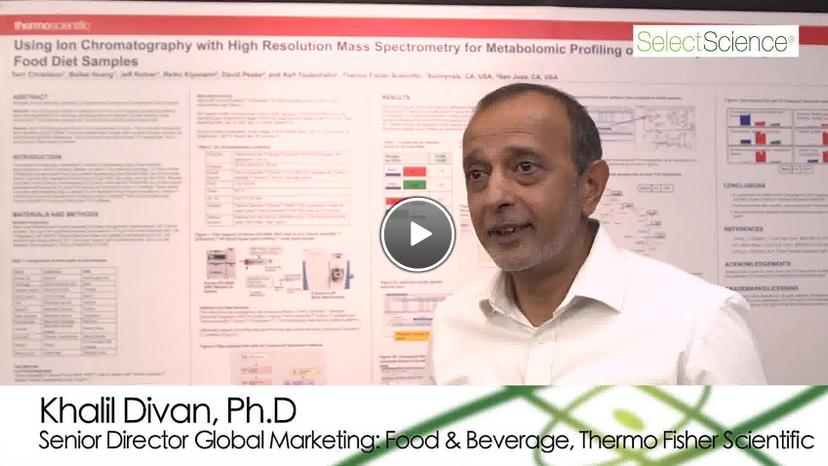
SelectScience® spoke to Khalil Divan, Ph.D, Senior Director Global Marketing: Food & Beverage, Thermo Fisher Scientific, to hear how his colleagues are investigating polar metabolites in a variety of foods. To carry out this type of investigation, Dr Divan believes that IC-MS, specifically anion exchange chromatography, coupled with high resolution accurate mass spectrometry, is the most effective technology for sensitive and selective analysis of polar metabolites.

The influence of factors such as diet, lifestyle and disease can be studied by analyzing the metabolites present in various foods, as they provide information on the biochemical and physical state of an organism. Dr Divan explained that, as part of an experiment conducted by Terri Christison in Sunnyvale, California, three types of food samples were investigated, representing three different diets: low animal protein, high fish & vegetables, and high beef, sugar & fat.

Separation was performed using the Thermo Scientific™ Dionex ICS-5000+ Reagent-Free HPIC System followed by detection with the Thermo Scientific™ Q Exactive™ HF Hybrid Quadrupole-Orbitrap™ Mass Spectrometer, Dr Divan explained, which he believes is “the best technology for separating ionic compounds and identifying them”. Following detection, the small polar molecules were identified using the Thermo Scientific™ Compound Discoverer™ Software, he added.

This method was selected due to proven success of IC-MS for the purpose of polar compound analysis. The diet groups targeted were selected to provide an accurate representation of three distinctly different diet types, enabling them to better understand how each diet is likely to relate to metabolomic disturbances.

To conclude, Dr Divan commented that “high resolution accurate mass is the ultimate technique for looking at these ionic compounds”. The results of the experiment confirmed that IC coupled with HRAM provided a superior method to other LC methods to resolve small polar metabolites, and demonstrated that the food groups had significant differences that could impact metabolomic cycles and health.

Watch the full video and more interviews from the AOAC 2016 Annual Meeting.

Use any of these instruments for your research? Leave a product review today and help other scientists conducting research in your field.

Links

Tags

Ion ChromatographyIon chromatography, also known as ion exchange chromatography, is a high-performance liquid chromatographic technique used for the separation and identification of ions or polar molecules in a sample, including proteins, nucleotides and amino acids. Equipment includes ion exchange columns, ion exclusion columns, ion chromatography systems, pumps, and detectors. Find the best ion chromatography equipment in our peer-reviewed product directory: compare products, check customer reviews and receive pricing direct from manufacturers.Mass SpectrometryMass spectrometry (MS) is a powerful analytical technique used to identify and quantify molecules based on the mass-to-charge ratio of gas-phase ions. It provides detailed information about the structure, composition, and properties of compounds and is widely used across fields such as environmental monitoring, materials science, drug discovery and development, food and beverage testing, and wider chemical research. Key MS techniques include tandem mass spectrometry (MS/MS), liquid chromatography–mass spectrometry (LS-MS) and inductively coupled plasma (ICP-MS). Choosing from these wide range of techniques and technologies can be a daunting task, so keep up to date with scientific applications, performance expectations, and customer reviews here all in one place. Visit our product directory to receive quotes direct from the manufacturer. MetabolitesMetabolites are the intermediate and end products of metabolism. Analyzing metabolites offers insight into cellular processes and disease mechanisms and is critical in fields like pharmacology, toxicology, and diagnostics. Explore our peer-reviewed product directory to find the best tools for metabolite analysis, compare products, check reviews, and get pricing directly from manufacturers.MetabolomicsMetabolomics is the study of small metabolites (the intermediates and products of metabolism). It involves the identification and quantification of cellular metabolites using analytical technologies such as GC, HPLC, NMR, and LC/MS.ChromatographyChromatography is a powerful technique used to separate and analyze components of mixtures based on their chemical properties. It is widely used in fields like biochemistry, pharmaceuticals, and environmental analysis. By exploiting differences in the interaction of substances with a stationary phase and a mobile phase, chromatography enables precise purification and quantification of compounds. Whether you're working with complex biological samples or industrial chemicals, chromatography is essential for obtaining high-quality results. Browse our peer-reviewed product directory to find the best chromatography systems, compare products, read customer reviews, and get pricing directly from manufacturers.Food TestingFood testing refers to a variety experiments including PCR, mass spectrometry, processing, QuEChERS, analyzing and Kjeldahl.