7 Hot New Technologies for Cancer Research

SelectScience reports from the American Association for Cancer Research (AACR) annual meeting in Philadelphia

26 Apr 2015
David Perrett
Other (please specify)

Editorial article

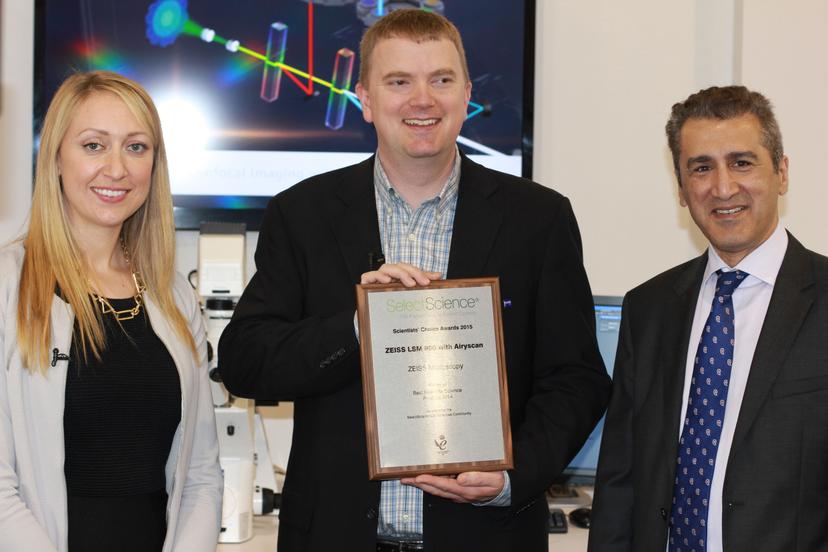
Kerry Parker, Editor-in-Chief of SelectScience (left), and Arif Butt, CEO of SelectScience (right), presented the Scientists' Choice Award™ for Best New Life Science Product of 2014 to Joseph Huff, ZEISS' Product Marketing Manager for Laser Scanning & Superresolution Microscopy

1. ZEISS LSM 880 With Airyscan Wins Life Science Scientists' Choice Award™

SelectScience has announced the ZEISS Microscopy ZEISS LSM 880 with Airyscan as the winner of the 2015 Scientists’ Choice Award® for Best New Life Science Product of 2014.

2. New Data Recognizes EKF PointMan Technology for Assessing Lung Cancer Mutation Status – EKF Diagnostics

EKF Diagnostics has announced that its PointMan™ DNA enrichment technology has been identified as an easy and useful method for non-invasively determining plasma EGFR T790M mutation status in late stage lung cancer patients.

3. First All-in-One Spectrophotometer/Fluorometer System– Denovix

DeNovix Inc. launched the DS-11 FX+ Spectrophotometer / Fluorometer at this year’s American Association of Cancer Research (AACR 2015) meeting.

4. Early Detection of Ovarian Cancer: Medical University of Vienna Demonstrates ‘Blood Biopsy’ Technology – ANGLE plc

Researchers from the Medical University of Vienna presented a scientific poster at the American Association of Cancer Research Annual meeting, detailing a protocol combining the novel microfluidic Parsortix™ technology with qPCR, to enable the molecular analysis of circulating tumor cells (CTCs) implicated in ovarian and breast cancer.

5. Mantra™ Quantitative Pathology Imaging System for Cancer Immunology Research – PerkinElmer

PerkinElmer, Inc. announced its wide range of cancer research solutions at the American Association for Clinical Research (AACR) Annual Meeting 2015, including Mantra™ Quantitative Pathology Workstation with inForm® Advanced Image Analysis Software.

6. Real-Time PCR Systems Connect Researchers in the Cloud – Thermo Fisher Scientific

New real-time PCR systems that fully integrate with cloud computing technology, such as Applied Biosystems QuantStudio 3 and QuantStudio 5 Real-Time PCR systems, mark a new era in data sharing and global research collaboration.

7. New XFp Cell Energy Phenotype Test Determines Metabolic Potential – Seahorse Bioscience

Seahorse Bioscience introduced the XFp Cell Energy Phenotype Test Kit, which enables a unique real-time assay on live cells that determines their baseline metabolic phenotype and potential.

Links

Tags

PCR and Thermal CyclingPolymerase chain reaction (PCR) kits and thermal cyclers are used for the in vitro amplification of DNA permitting subsequent analysis and experimental procedures. Explore a range of high-quality polymerase, primers and nucleotides or simplify your workflow with a PCR mastermix. Find reverse transcription PCR (RT-PCR) and cDNA synthesis kits for RNA products and libraries. Quantitatively measure the amplification of DNA with real-time PCR (qPCR) and droplet digital PCR (ddPCR) kits and systems, and discover automated PCR setup solutions to increase throughput. Alternative DNA amplification methods also include recombinase polymerase amplification (RPA) kits. Find the best PCR kits and thermal cyclers and purification equipment in our peer-reviewed product directory: compare products, check customer reviews and receive pricing direct from manufacturers.Clinical ChemistryBiochemistry (or clinical chemistry) involves the analysis of bodily fluids using chemical tests. Techniques used include HPLC, chromatography, spectroscopy, mass spectrometry, immunochemical, electrophoresis, turbidometric / spectrophotometric assay, MRI and ISE analysis. Tests are often carried out on plasma or serum but urine (urinalysis) and fecal specimens are also processed.Clinical GeneticsMolecular Genetics covers the analysis of hereditary genetic disease and chromosomal abnormalities. Genetics can be analysed using DNA, RNA, and protein microarrays, PCR, RT PCR and DNA sequencing. Genetic equipment includes genetic workstations, thermal cyclers, cooling blocks and electrophoresis products. Diagnostic kits are used for DNA / RNA extraction and purification.Clinical MicrobiologyMicrobiology is the study of microorganisms including protists, prokaryotes, fungi, and, often, viruses. Microorganisms are a useful research tool as genetic vectors and, in immunology, for antibiotic susceptibility testing, cellular biology and genetics. Microorganisms commonly grow readily in incubators with microbial culture media; this can contain chromogenic supplements to differentiate between cell lines. Estimate your culture’s density of microorganisms with colony counters, or screen and select colonies for desirable clones with automated colony pickers. Additionally, equipment is available to monitor environments for the presence of microbes and identify with microbial identification instruments. Find the best microbiology products in our peer-reviewed product directory: compare products, check customer reviews and receive pricing direct from manufacturers.Light MicroscopyLight microscopes or optical microscopes are used to visualize microscale objects under magnification, including cells, clinical specimens and materials. Lab equipment for light microscopy includes confocal microscopes, fluorescence microscopes, zoom and stereo microscopes. Microscope slides and imaging reagents are available for visualizing samples, as well as various microscope stages and incubators for large or temperature-sensitive samples. Find the best light microscopes in our peer-reviewed product directory: compare products, check customer reviews and receive pricing direct from manufacturers.Cancer ResearchAlthough cancer is often referred to as a single condition, it actually consists of more than 100 different diseases. Microscopy, mass spectrometry, high throughput sequencing and flow cytometry are some of the most common techniques employed in cancer research labs.Cancer DiagnosticsThere are a wide variety of diagnostic tests for cancer available, and this range continues to expand as our knowledge of cancer improves. Current diagnostic methods include biopsy, imaging and blood tests for known biomarkers. New methods in research development include liquid biopsies and cancer breathalyzers.AACRThe American Association for Cancer Research (AACR) is a leading organization focused on cancer research and treatment. It provides a platform for scientists, healthcare professionals, and industry leaders to share knowledge and collaborate in the fight against cancer.
7 Hot New Technologies for Cancer Research