
The HyPix-3000 Shows High-Speed Performance in Impressive Display
The detector managed to determine the precise temperature range for the melting point of aliminium during a rapid-heating experiment
5 Mar 2019Rigaku Corporation has published an application report demonstrating the performance of the Rigaku HyPix-3000 hybrid pixel array multi-dimensional detector in the shutterless measurement of 2D X-ray diffraction images.
To capture the moment when materials change, such as during melting, solidification or crystal phase change, by in-situ X-ray diffraction measurement, the acquisition time of the X-ray diffraction images at each temperature needs to be as short as possible. 0D and 1D detectors take time to scan the detector and prepare for operation, while conventional 2D detectors require the X-ray shutter to be opened and closed between counting and reading the data.
The HyPix-3000 detector in 2D mode can acquire X-ray diffraction images without scanning the detector. The HyPix-3000 detector has two counters inside. Switching between them allows measurement without dead time and enables shutterless measurement of 2D X-ray diffraction images, which makes it possible to observe rapid changes in crystalline state.
The HyPix-3000 hybrid pixel array detector is available on the new Rigaku SmartLab intelligent multipurpose X-ray diffractometer and, coupled with the new PhotonMax high-flux 9 kW rotating anode X-ray source, allows all applications to be handled with a single detector, eliminating the need to prepare and switch individual detectors for different applications.
Rigaku Application Note B-XRD 1105 - “High-speed in-situ measurement of Al metal melting process” – details the recording of 2D X-ray diffraction images of an aluminum plate sample. Images were recorded every 0.5 seconds while rapidly increasing the temperature at 300˚C/min.
Continuous Debye rings - concentric diffraction rings obtained from polycrystalline thin films - from the aluminum plate were observed at room temperature, revealing that the aluminum crystal had fine grains before heating. During the increase in temperature, the Debye rings became dotted, indicating that grain growth occurred due to heating. When the temperature was increased even further, the Debye rings eventually disappeared due to the melting of the aluminum. It was confirmed that there was a temperature range where the continuity of the Debye rings increased just before melting. This was the moment when the grain boundaries of the aluminum melted, and the liquid phase and minute crystal grains coexisted.
Related Products
Request Quote for All Products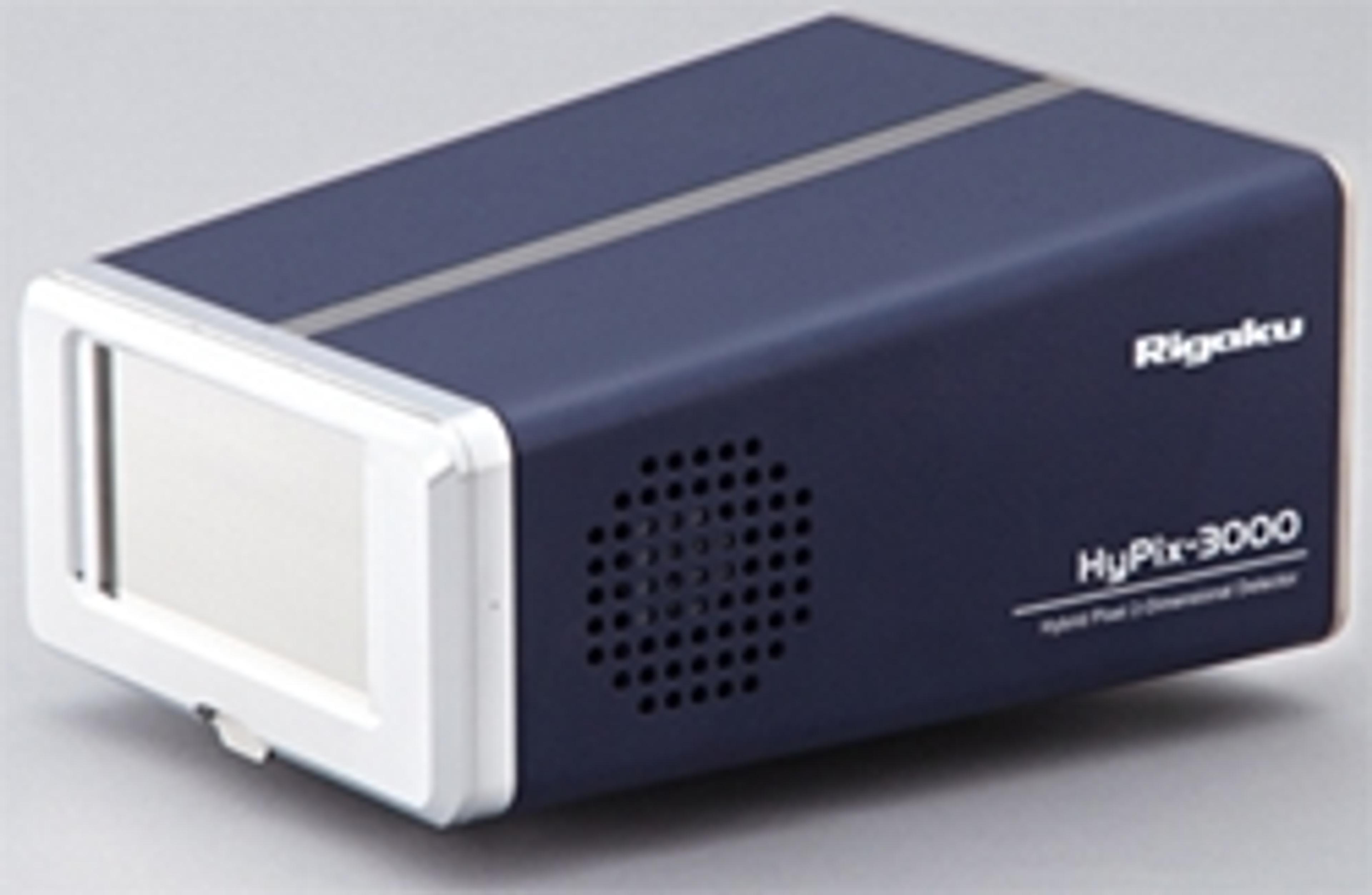
HyPix-3000 2D Hybrid Pixel Array Detector
Rigaku CorporationRigaku’s HyPix-3000 is a next-generation two-dimensional semiconductor detector designed specifically to meet the needs of the home lab diffractionist. One of the HyPix-3000’s unique features is its large active area of approximately 3000 mm² with a small pixel size of 100 μm², resulting in a detector with high spatial resolution. In addition, the HyPix-3000 is a single photon counting X-ray detector with a high count rate of greater than 10⁶ cps/pixel, a fast readout speed and essentially no noise.Featuring a double-threshold (window) discriminator, the HyPix-3000 has three readout modes that can be selected based on the purpose of a measurement. “Differential” mode can be used to suppress fluorescence from elements in a sample or background derived from cosmic rays. “31-bit” mode is used for experiments in which a very wide dynamic range is needed. “Zero dead time” mode makes it possible to perform extremely fast data collection.The HyPix-3000 was designed for optimal flexibility and minimal maintenance. For example, the compact angular enclosure was designed to allow excellent high angle accessibility. Compared to the design of other types of detectors, the HyPix-3000 is essentially maintenance free. Unlike other types of detectors, it does not require an external cooling device as required on CCD detectors, or gas exchange and anode wire washing as required on multi-wire detectors.Features: Available with Rigaku's SmartLab diffractometer Ultra-high dynamic range and high sensitivity Seamless switching from 2D-TDI (Time Delay and Integration) mode to 2D snapshot mode to 1D-TDI mode to 0D mode with a single detector XRF suppression by high and low energy discrimination High spatial resolution, direct-detection pixel array detector