
Why HUB Organoids are key to advancing personalized cancer therapies
Dr. Sylvia Boj discusses the advantages of organoids and how these 3D tissue cultures have enormous potential to revolutionize how we treat patients and predict therapeutic response
19 May 2020
In this exclusive interview, we speak with Dr. Sylvia Boj, Chief Research Officer at Hubrecht Organoid Technology (HUB), to find out how patient-derived organoids are becoming promising models for personalized treatment. Collaborating with Corning and Yamaha Motor Corporation, Boj aims to develop organoids using state-of-the-art 3D culture technologies to advance our understanding of disease mechanisms, improve drug development, and transform personalized medicine for the better.
Discovering the third dimension
In 2008, Dr. Nick Barker at the Hans Clevers Laboratory identified that Lgr5 (leucine-rich repeat-containing G protein-coupled receptor 5) was a unique marker of adult stem cell populations. Since then, organoid research has advanced at a phenomenal rate. It was soon discovered that these cell-derived in vitro 3D organ models held remarkable promise for disease modeling, with the potential to help study cell behavior, tissue repair and drug response in an environment that mimics real-life clinical situations. A whole array of organs and tissues can now be recreated from stem cells, mimicking the genetics and cellular makeup of their source material to model human disease.
Since the Lgr5 discovery, the Clevers Lab has continued to develop new in vitro models to improve drug development and understanding of patient response, with the aim of translating the technology over to industry through its spin-out company, Hubrecht Organoid Technology (HUB). “We began to develop models via samples taken from the small intestine of a mouse,” says Boj. “We have now developed our processes using human tissue, producing liver, pancreas, breast, lung, and ovary organoids. We grow and send HUB Organoids to our international customers throughout the world, and we continue to maintain a small collection of animal models for our toxicology program.”
The path to personalized medicine
As science advances, so does the number of treatment options available to patients, yet it remains difficult to predict which patient will be sensitive to which treatment. The ability to grow patient-derived organoids mimicking the biological features of a patient’s tissue makes it possible to test an array of drugs and observe how those cells react. For this reason, hospitals and pathology departments across Europe have chosen to collaborate with HUB, which now receives samples ranging from rectal and needle biopsies to tumor lesions.
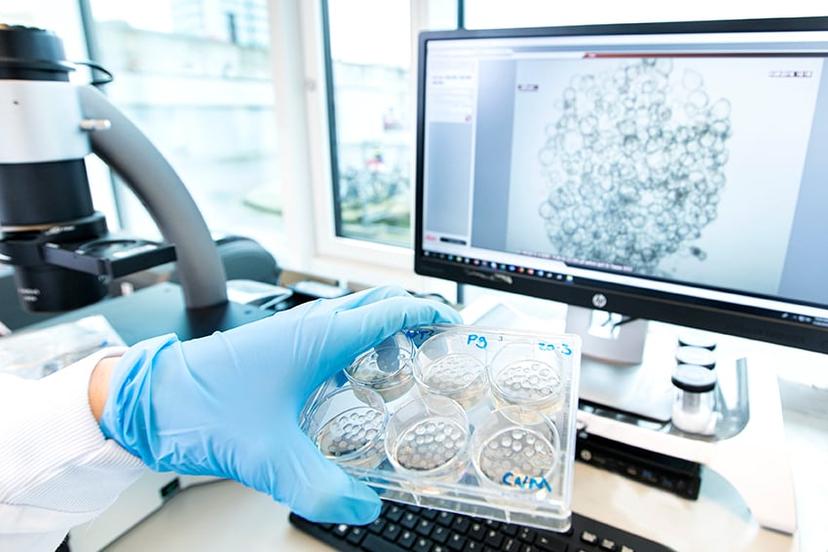
“As soon as we receive a sample from a hospital, the sample is processed. My team dissociates the cells and isolates the epithelial cells,” says Boj. “Once isolated, the cells are transferred onto a culture plate, and in a matter of days, we can physically observe the organoids. Depending on the tissue type, the sample quantity and quality and the disease model, we can generate enough organoids to create a master cell biobank within weeks of receiving a patient sample.” While intestinal models, for example, usually take two to three weeks, other models can take up to 12 weeks.
“After the identification of a tumor, we need to be able to quickly generate organoids and perform a screen,” continues Boj. “Doctors need to treat the patient with the most effective treatment between four and six weeks after diagnosis.” Despite the short deadlines, the team at HUB has succeeded in meeting this target for some cancers, but not all. “Another significant challenge of ours is to predict patient response,” Boj continues. “Genetics does help identify certain treatments based on genetic landscape and mutation presence, however, the same mutation present in another patient does not necessarily mean that you can predict patient response. We now observe organoids from a range of patients suffering from the same mutations and we carefully observe the difference in response.’’
Favored by researchers
As organoid research develops, many researchers are beginning to favor their use as an in vitro model. Boj explains: “HUB Organoids represent heterogeneity and are able to maintain different clones that are present within a tumor. Undesirably, these clones are difficult to maintain in a 2D cell line, as they only represent one clone of the tumor.” And there are other advantages too. Boj continues: “An important aspect of organoid development is that we are able to grow healthy tissue. The ability to grow healthy tissue has significant benefits, helping researchers explore the effect drugs have on normal cells and their potential side effects.” This enables HUB to investigate patient response variability on a large scale.
HUB Organoids do share similarities with patient-derived xenotransplants (PDX models), as relevant clinical models. However, PDX models can take time to develop and be costly. “HUB Organoids do display better efficiency compared to PDX models, since PDXs are produced within mouse models and are more complex,” says Boj.
Collaboration success
As 3D cell cultures rise in popularity, they bring about new challenges in the lab — specialized facilities, technologies and techniques are needed to ensure optimum organoid growth, efficiency and maintenance. In order to reduce the number of organoids required to effectively perform a screen and predict patient response, Boj and her team have joined forces with Yamaha Motor Corporation to explore and validate the CELL HANDLER™ technology. “The CELL HANDLER is helping us standardize all our procedures by generating reproducible and robust data from the screens we are performing. The handler has really helped us reduce the number of organoids we need to perform our screening procedures,’’ states Boj.
Also key to HUB’s organoid success is Corning® Matrigel® Matrix. “We have chosen to work closely with the products Corning produce. Matrigel Matrix facilitates the optimum organoid growth necessary,’’ says Boj. “The extracellular matrix provided by Corning has allowed us to save valuable time by not having to test every batch we receive.’’ Boj and her team have found that the Matrigel consistently provides robust and reliable results and would recommend the product to other scientists working within organoid research. “We found that the organoids grew faster and better using the Matrigel Matrix,’’ she adds.
Future outlooks
There is no doubt that Boj and her team have made significant developments in the field of personalized medicine, contributing not only to better treatment outcomes, but also the identification of new monogenetic diseases. Looking ahead, the team at HUB will continue to push scientific boundaries to better reproduce and mimic patient response by investigating host-microbiome interactions and continuing to save lives, one organoid at a time.
For more on the latest developments in cancer research, visit our feature page >>
Related products
Request Quote for All Products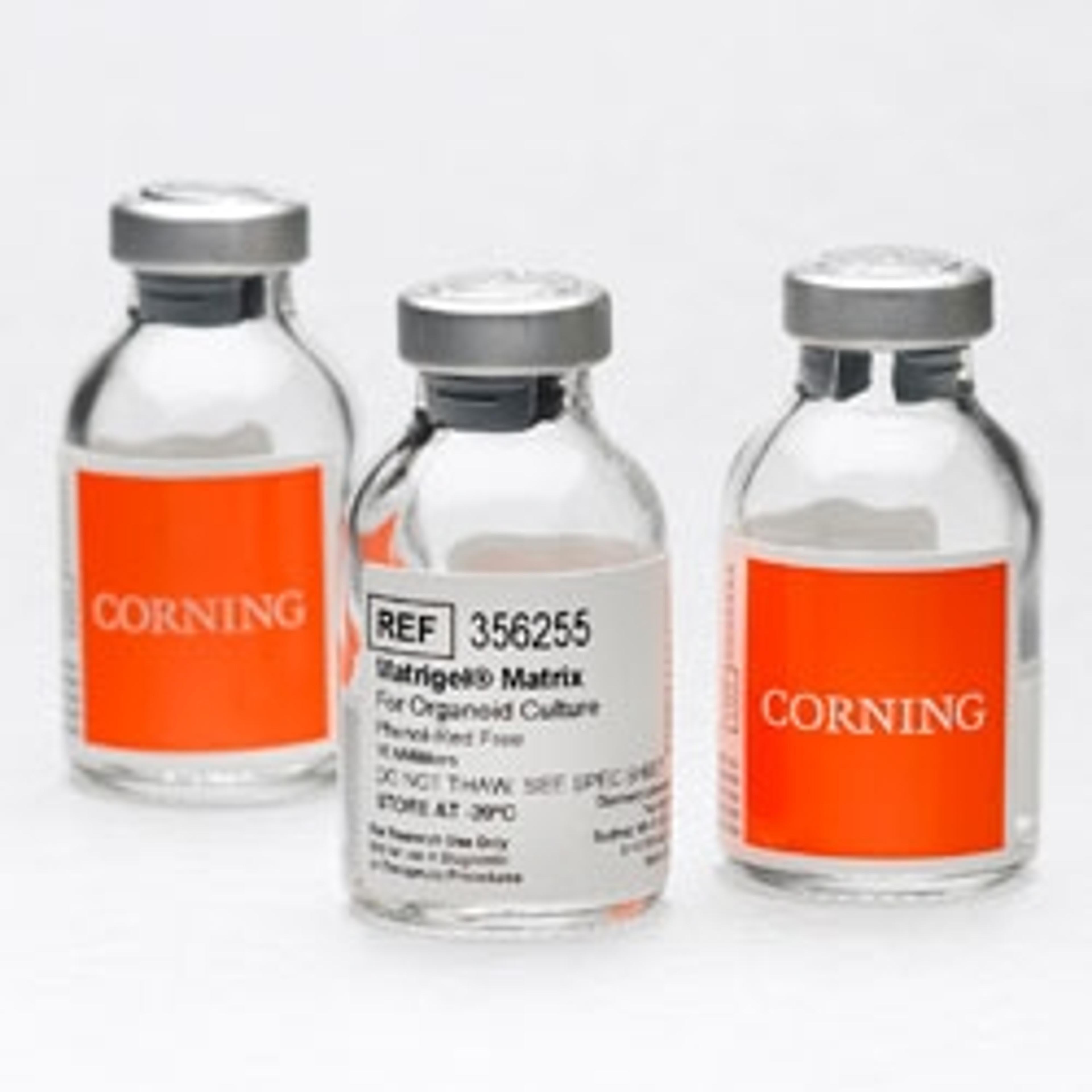
Corning Matrigel Matrix for Organoids
Corning Life SciencesAn optimized extracellular matrix that provides a convenient, ready-to-use solution, verified to support organoid growth and differentiation