
Olympus cellFRAP: High-Speed Photomanipulation for Fast In-Vivo Processes
Olympus introduces its new cellFRAP imaging platform for the acquisition, monitoring and analysis of dynamic in-vivo processes by photomanipulation techniques
7 Sept 2015Enabling the easy addition of photomanipulation techniques to imaging platforms, Olympus has launched a new cellFRAP deck system for the popular IX3 ‘open source concept’ IX83 and IX73 microscopes. Designed with researchers in mind, the easy-to-use platform delivers highly accurate and flexible live-cell photomanipulation, with excellent optical performance and µsprecise control.
Capturing fast in-vivo processes is possible thanks to the highest spatial and temporal resolution. Driven by the Olympus Real-time controller, the cellFRAP system achieves an unrivalled short switchover time of only 200 µs between bleach and post-bleach acquisition. This ensures detection of the initial, and most valuable, sample response after stimulation. Interactive and precise positioning of the bleaching region across the full field of view (FOV) is possible according to individual requirements, where unlike conventional widefield-based FRAP systems, Olympus’ cellFRAP employs a diffraction-limited laser spot. This ensures that photomanipulation reaches every point in the FOV without needing to move the sample.
Seamless integration into cellSens imaging software enables easy set-up and control of experiments. A straightforward auto-calibration wizard makes it easy to adjust the scanner to the camera, while using the cellFRAP solution in the cellSens Graphical Experiment Manager provides intuitive system set-up and experiment control. This ensures excellent flexibility in experiment design and perfect synchronization for maximum speed performance.
The cellFRAP system enables users to easily extend their imaging platform with photomanipulation capabilities, and the availability of compatible accessories for the IX3 microscopes allows photomanipulation experiments to be set-up in combination with other high-end systems, for example, spinning disk or TIRF.
Related products
Request Quote for All Products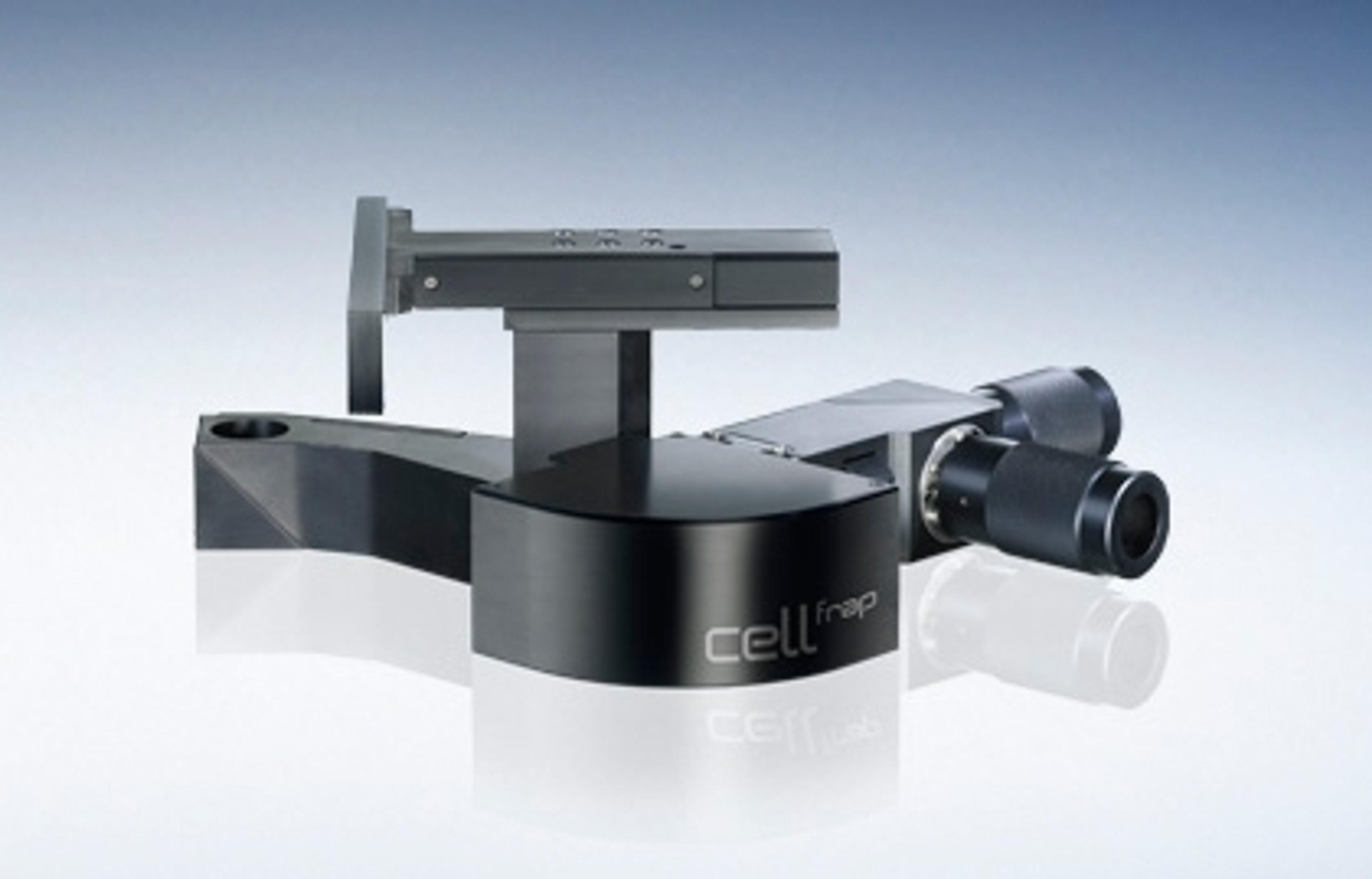
cellFRAP - Photomanipulation solution for Olympus imaging systems
EVIDENTThe cellFRAP system provides a versatile platform for a wide range of experimental needs, from basic bleaching to advanced protocols including FRAP, iFRAP, FLIP and FLAP. The system is also ideal for processes such as photo−conversion, photo−activation, pattern bleaching, laser cutting and trapping. An independent light path enables simultaneous imaging and bleaching and the module integrates seamlessly with other imaging modules and laser options. Intelligent scanning modes enable much faster bleaching rates than standard methods and facilitate accurate bleaching of very small structures. Features: From bleaching to photo−conversion - Users can control each setting for a broad range of procedures, including inverse FRAP, FLIP, FLAP, photo-activation, photo-conversion and photo-switching with multiple regions of interest. Optically advanced - The Olympus xcellence cellFRAP system uses an independent light path, which enables simultaneous fluorescence imaging and bleaching. Pattern bleaching - The cellFRAP system is capable of bleaching a large number of points in a defined pattern at high speed. Combined with diffraction limited optics, this method provides a useful and attractive alternative to fluorescent speckle microscopy (FSM). Rapid synchronisation - The Olympus cellFRAP module is capable of incredibly fast switching between bleaching and image capture, matching the requirements of all kinds of photomanipulation experiments. Flexible laser options - Can be integrated with two separate laser channels or a multi-laser combiner, providing excellent flexibility. Combined with UV-compatible optics, this gives the user an unmatched level of flexibility when it comes to laser and fluorophore choice. Intelligent scanning modes - By scanning only the region of interest, bleaching is achieved at a rate up to ten times faster than standard methods, and multiple areas within the same frame can be bleached very quickly. Sub−cellular laser cutting - The unique optical path employed by the system enables the use of pulsed lasers to cut cellular components such as growth cones and filopodia as well as intracellular structures such as actin fibres, microtubules, ER and mitochondria.