
New software solutions are rewiring formulation science
From smarter data capture to predictive analysis, next‑generation R&D data platforms are streamlining complexity and accelerating decision‑making across the lab
24 Mar 2026

Jun Liu, Global Marketing Manager, Revvity Signals Software
Formulation science underpins every successful product development. A breakthrough molecule still needs to be delivered efficiently, remain stable, and reach its target to have any real impact. Leveraging the overlap between formulation and data science helps organizations meet these demands and stay ahead in an increasingly competitive marketplace.
Running the risk of falling behind
Across multiple chemistry related industries, formulation scientists are under enormous pressure to create products that are not only safe, effective and low cost, but also that meet tight industry timelines, perform better than competitors’ products, and can be manufactured and packaged sustainably. Formulation scientists are expected to meet these goals repeatedly, but many of them are still working with tools that haven’t fundamentally changed in decades.
“The biggest risk is that organizations slowly grind themselves down without realizing it. When formulation work still lives across spreadsheets, disconnected electronic lab notebooks, instrument folders, and email threads, scientists spend more time hunting for data than learning from it. That slows iteration, delays scale-up decisions, and ultimately extends product development timelines,” says Jun Liu, Global Marketing Manager, Revvity Signals Software.
The issues impact more than timelines. There’s a major scientific risk involved, as data may get captured without enough context. This means that the meaning behind the results gets lost. Also, if researchers cannot find the prior work, or analyse it in the right context, they may need to repeat experiments or could miss subtle but important insights. Over time, institutional knowledge can be lost, not because it wasn’t captured, but because it wasn’t captured in a usable, structured way.
“These issues make it hard for many companies to compete on speed, cost and innovation. It also leaves them unprepared or unable to take advantage of scientific AI, because this depends on high-quality, connected data,” explains Liu.
Hacking to bridge the gaps
Teams of formulation scientists have access to useful software, for example for capturing data or running statistics, but the lack of connections between the tools leads to gaps in the product development process, from analysis and comparison, through experimental design, to decision-making.
To compensate, teams may ‘hack’ their way forward, for example by exporting data into spreadsheets to compare formulations, building homegrown databases to track ingredients, or relying on shared drives and text messages to keep everyone aligned.
“While these workarounds may help in the short term, they can introduce errors and version control issues. They also require a lot of manual effort. Over time, the workaround becomes the workflow, and that’s where scalability breaks down,” said Liu.
Bringing in the power of AI

Revvity Signals Software solutions empower scientists and decision-makers to gain critical insights from data analytics, accelerating informed decisions.
Liu spends his time translating real scientific pain points into practical digital solutions, and just as importantly, helping organizations understand why modern R&D data management isn’t just an IT upgrade, but a competitive advantage.
“To achieve this, I work at the intersection of formulation science, digital R&D workflows, and business strategy. I help R&D teams to move away from fragmented, manual ways of working and towards more connected, data-driven formulation processes that actually scale,” Liu added.
Liu’s goal is to enable scientists to spend more time doing R&D and less time managing data.
“When workflows are well designed and data is structured, connected, and accessible, teams make better decisions faster, and that directly impacts innovation speed, product quality, and business outcomes,” said Liu.
This approach is backed by Revvity Signals Software, a connected R&D data platform powered by AI. The aim is to turn everyday experimental work into structured, connected knowledge.
Signals One™, an intelligent R&D data management platform, has been designed to provide an end-to-end R&D workflow solution for drug discovery, materials, and food science. It provides data capture and collaboration, data processing, and data-driven analytics in one place.
“Instead of treating data capture, analysis, and collaboration as separate steps, Signals One brings them together in a single, unified environment. Experiments are documented with context, ingredients and variations are structured, and results are immediately analysable,” said Liu.
This is supported by AI capabilities such as intelligent search, summarisation, and predictive modelling to help scientists to access and use their data.
“Rather than just storing results, the platform makes them findable, comparable, and ready for insight generation. The net effect is that teams move faster, learn more from what they already know, and are finally positioned to take advantage of AI — not as a buzzword, but as a practical, day-to-day accelerator for formulation science,” said Liu.
Breaking through data and culture barriers
There are a number of barriers, both cultural and technical, that are preventing organizations from moving toward fully digital, AI-powered formulation environments, as Liu explains:
“Technically, legacy systems are a big hurdle. Data lives in silos, formats vary wildly, and there’s often no consistent metadata or structure. That makes integration hard and AI nearly impossible to scale. Even when companies want to modernize, connecting instruments, electronic lab notebooks, analytics, and automation can feel overwhelming. Culturally, change is often harder than technology. Scientists may be sceptical of new tools, especially if past systems slowed them down instead of helping. There can also be gaps in data literacy, uncertainty around AI trustworthiness, and concerns about governance, IP, or compliance. Without clear leadership and a focus on making scientists’ lives easier, not more complicated, digital transformation tends to stall.”
Simplifying complexity
Looking into the future, Liu sees the value of AI and automation to change the daily experience of a formulation scientist:
“In the next few years, formulators won’t start their day by digging through files or asking colleagues if something’s been tried before. They’ll start with software that already understands their data. AI will pull out relevant past projects and experiments, suggest promising formulation ranges, and highlight trade-offs before a single experiment is run,” he explains.
Liu sees formulation science as becoming less transactional and more strategic, with scientists designing experiments with structured templates that automatically connect to historical data. This will allow them to spend more time thinking critically and creatively, and far less time managing data.
“Results will flow in directly from instruments, already contextualized and ready for analysis. Instead of manually comparing dozens of trials, AI will help scientists to identify patterns, predict outcomes, and recommend next steps. All of this will make collaboration feel more natural, as everyone will be working from the same live data, not copies,” said Liu.
Related products
Request Quote for All Products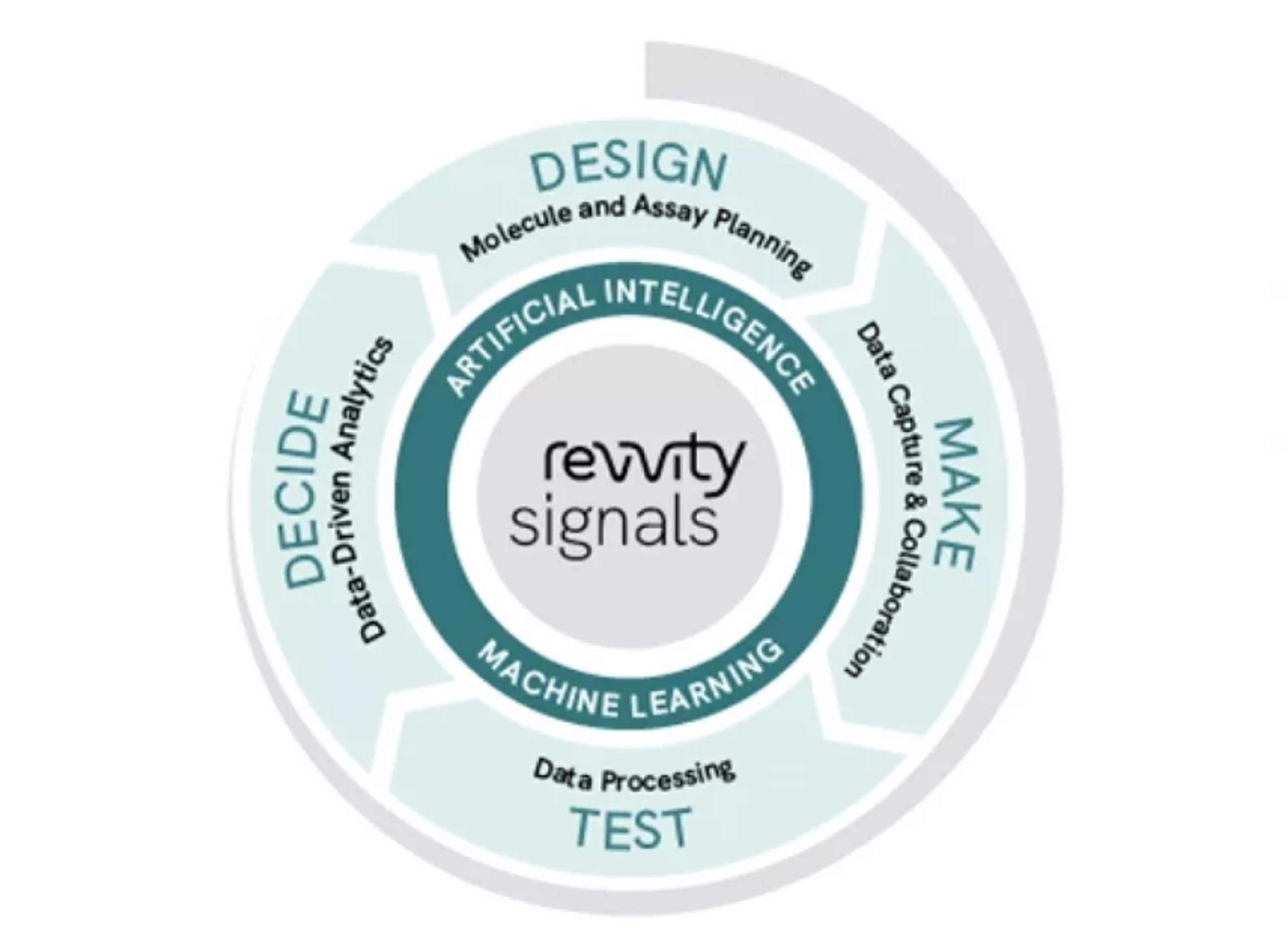
Signals One™
Revvity SignalsMake your innovations a reality with the first unified, cloud-native SaaS R&D solution that streamlines scientific complexity and promotes collaboration.