
Monitoring Contamination Through Environmental Soil Testing at Stanford University
SelectScience® spoke to Dr Guangchao Li, Technical Director of the Environmental Measurements Facility at Stanford University, about the technology enabling his research
6 Jul 2016
Dr Guangchao Li, Technical Director of the Environmental Measurements Facility at Stanford University discusses cutting-edge technology
Environmental soil testing and analysis is a reliable way to monitor environmental contaminations, from heavy metals to persistent organic pollutants. The Environmental Measurements Facility, managed by Dr. Guangchao Li, allows students and researchers from the Stanford University to perform accurate and precise analysis on a range of environmental soil, mineral and water samples. SelectScience spoke to Dr Li about technology at this cutting-edge facility.
At the facility, “users analyze soil and mineral samples at the same time as water samples”, explained Dr Li. When users bring samples to the facility, “we can analyze samples for them, or we can train them so they analyze the samples by themselves”. When it comes to sample preparation, the degree of difficulty varies. Generally, the two most common methods are solid phase extraction or a sample digestion. “Some soil samples can be a problem because they are very hard to digest”, Dr Li revealed. “We have to use a pretty strong acid such as nitric acid or hydrochloric acid, hydrofluoric acid – we try to minimize the use of these substances as they are very toxic or dangerous to human beings but sometimes we have to use it.”
Another challenge is that when using chemicals for digestion in high concentrations, “we have to dilute the sample a lot for our ICP analysis, which can lead to the soil concentration to be really low”. Coupling ICP with ion chromatography can overcome this problem – “combined together, these instruments help a lot with our environmental measurement”. “Our technicians spend time improving our methods so they are very robust”, Dr Li explained, “which can be very challenging”.
“Three instruments we use a lot in the labs are a Thermo ICP-MS XSeries II, a Thermo ICP-OES, which is the iCAP 6500, and a Thermo Dionex Ion Chromatograph”. Some elements, such as arsenic, can exist in many forms, such as arsenic III or arsenic V – “it is important to find out what the form is because they have different toxicities, so we have to couple different instruments together to get our measurements” revealed Dr Li.
For environmental research, Dr Li explained, “new instruments will help - sometimes there are certain analyses that need to be done, or a new result is needed, so new technology is needed for new research”. There are lots of instruments at the Stanford’s facility, which are not always “as accurate or as precise as ICP-MS or ICP-OES” – existing technology is “still not perfect”. “If we don’t have to digest or do the extraction of the sample to obtain accurate results– that will be the ideal situation”.
Find out more about environmental soil analysis on our dedicated community page.
Have you used the product mentioned here? What do you use in your analysis? Share your experiences and you could win an iPad!
Related products
Request Quote for All Products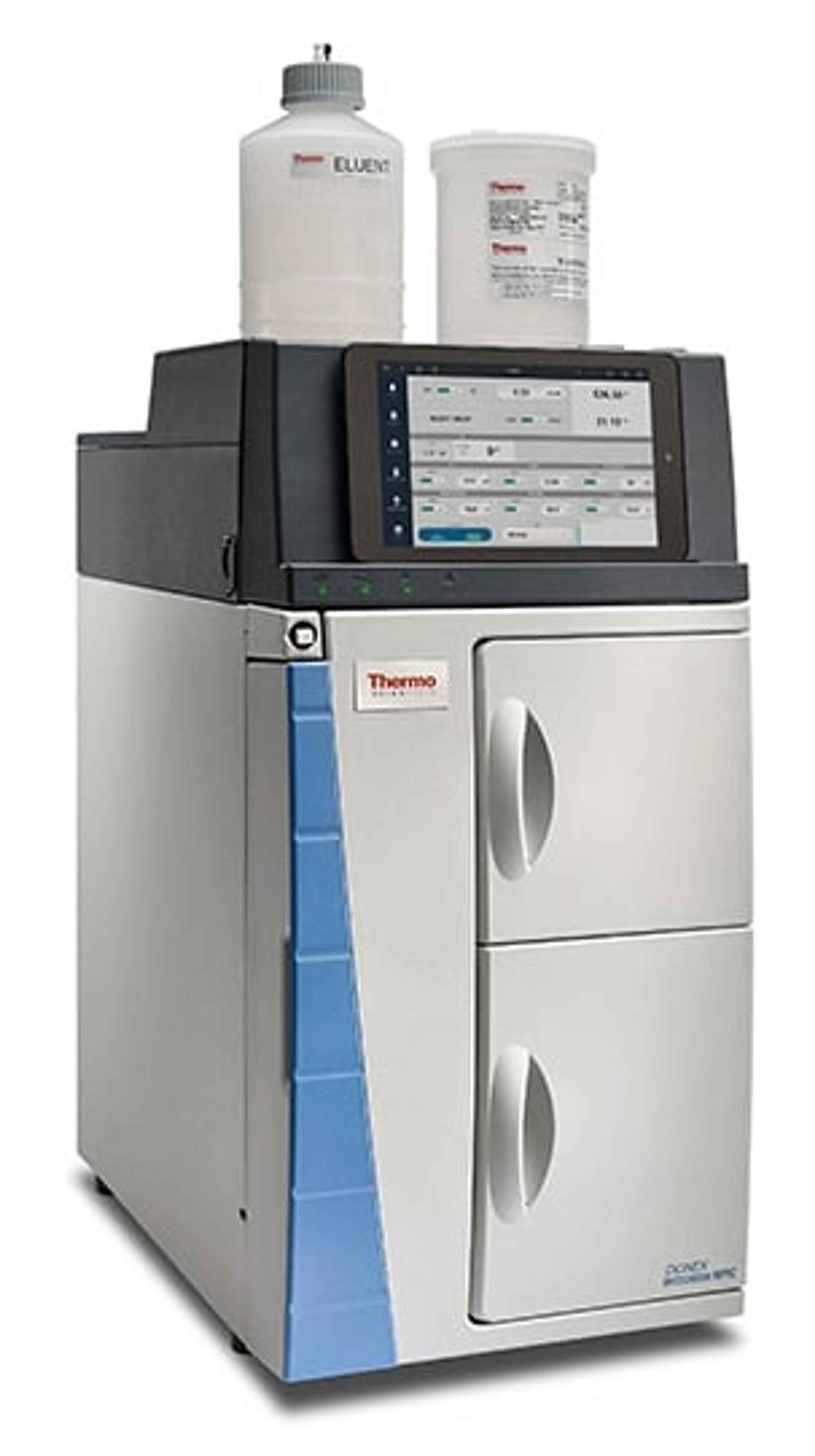
Thermo Scientific™ Dionex™ Integrion™ HPIC™ System
Thermo Fisher ScientificAs an ion chromatographer, the routine IC applications you run give the rest of us the peace of mind to use everyday resources like water, food and beverages, biofuels and pharmaceuticals without a second thought. Using this high-pressure-capable IC system to separate and quantify common ionic pollutants in municipal drinking water and wastewater can provide faster, more cost-effective methods for regulatory compliance testing. Nothing supports you in this role more than your laboratory instruments. The Thermo Scientific™ Dionex™ Integrion™ HPIC™ system is designed to be your reliable lab partner. Features: Simplified plumbing layout with integrated architecture - Layout based on logical flow-path for easy component access in a compact platform with a small physical footprint. Consumables Device Monitor - Provides positive identification of a consumable's performance metrics, preventing consumable installation errors and mismatches by automatically logging consumable use and performance. Detachable tablet with local language support - Flexible access to IC controls that speak your language Upgradeable features - In a fluid market with changing demands, the Dionex Integrion IC system offers a wide range of upgradable components, so it can grow with your needs over time. These include electrolytic sample preparation and electrolytic water purification Automated Eluent Generation (EG™) - Eliminate human errors associated with manual eluent preparation and improve method reproducibility from operator-to-operator and lab-to-lab. The Dionex Integrion IC system brings consistent results to all your applications. In this case, 100 injections of a simple sugar mixture are highly reproducible. Wide range of column support - Choose the column sizes you need for your applications, including smaller-particle-size 4 µm columns that provide faster run times and better resolution. Flexibility – two different models to choose from and option to choose right detector or column format for your application