
FuGENE<sup>®</sup> Transfection Reagents – Meet the Winners of the Roche Transfection Research Award
13 Nov 2007We invite you to meet the winners of the Roche Transfection Research Award at the ASCB 47th Annual Meeting, December 1-5, 2007. Join Roche Applied Science at our booth #705 or at our workshops. Meet guest speakers and other researchers, discuss enabling technologies, and accelerate your own research successes.
Discuss the winners' excellent data on FuGENE® Transfection Reagent:
Sunday, December 2, 1 p.m. - 3 p.m. Washington Convention Center, Booth 705:
Karen Vrijens - Department of Medical Genetics, University of Antwerp,"Preliminary characterization of the Dfna5 promoter region"
Monday, December 3, 1 p.m. - 3 p.m. Washington Convention Center, Booth 705:
Dr. Adriana Estrada-Bernal - Department of Pediatrics, University of Colorado Health Sciences Center,"Myristoylated, Alanine-rich C-kinase substrate phosphorylation regulates WM-1617 cell adhesion"
Participate at the Roche Applied Science Technology Workshop "Enabling Technologies for Transfection and Real-Time Cellular Analysis"
Monday, December 3, 6:15 p.m. – 8:15 p.m.
Washington Convention Center, Room 201
Speakers include:
- Dr. Andrew West, University of Alabama at Birmingham "Iduna mediates excitotoxicity via sequestration of PAR-polymer"
- Dr. Amritha De Croos, Samuel Lunenfeld Research Institute, Mount Sinai Hospital "Regulation of the membrane bound matrix metalloprotease (MT1-MMP) in mechanically stimulated bioengineered articular cartilage"
- Dr. Yama Abassi, ACEA Biosciences Inc. "Using cell sensor impedance technology for real-time label-free cell-based assays"
Hors d’oeuvres and drinks will be provided. Space is limited. Preregister online via the article webpage.
All pre-registrants will be automatically entered in a drawing to win one of three video iPods®.
Related products
Request Quote for All Products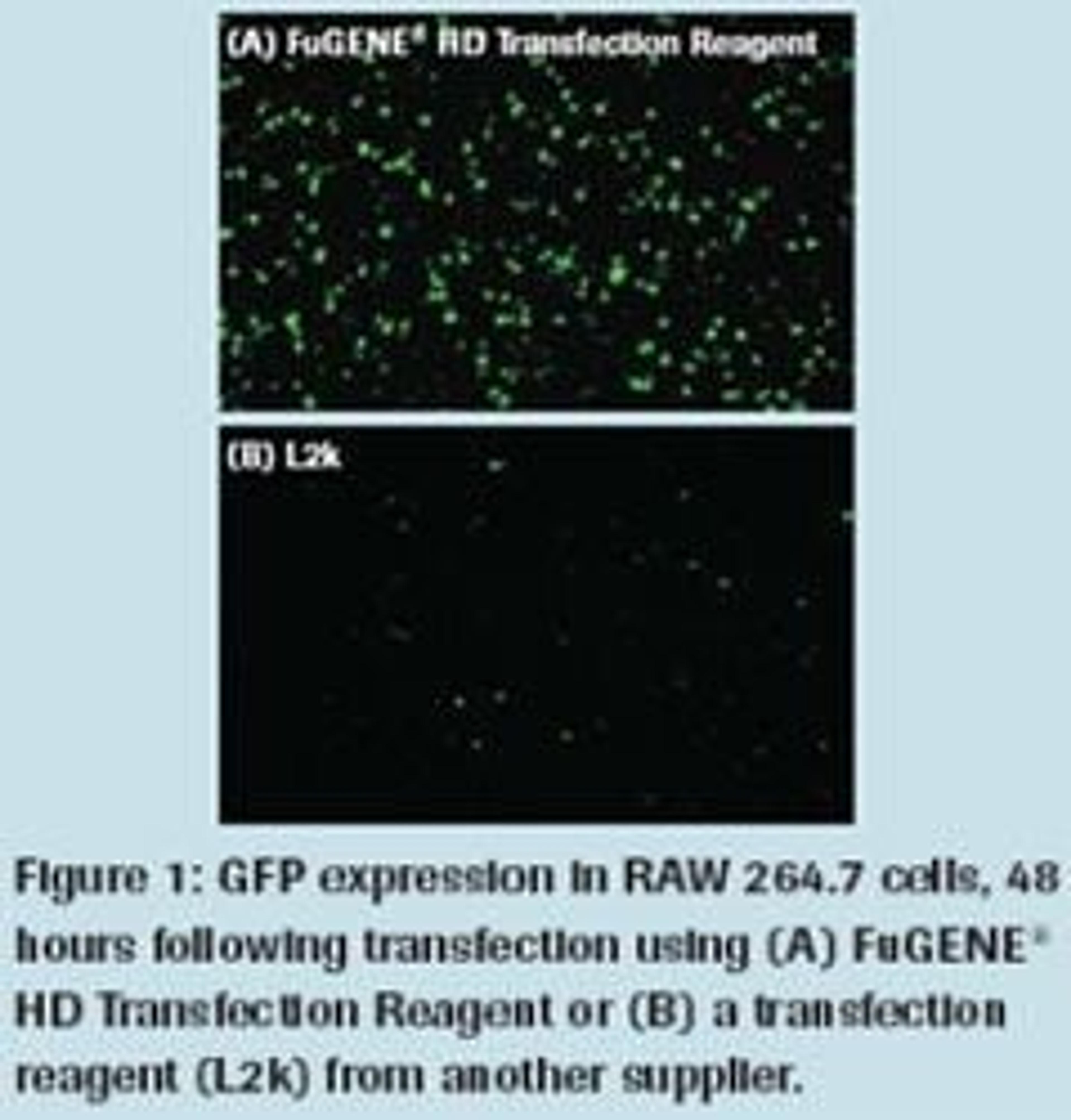
FuGENE® HD Transfection Reagent
Roche FuGENE HD Transfection Reagent is a next-generation transfection reagent, free of animal-derived components. Roche FuGENE HD Transfection Reagent is designed to transfect a wide range of eukaryotic cells, including insect cells and many tumor cell lines not transfected well by other reagents (e.g., MCF7, Hep G2, PC-3, HeLa, MA-10, Hep G2, SH-SY5Y, A7r5, STO, SCC-61, SQ20B, T98G, STSAR-90, A375, A549, and others). In addition, embryonic stem cells are effectively transfected with FuGENE® HD Transfection Reagent.Roche FuGENE HD Transfection Reagent can be successfully used in a variety of applications, such as gene expression analysis and protein production using transiently transfected cells, generation of stable cell lines, generation of retroviruses and lentiviruses, expression of shRNA for Gene Knockdown studies, in drug discovery programs, and for target validation. Features of Roche FuGENE® HD Transfection Reagent: Achieve new levels of transfection efficiency in difficult-to-transfect cell lines, such as RAW 264.7 and many tumor cell lines that are not transfected well by other reagents. Select FuGENE® HD Transfection Reagent for the transfection of stem cells and obtain superior results, as demonstrated in a publication (Biochemica, 4, 2006; 24 – 26) where the reagent was compared with a pool of 37 other transfection reagents. Generate physiologically relevant data you can trust by using a reagent that has exceptionally low cytotoxicity, as measured through the amount of off-target effects and cell proliferation. Obtain higher expression levels of proteins in many adherent and suspension-adapted eukaryotic cell lines (HEK-293, CHO-S, CHO-K1, COS-7) and insect cell lines such as High Five and Sf9, over extended periods with scalability that other reagents cannot provide. Accelerate the move to development by using this unique non-liposomal reagent that is free of animal-derived components, stable at room temperature, sterile (0.1 µm filtered), and active in up to 100% serum. The ability to transfect cells in up to 100% serum provides a good model to mimic biological conditions. Increase experimental throughput and enable target validation by using a stable reagent with a simple, consistent, and fast protocol across a wide range of cell types.