Experts explore how next-generation sequencing is evolving to open new possibilities in disease research
In our SelectScience NGS Forum, genomics leaders discussed the challenges and opportunities driving the next chapter of next-generation sequencing
13 Feb 2026
In a recent SelectScience® Forum, held in partnership with SPT Labtech, three leading experts in next-generation sequencing (NGS) explored the rapidly evolving landscape of genomics and the technologies driving reliable, scalable sequencing outcomes. The discussion addressed current challenges in the field, the expanding role of NGS in modern medicine, how advances in automation are opening new opportunities, and what the future may hold for genomics research.
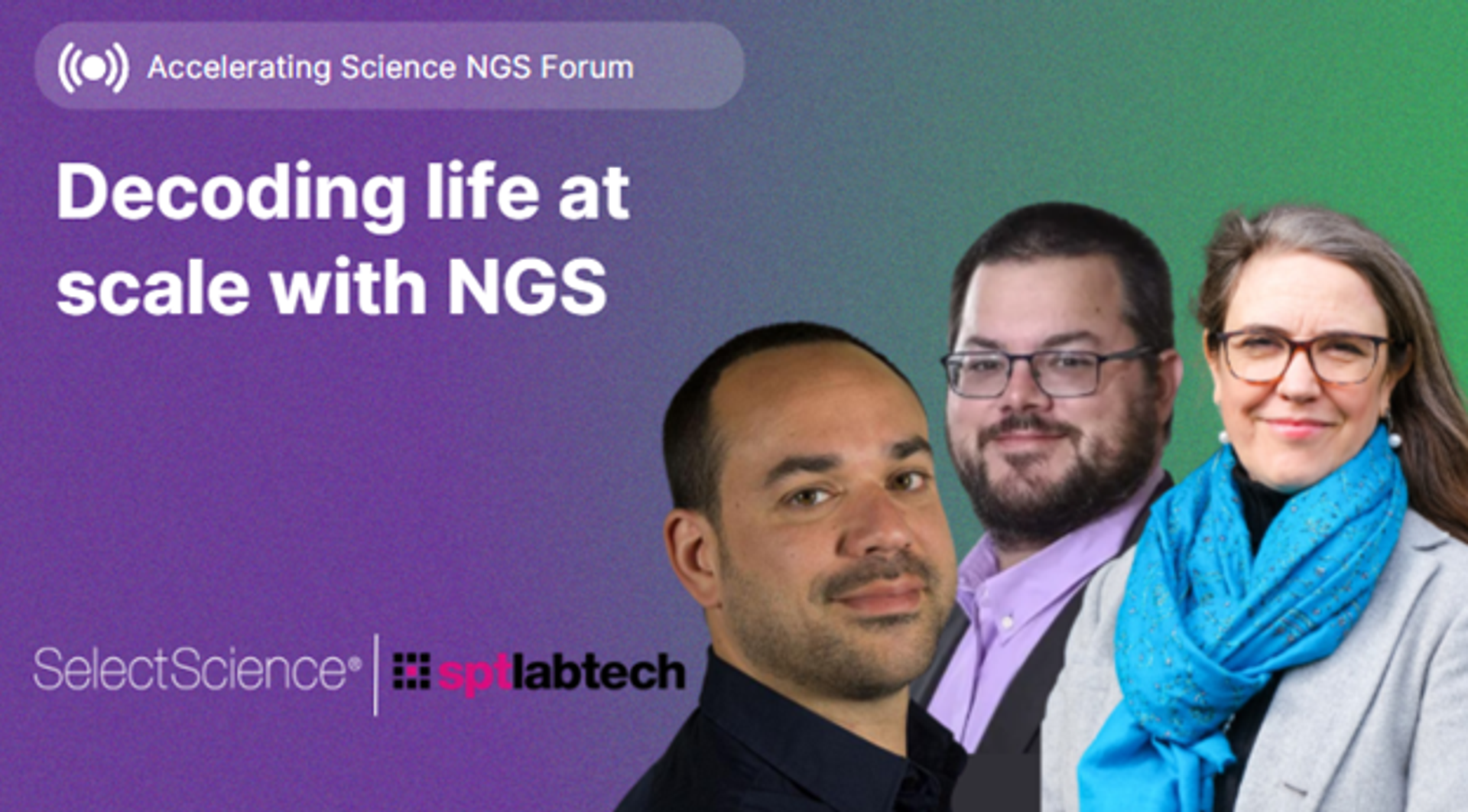
The panel brought together Dr. Ana Toribio, Head of the Stratified Medicine Core Laboratory at the University of Cambridge; Dr. Karim Gharbi, Head of Technical Genomics at the Earlham Institute; and Dr. Fritz Sedlazeck, Associate Professor at the Human Genome Sequencing Center at Baylor College of Medicine.
From early sequencing to scalable, integrated genomics
Looking back over their careers, the panel reflected on how genomics has evolved from early sequencing efforts into a scalable, integrated field that now directly informs diagnosis, treatment decisions, and modern medical care.
Dr. Toribio emphasized that the evolution of genomics has been driven as much by collaboration as by technology. “Genomics is literally about our genes,” she said, “but in practice, it’s about how people work together across very different disciplines. While falling costs and faster sequencing thanks to high-throughput technology have enabled major advances, integration has been the most important transformation. Genomics is no longer a standalone technology. It’s embedded within clinical care, drug discovery, and population health.”
For Dr. Gharbi, the change in scale has been striking. “When I first started in genomics over 15 years ago, the amount of data we generated was tiny compared to today,” he recalled. “Now we have multiomics approaches that combine multiple layers of data from genomics, proteomics, metabolomics, and transcriptomics, revealing insights and complexities we never knew existed.”
How NGS is transforming disease research
NGS has fundamentally changed how researchers investigate disease, providing both the breadth to explore entire genomes and the depth to interrogate specific targets with precision.
Dr. Sedlazeck explained that whole genome sequencing provides insight into every single base pair, enabling the detection of low-frequency mutations, mosaicism, and structural variation. “Identifying these changes is critical, as they can drive disease development, influence progression, and, in some cases, shape treatment decisions,” he said.
Dr. Toribio highlighted the power of NGS to ask unbiased questions. “With whole genome sequencing, we are no longer limited to looking only where we expect the answer to be. We can detect rare variants, structural changes, and non-coding effects all in a single experiment. This is particularly important in complex and rare diseases, where the underlying cause may lie outside well-studied genes and would be missed if researchers focused only on predefined targets," she said.
However, targeted sequencing still remains important in clinical settings. “It allows us to focus deeply on genes or pathways we know are relevant, so we can reliably detect even rare mutations with high confidence,” Dr. Toribio added. “This is critical for cancer diagnosis, minimal residual disease, and inherited disorders.”
The biggest hurdles in implementing NGS
Despite its transformative potential, the panel stressed that challenges in implementing NGS can hold it back. “Successful NGS isn’t as simple as just purchasing a sequencer,” said Dr. Toribio. “In reality, it’s an entire ecosystem that spans sample collection, wet lab workflows, automation, bioinformatics, data storage, quality control, and regulatory compliance — all of which must work seamlessly together, and that’s not always easy.”
She explained that sample variability is also a major challenge. “Laboratories frequently deal with degraded material, low input DNA or RNA, and mixed cell populations. If your upstream processes aren’t robust, no amount of sequencing depth can rescue the data.”
“Sustainability is another growing concern,” she added. “High-throughput sequencing generates vast volumes of data and relies heavily on consumables, making scalable, cost-effective, and environmentally conscious workflows essential.”
Dr. Sedlazeck explained that even after decades of studying the human genome, significant gaps remain. “While technology has advanced and we have delivered incredible successes, interpretation of genetic variants remains one of our biggest challenges,” he said. “In clinical contexts, we can confidently interpret only 1–2% of the genome.”
He also stated that although single nucleotide polymorphism (SNP) analysis has improved considerably, structural variants, tandem repeats, and other complex genomic regions remain difficult to resolve and interpret. “There’s still so much left to explore,” he said.
Automation and AI are reshaping NGS workflows
As sequencing has scaled, so too has workflow complexity. For laboratories processing hundreds or thousands of samples, consistency is essential, and automation is now key to delivering reliable NGS outcomes.
Dr. Gharbi explained that laboratories are moving beyond standalone liquid handling systems toward fully integrated platforms. “We’re increasingly seeing lab setups with multiple robotic instruments connected together and linked with laboratory information systems,” he said. “This reduces hands-on time and gives us much greater control over sample tracking and metadata as they move through the workflow.”
“Miniaturization and microfluidics are also improving efficiency,” he added. “By reducing reaction volumes, laboratories can lower reagent consumption, cut costs, and support more sustainable, high-throughput workflows.”
Dr. Toribio stressed that automated liquid handling systems can determine success or failure in many NGS workflows. “Library preparation is highly sensitive at the molecular level, and even small pipetting inaccuracies can introduce uneven coverage, batch effects, or sample loss — problems that become amplified at scale,” she said. “Automation improves precision and reproducibility while reducing contamination risk, and standardized workflows can be applied consistently across operators and sites. This results in cleaner libraries and more uniform sequencing coverage.”
The panel also described how artificial intelligence (AI) is being used to optimize workflows based on sample quality and behavior. “AI-driven tools can flag problematic libraries before sequencing, optimize run parameters, and detect subtle batch effects that may be invisible to the human eye,” Dr. Toribio said. “As datasets grow, AI becomes essential in helping us extract meaningful patterns.”
The future of NGS and multiomics
Looking ahead, the panel agreed that the future of genomics lies in integration. “Genomics alone is powerful,” said Dr. Toribio. “But when we combine it with transcriptomics, epigenomics, proteomics, and clinical data, we move from a static snapshot to a dynamic understanding of biology.”
She explained that multiomics reveals not just which variants exist, but how they influence cellular function, disease progression, and treatment response.
Dr. Sedlazeck highlighted that advances in reference genomes and long-read sequencing technologies are improving resolution in complex and previously inaccessible regions of the genome. He added that emerging approaches such as methylation analysis and early developments in protein sequencing could further expand our understanding of disease.
For Dr. Toribio, however, the most exciting development is translation into patient care. “The technology is incredible, but the real impact is human — better diagnosis, better treatments, and better outcomes,” she enthused.
Equipping the next generation of genomics leaders
In closing, the panel offered advice for the next generation of scientists. Dr. Gharbi emphasized the importance of collaboration for success. “NGS is about the people and not just the technology,” he said. “Success in genomics requires the ability to work effectively across disciplines.”
He also urged researchers to stay critical. “Companies are very good at showing how something works,” he added. “But it’s just as important to understand what failure looks like so that you can go back and fix it.”
Dr. Sedlazeck echoed that sentiment. “Don’t be shy to ask questions,” he said. “If you think it’s a stupid question, it’s usually not.”
For Dr. Toribio, meaningful training is essential. “We need to invest not just in how to run assays, but in improving experimental design, interpretation, and understanding the limitations of the experiments we do,” she said. “Empowered scientists make better decisions, and better decisions lead to better science.”
She closed by encouraging researchers to stay curious. “Genomics is evolving rapidly, and those who make the biggest difference will be the ones who continue learning.”