The Resurgence of CombiChem Technologies

10 Nov 2014

Kerry Parker
CEO

Editorial article

The generation of large diverse libraries of new compounds from defined building blocks for screening, known as ‘combinatorial chemistry’, is a key part of the drug discovery process. Two recent studies in Nature Chemistry provide examples of 'modern combichem' and describe the products and techniques used to combine the features of natural product biosynthesis into the creation of compound libraries.

Both methods described in these papers rely on minimal purification of their compound mixtures, and do not separate the compounds produced before assaying them for activity. Both combinatorial systems have a mechanism to determine which compounds in the assay mixture are active, without the need for separation. This is very important for downstream processing and scale-up.

Synthetic fermentation
The paper, by Yi-Lin Huang and Jeffrey Bode, describes how amide-forming ligation chemistry, described as ‘synthetic fermentation’, can be adapted to combinatorial ends for drug discovery. It demonstrates the preparation of a 6,000-member library from 23 simple precursors using several medicinal chemistry techniques. The ease of running these catalytic reactions without enzymes, allows for defined mixtures of compounds to be produced well-by-well in a screening plate for use directly in downstream screening processes. With the use of these techniques and the many different starting materials available, a library as large as 30,000 compounds could be produced greatly increasing the number of possible products for screening.

Reaction pathways
The other paper, from George Karageorgis, Stuart Warriner and Adam Nelson, uses deliberate variations in reaction pathways, exploiting the multiple reactivity of a natural α-diazo amide group. Different reaction conditions, created by using different concentrations of the starting material, produced a range of structures, and as in the amide ligation work, defined mixtures are produced in each well of a screening plate. This is another example of classic medicinal chemistry driving on compound activity, but this process combines combinatorial reaction discovery with ligand discovery.

Medicinal chemistry
In both papers, the medicinal chemistry techniques are similar. Thin layer chromatography and flash layer chromatography were performed on SiliCycle SiliaFlash® F60 (40-63 µm, 60 Å). NMR Spectra of the compounds was measured using Bruker Biospin Avance or Bruker Biospin AV spectrophotometers. High-resolution mass spectra and MS/MS spectra were measured using the Bruker Daltonics maXis ESI-QTOF or Bruker SolariX ESI/MALDI-FTICR. Analytical LC/MS was performed on a Dionex UltiMate 3000 RSLC or Agilent 1200 series LC system.

A combination of these two aqueous, no-workup combinatorial chemistry methodologies, using discretely analyzed and ordered compounds that can be sent down different synthetic pathways by varying the reaction conditions, is the perfect set-up to complement automated drug discovery.

References
Nature Chemistry, doi:10.1038/nchem.2074
Nature Chemistry, doi:10.1038/nchem.2034
Nature Chemistry, doi:10.1038/nchem.2048

Metal Scavengers and Organic Scavengers – SiliaMetS® & SiliaBond®

SiliCycle Inc.

SiliCycle is a pioneer in metal and organic scavenging solutions. We have nearly two decades of know-how in silica-grafting and scavenging technologies, and the broadest portfolio of scavengers.The removal of post-reaction residues has become a major issue in the pharmaceutical industry, among others. Purification of APIs by traditional methods (chromatography, activated carbon, distillation, etc.) often leads to problems such as high costs, time loss, low efficiency and reduced final yields. To overcome these drawbacks, SiliCycle has developed two families of scavengers that have significantly improved how chemists purify APIs: SiliaMetS Metal Scavengers and SiliaBond Organic Scavengers. The backbone of all those products is SiliCycle SiliaFlash® F60 (40-63 µm, 60 Å) which provides superior performance for all types of applications, due to its narrow particle size distribution and exceptional purity. What's more, we can provide different particle sizes or pore diameters on a custom basis.SiliCycle’s quality is famous and recognized, proven by countless applications and patents in literature. With our strong, extensive and confidential team of experts, your projects are in the best possible hands. SiliaMetS, your Metal Scavenging Final Solution Highly selective and cost-effective alternative for metal removal Expert team to help you consider every parameter: metal catalyst, solvent, residual reagent, by-products, structure of the API, temperature… Kits available for initial screenings. No leaching (no contamination). High selectivity (total recovery of the API). Wide range of metal species scavenged. Fast kinetics even at r.t. for maximal time-savings. Excellent stability (thermally and mechanically). New technologies compatibility (flow chemistry, microwave). Available both in Bulk or Fixed Bed (SPE or Flash cartridges) Mode. SiliaBond, your Best Bet for Removing Unwanted Organic Impurities and PGIs: Designed to react and bind a very large array of excess reagents and by-products High selectivity (total recovery of the API) Kits available for initial screenings Great for purification of potentially genotoxic impurities (PGI) Eliminates tedious post-reaction purifications Available both in Bulk for direct trapping or in SPE cartridges for the so-called “catch-and release” method Electrophile and Nucleophile Scavengers available Large team of experts always available to help you develop the best experimental conditions

(0)

AVANCE 1000

Bruker BioSpin launches a breakthrough one Gigahertz Ultra-High Field AVANCE 1000 MHz NMR spectrometer. Incorporating a record-breaking 23.5 Tesla standard-bore (54 mm) superconducting NMR magnet, the AVANCE 1000 MHz NMR spectrometer, brings one Gigahertz technology to NMR research. AVANCE 1000 MHz NMR Spectrometer with the first 1 GHz CryoProbe installedThe high field strength and high field stability in combination with the first 5 mm triple-resonance CryoProbe enables unique 1 GHz NMR applications. Bruker is proud to be able to equip researchers with such an outstanding instrument that will helpto push the frontiers in biochemistry, structural biology and other molecular research. The first Avance 1000 system was delivered to the new ‘Centre de RMN à Très Hauts Champs’ in Lyon, France in July 2009. Bruker BioSpin has successfully completed installation in November 2009. The AVANCE 1000 now offers unparalleled research opportunities, both to CRMN and to other National and European scientists who will access the unique facility.
(0)

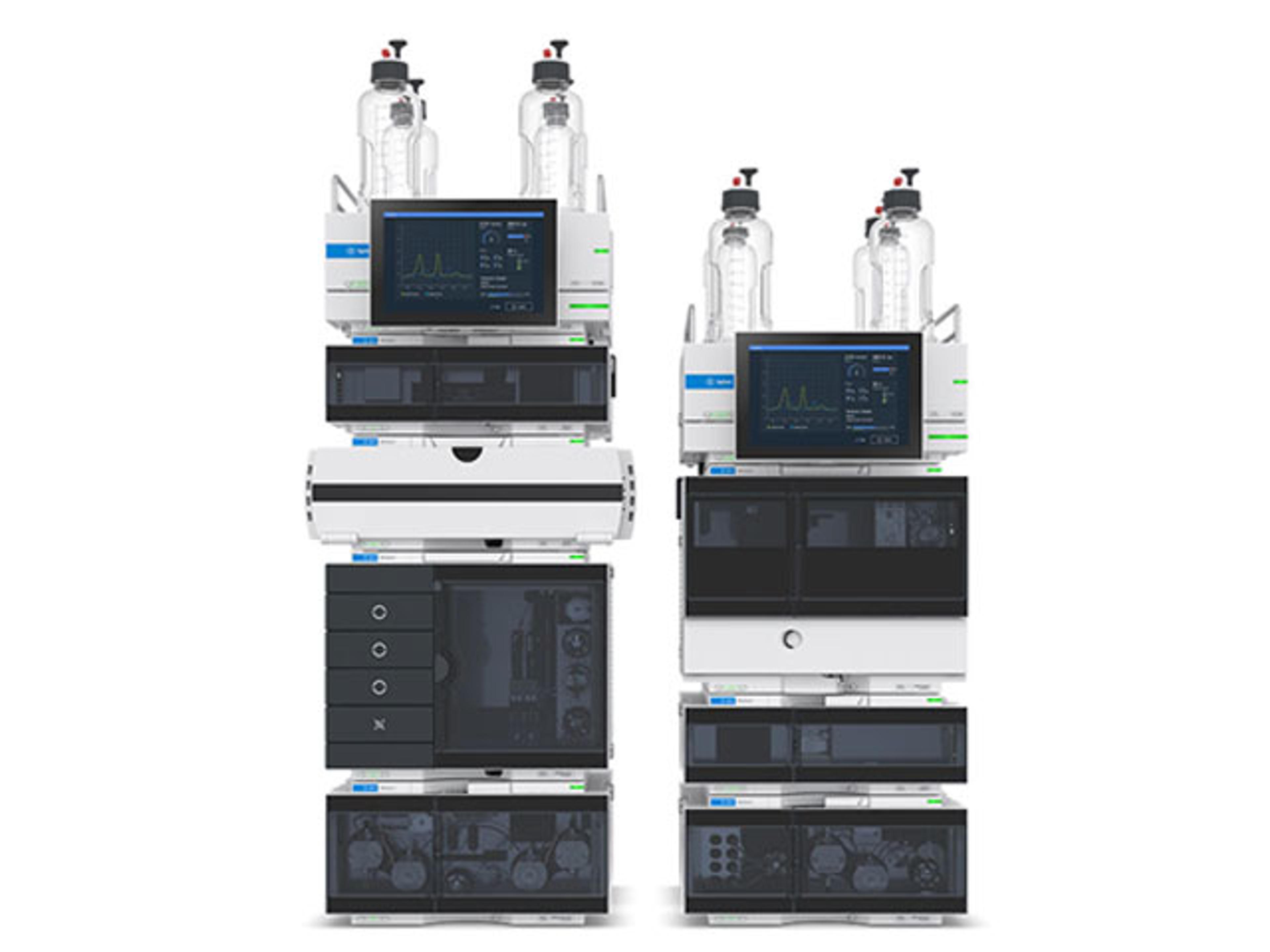
Agilent Analytical HPLC Systems

Agilent Technologies

Whether you need assistance with your daily HPLC routines, confidence in your HPLC results, protection for your HPLC investments, or support for your sustainability goals, Agilent HPLC & UHPLC products can help achieve your lab's HPLC objectives both today and tomorrow.

(242)

Links

Tags

Flash ChromatographyFlash chromatography is a fast-preparative column chromatography technique used for separation and purification of liquid analytes. Flash chromatography systems use small silica gel particles for separation and a pressurized gas for driving the solvent through the column or pre-packed cartridge. Find the best flash chromatography equipment in our peer-reviewed product directory: compare products, check customer reviews and receive pricing direct from manufacturers.UHPLC and HPLCHigh performance liquid chromatography (HPLC) and ultra high performance liquid chromatography (UHPLC), also known as UPLC, are analytical techniques used to separate, identify and quantitate components of complex mixtures including biological samples such as proteins and lipids as well as chemical mixtures of pesticides, drugs and oils. Both techniques are liquid chromatographic methods but differ by operating pressures (HPLC < 6000 psi < UHPLC ). Components of HPLC and UHPLC systems include columns, detectors, pumps, autosamplers and column heaters. Explore a range of UHPLC and HPLC columns for your specific sample needs including reverse phase, normal phase, ion exchange, HILIC, ion exclusion and size exclusion columns. For more specialized HPLC, explore FPLC, countercurrent LC and simulated moving bed systems. Find the best UHPLC and HPLC equipment in our peer reviewed product directory: compare products, check customer reviews and receive pricing direct from manufacturers.Infrared / IR SpectroscopyInfrared (IR) spectroscopy measures the interaction of infrared light with a sample, including transmission, reflectance & absorbance, facilitating the identification of analytes. Equipment used for quantitative analysis includes Fourier-transform infrared (FTIR) spectrometers, infrared cameras, FTIR gas analyzers, as well as attenuated total reflectance (ATR) accessories and pellet or film presses. Find the best IR spectroscopy products in our peer-reviewed product directory: compare products, check customer reviews and receive pricing direct from manufacturers.LC-MSLC-MS (liquid chromatography-mass spectrometry) systems and equipment are used for separation and quantitative analysis of complex mixtures, combining liquid chromatography and mass spectrometry. Quantify proteins, contaminants, pesticides or screen for drug metabolites with a high level of sensitivity. LC-MS systems and equipment include reverse phase, normal phase and specialized columns integrated with various MS detectors such as time-of-flight (TOF), quadrupole, orbitrap or ion trap mass analyzers. LC-MS/MS instruments equipped with a qTOF or triple quadrupole analyzer give greater sensitivity and resolving power to your analysis. Find the best LC-MS equipment in our peer-reviewed product directory: compare products, check customer reviews and receive pricing direct from manufacturers.Mass SpectrometryMass spectrometry (MS) is a powerful analytical technique used to identify and quantify molecules based on the mass-to-charge ratio of gas-phase ions. It provides detailed information about the structure, composition, and properties of compounds and is widely used across fields such as environmental monitoring, materials science, drug discovery and development, food and beverage testing, and wider chemical research. Key MS techniques include tandem mass spectrometry (MS/MS), liquid chromatography–mass spectrometry (LS-MS) and inductively coupled plasma (ICP-MS). Choosing from these wide range of techniques and technologies can be a daunting task, so keep up to date with scientific applications, performance expectations, and customer reviews here all in one place. Visit our product directory to receive quotes direct from the manufacturer. NMR and EPR SpectroscopyNuclear magnetic resonance (NMR) spectroscopy is used to resolve the local chemical environment of atomic nuclei with spin, revealing information on molecular structure, dynamic processes and chemical reactions of organic molecules, from proteins to synthetics. Electron paramagnetic resonance (EPR) also known as electron spin resonance (ESR) spectroscopy is used to detect and quantify paramagnetic species in a sample, including free radicals as transition metal ions. By immersing the sample in a strong magnetic field, both NMR and EPR spectrometers probe the sample with either radio waves or microwaves respectively. A range of benchtop, solid-state and time domain NMR spectrometers & EPR spectrometers are available, as well as NMR tubes, NMR solvents, software, coils, and magnets. Find the best NMR & EPR equipment in our peer-reviewed product directory: compare products, check customer reviews and receive pricing direct from manufacturers.Medicinal ChemistryMedicinal chemistry is a broad discipline encompassing the design, identification, synthesis and development of chemicals in drug discovery. It includes a number of techniques covering structural biology, synthetic chemistry and molecular biology. Technologies used in medicinal chemistry include ADME, lab-on-a-chip, high content screening and assay assembly.Thin Layer ChromatographyThin-layer chromatography (TLC), also called planar chromatography, is an inexpensive and simple liquid chromatographic technique used to separate and identify small amounts of compound in a mixture, monitor progress of a reaction or determine purity of substance. TLC plates come in multiple sizes with common adsorbent layers being silica, aluminum oxide or cellulose and high-performance (HP-TLC) plates are also available for increased sensitivity. Other equipment needed includes TLC developing chambers, applicators, TLC sprayers and visualizing devices, such as a viewing cabinet and UV lamp. Find the best TLC products in our peer-reviewed product directory: compare products, check customer reviews and receive pricing direct from manufacturers.Compound AnalysisCompound analysis is used to discover specific compounds that could be promising candidates for pharmaceutical use. This potential is identified when compounds have the desired effect, such as interaction with a target protein, during high throughput screening.ChromatographyChromatography is a powerful technique used to separate and analyze components of mixtures based on their chemical properties. It is widely used in fields like biochemistry, pharmaceuticals, and environmental analysis. By exploiting differences in the interaction of substances with a stationary phase and a mobile phase, chromatography enables precise purification and quantification of compounds. Whether you're working with complex biological samples or industrial chemicals, chromatography is essential for obtaining high-quality results. Browse our peer-reviewed product directory to find the best chromatography systems, compare products, read customer reviews, and get pricing directly from manufacturers.Compound ScreeningCompound screening is a method used to discover specific compounds that could be promising candidates for pharmaceutical use. This potential is identified when compounds interact with the target protein during screening and could therefore be carried forward in the drug development process.