
Developing Effective Assays with Clever New Assistance Software
Learn how the team at NanoTemper Technologies is helping scientists design better assays and quickly generate meaningful results
29 Mar 2017

Julia Sica, Guest Editor
Beate Kern, Customer Support NanoTemper Technologies
Have you ever been stuck in your experiment because of trouble with the technologies you use? Not sure how to interpret the output? At NanoTemper Technologies, Beate Kern is part of Customer Support and happy to help you out. In this interview with Guest Editor Julia Sica, she talks about the experiences that brought her to this field of work, her role in developing clever assistance software and the recent introduction of webinars.
JS: What is your scientific background and how did you find your way to NanoTemper Technologies?
BK: I studied biology with focus on microbiology in Munich, except for a year abroad in Japan during my Master's degree. The topic of my PhD thesis was investigating the consequences of the toxins of Helicobacter pylori on human T cells - so it had nothing to do with the aspects we work with at NanoTemper Technologies (such as proteins or affinities) at all! Close to the end of my PhD, I started working part-time at the Deutsche Museum, Munich, a huge museum for science and technology, where I explained basic methods like PCR or DNA extraction to pupils. I really enjoyed teaching and therefore I was looking for a job where I could combine my scientific background with teaching and training tasks.
JS: What are your main tasks right now in Customer Support?
BK: Basically, I am helping our customers be successful in their research. This involves training new users who don't have any experience with our technology, but I also assist advanced users with their experimental design and data analysis. I support them if they have questions about their application and offer practical advice.
JS: What do you find most exciting about your work?
BK: I really appreciate the contact with different scientists and helping them to achieve their goals. It is great to still be connected to research, working with our clients on diverse topics. The samples are always different, their approaches vary and it is exciting to support various projects and to solve some of their problems.
JS: What are the biggest challenges you face?
We want to make the whole process of using our instruments easier for our clients.
Beate Kern NanoTemper Technologies
BK: In the last two years at NanoTemper Technologies, I've been visiting many clients in Europe. I noticed that some customers are faster at learning new software than others and if we make our instruments as easy as possible to use, then they can focus their energy on their research.
JS: What exactly is the goal of your assay development software?
BK: We want to make the whole process of using our instruments easier for our clients. Our new MO.Control software takes them by the hand and leads them through the procedure step by step on their way to the results. It also runs some important pre-tests, performs quality checks and helps the clients understand the outcomes and data. Since our tools are becoming a standard technology for the pharmaceutical industry, it is important to make them as easy to use as possible.
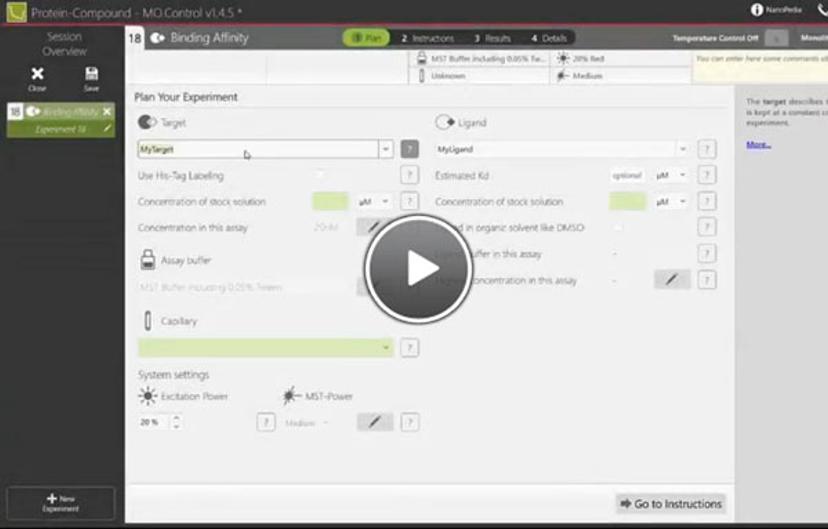
Watch this video to find out more about the features of the MO.Control software
JS: What was your motivation to help develop the software?
BK: The bulk of the work was done by our brilliant team of software developers and designers. Since I am clearly not a software developer, my role is to contribute to the software from the client's perspective. Supporting our customers taught me which kinds of experiments they typically perform and which problems they face. Since I also took part in writing the current manuals and FAQs, I am aware of how a new user feels and I can clearly explain all the procedures.
JS: What is your impact on the new software?
BK: I was mainly helping to design MO.Control software by making the software development team aware of customer needs. For example, I kept them updated with typical problems that occur in assay development so they could help to solve them. Moreover, I have written entries to an in-software database we call NanoPedia to facilitate the support.
JS: NanoTemper Technologies now also offers support webinars. What are the reasons and the goals?
BK: We are, of course, adding additional resources to guide and support everyone who uses our products. We realized that additional users may come on board after we've provided the initial training so this helps those who may have missed it. It would be great to increase the contact with our customers and offer help on different levels. Therefore, we started to offer webinars on different specific topics - our first one was about Assay Setup for MicroScale Thermophoresis. Since we received such positive feedback, we're continuing our efforts with an introduction to the new MO.Control software and how it guides you through MicroScale Thermophoresis experiments. We are planning to offer more webinars in the future, so please visit our website to stay informed about upcoming webinars, it would be great to meet you there!