Restek<sup>®</sup> Pure Chromatography
3 Jul 2016
This video introduces the chromatography technology from Restek, showing how it can be applied to a variety of fields and improve lab performance.

This video introduces the chromatography technology from Restek, showing how it can be applied to a variety of fields and improve lab performance.


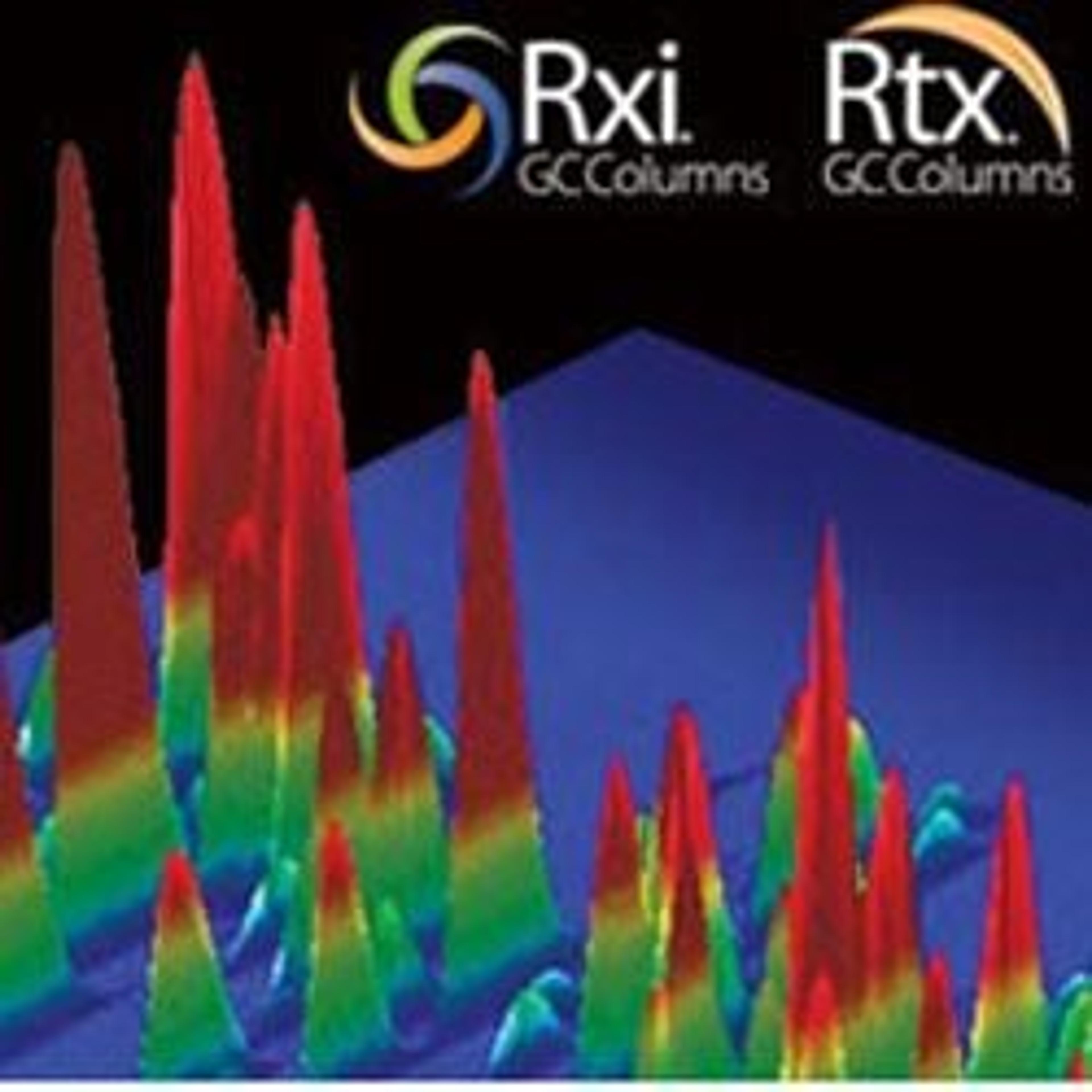
• Wide range of stationary phases offers orthogonal separations. • High thermal stability maximizes system ruggedness and sensitivity. • Unrivaled column inertness for accurate analysis of active compounds. • 0.15, 0.18, and 0.25 mm ID formats accommodate varying sample capacities, speeds, and detectors. • Secondary columns come in convenient 2 m lengths for economical method development. GCxGC is a powerful multidimensional GC technique that combines two independent separations to accurately analyze highly complex samples. GCxGC involves two columns with differing (orthogonal) stationary phases that are press-fitted together in series and separated by a modulator. The first (primary) column performs a separation, and its effluent is continually focused and “injected” by the modulator onto the second (secondary) column, where another separation occurs. By choosing a secondary column that is orthogonal to the primary column, it is possible to identify analytes that cannot be separated by the primary column. And by keeping the secondary column short, it is possible to maintain the separation produced by the primary column. Results generated through a series of high-speed chromatograms are plotted as a retention plane, or contour plot (column 1 time x column 2 time). Restek has been performing comprehensive two-dimensional gas chromatography since its commercial inception. Our innovations lab boasts multiple instruments dedicated to GCxGC applications, and we are continually exploring new application areas—including environmental, food safety, petroleum, forensics, fragrance, natural products, and dietary supplements. Restek GCxGC secondary columns can be matched with any Restek Rtx® or Rxi® primary column to create the perfect orthogonal separation for your application.


With Raptor™ LC columns, Restek chemists became the first to combine the speed of superficially porous particles (also known as SPP or “core-shell” particles) with the resolution of highly selective USLC® technology. This new breed of chromatographic column allows you to more easily achieve peak separation and faster analysis times without expensive UHPLC instrumentation.


The Rxi®-PAH GC columns were designed by Restek with a higher phenyl-content stationary phase that provides unique selectivity to separate important polycyclic aromatic hydrocarbons (PAH) for food safety that cannot be distinguished by mass spectrometry. Even difficult priority compounds, such as the European Food Safety Authority (EFSA) PAH4, are easily separated and accurately quantified, results that cannot be achieved on typical GC columns.Arylene modification and surface bonding of the stationary phase increase thermal stability and ruggedness so relatively nonvolatile, higher molecular weight PAHs can be analyzed routinely without interference from column bleed.Excellent column efficiency means that the column can be trimmed for maintenance purposes many times without losing critical PAH separations, including those that are part of environmental methods, as well as food safety testing. The selectivity and efficiency of the Rxi®-PAH column make it ideal for EFSA PAH4 analysis; chrysene/triphenylene separation and resolution of all benzofluoranthenes are easily achieved.Features: Ideal for EFSA PAH4 analysis—separates all priority compounds: benz[a]anthracene, chrysene, benzo[b]fluoranthene, and benzo[a]pyrene. Best resolution of chrysene from interfering PAHs, triphenylene, and cyclopenta[cd]pyrene. Complete separation of benzo [b], [k], [ j], and [a] fluoranthenes. 360 °C thermal stability allows analysis of low volatility dibenzo pyrenes.