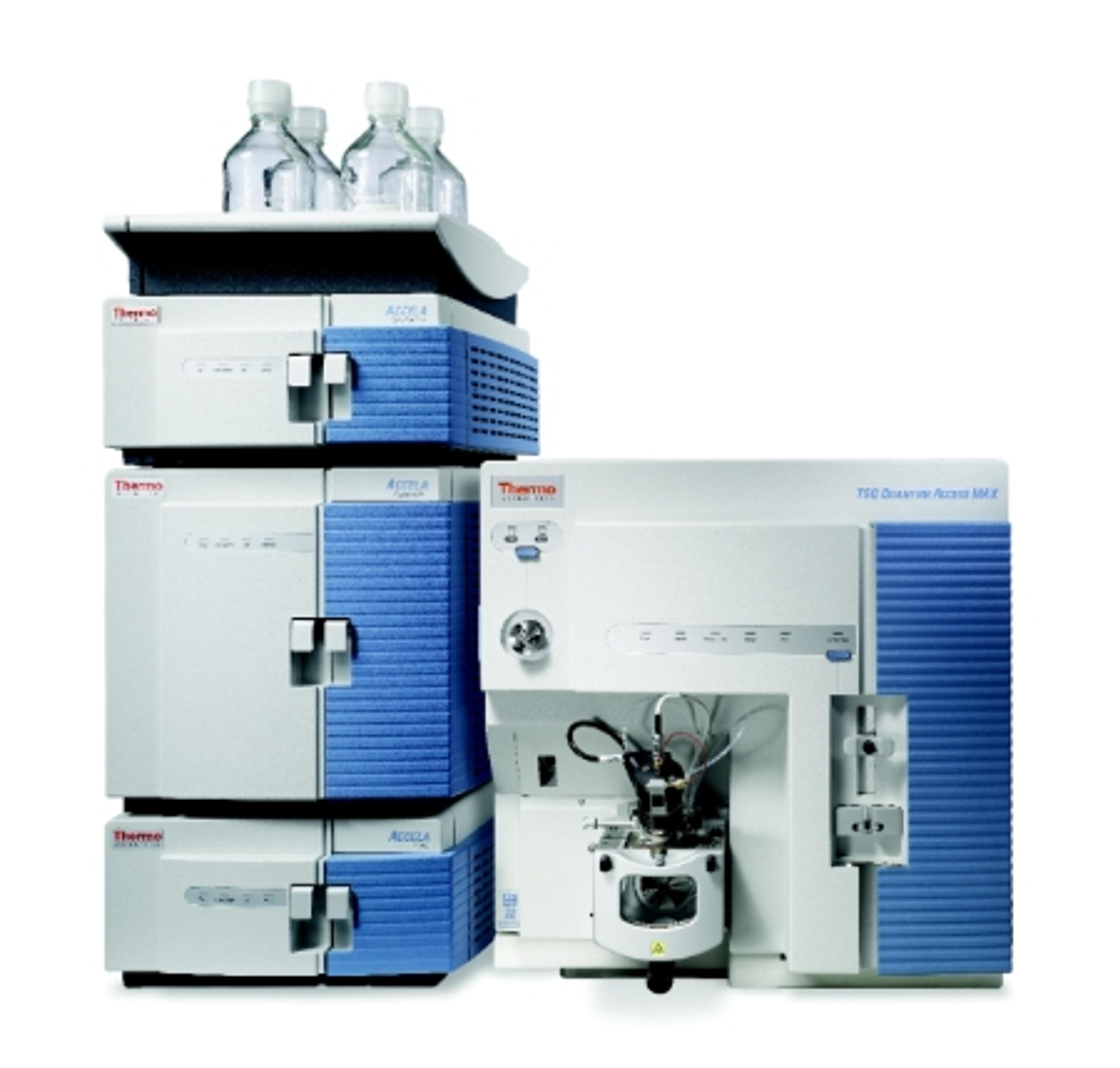
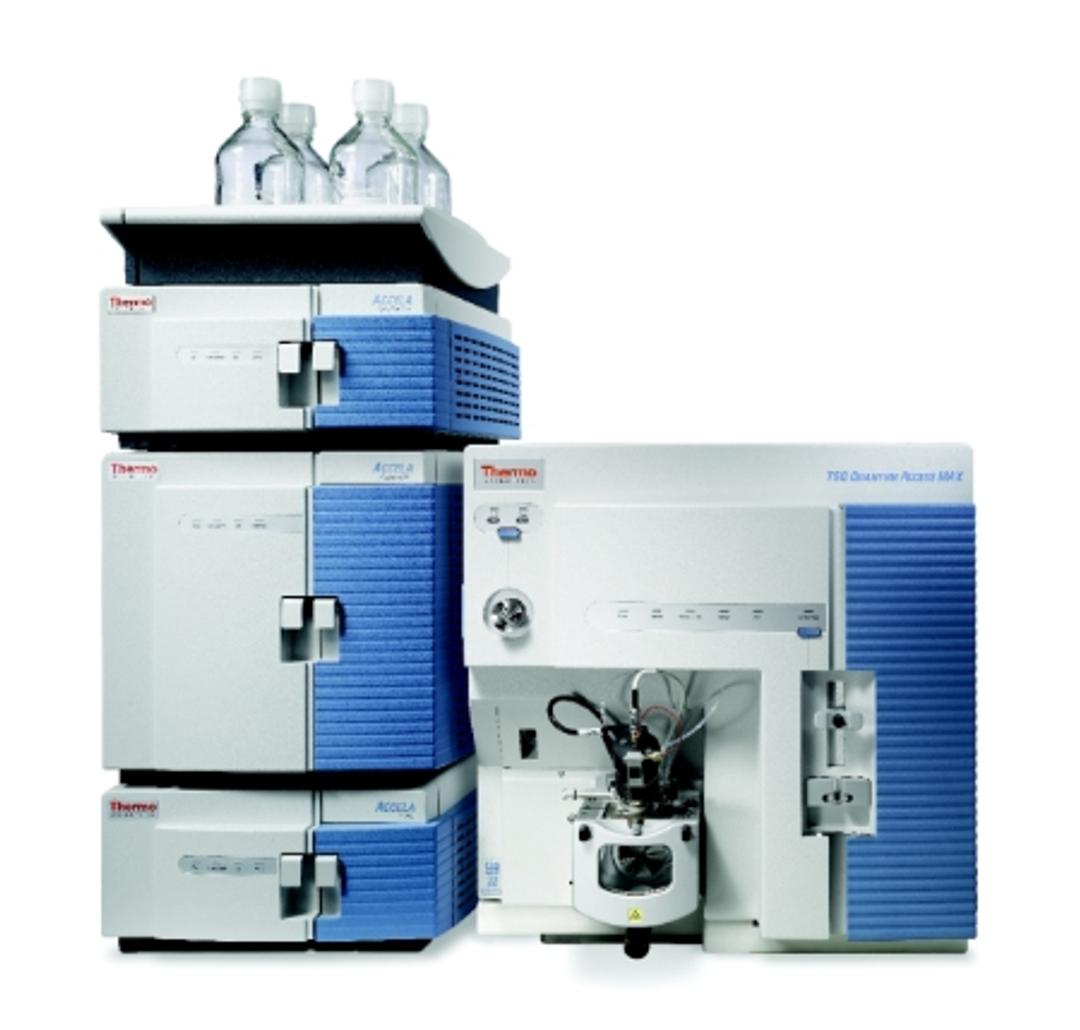
Thermo Scientific™ TSQ Quantum™ Access MAX Triple Quadrupole Mass Spectrometer
Achieve high quantitative sensitivity and specificity economically with the Thermo Scientific™ TSQ Quantum™ Access Max triple quadrupole mass spectrometer. Applications such as pharmaceutical development, environmental and food safety testing, clinical research, and forensic toxicology demand analytical sensitivity and specificity—even when budgets are constrained. The Thermo Scientific™ TSQ Quantum™ Access MAX Triple Quadr…

The supplier does not provide quotations for this product through SelectScience. You can search for similar products in our Product Directory.
Great value for the money
Analyze metabolite
This is stable quadrupole system, entry level, with enough sensitivity for more applications.
Review Date: 27 May 2022 | Thermo Fisher Scientific
Achieve high quantitative sensitivity and specificity economically with the Thermo Scientific™ TSQ Quantum™ Access Max triple quadrupole mass spectrometer.
Applications such as pharmaceutical development, environmental and food safety testing, clinical research, and forensic toxicology demand analytical sensitivity and specificity—even when budgets are constrained. The Thermo Scientific™ TSQ Quantum™ Access MAX Triple Quadrupole Mass Spectrometer is an outstanding LC-MS/MS value, providing excellent sensitivity, specificity, and flexibility that is also more affordable.
Features:
- Thermo Scientific™ Ion Max™ API source with HESI-II probe reduces noise and increases sensitivity, enhancing quantitative performance.
- Up to 3,000 definable, timed SRMs and fast 25 ms positive/negative switching improve productivity.
- Quantitation-enhanced data-dependent MS/MS (QED-MS/MS) provides simultaneous compound confirmation and quantification.
- High-resolution selected reaction monitoring (H-SRM) with 2 ms dwell times enables quantification of hundreds of compounds in a single run.
- Mass range of 10–3000 m/z allows analysis of small molecules and intact proteins.
- Zero-cross-talk collision cell eliminates false positives.
- Optional FAIMS interface enhances specificity.
- Intuitive software with searchable compound libraries and database of methodologies for the analysis of pesticides, azo dyes and banned pharmaceuticals in water and food, make the system easy to use.
- Self-cleaning Ion Max API source heater with automatic source recognition simplifies use and increases reliability.

Determination of Carbendazim and Benomyl Residues in Oranges and Orange Juice by Automated Online Sample Preparation Using TLX-LC-MS/MS
This application note describes an adaptation of an existing online, multi-residue pesticide method proven and verified specially for the actual carbendazim contamination issue of orange juices in the US. Methyl 2-benzimidazole carbamate, most commonly known as carbendazim, is a widely used broad-spectrum benzimidazole fungicide and a decomposition product of benomyl. Carbendazim is used to control plant diseases in cereals and fruit, including citrus, bananas, strawberries, pineapples, and pome fruits. Many methods in widespread use for monitoring carbendazim have been developed for multi-residue determination of fungicides and employ a variety of sample preparation and cleanup techniques.
Rapid Analysis of 303 Pesticide Residues in Green Beans using Triple Quadrupole GC-MS/MS
This application note demonstrates the method for analysis of 303 pesticides in green beans by using an acetonitrile extract, followed by SPE clean-up steps, and analysis by the TSQ Quantum GC-MS/MS using timed-SRM mode. The combination of triple quadrupole GC-MS/MS and ion trap GC-MS with QuEChERS sample preparation method has been investigated for the pesticide analysis in different food matrices. However, solid phase extraction (SPE) as a clean-up procedure is still the official analytical method for pesticide residues analysis in some countries.
Determination of Pesticides in Grapes, Baby Food and Wheat Flour by Automated Online Sample Preparation LC-MS/MS
European Regulation 396/2005 sets maximum residue levels of pesticides in different products of plant and animal origin. In recent years the QuEChERS (Quick, Easy, Cheap, Effective, Rugged and Safe) method has become widely adopted for handling fruit and vegetables. This method describes a novel sample preparation technique as a possible alternative to the QuEChERS method for high throughput pesticide analysis, employing Thermo Scientific’s Transcend TLX system coupled with the TSQ Quantum Access Max triple quadrupole mass spectrometer.
Start-to-Finish Workflows for Pesticide Analysis
The Thermo Scientific™ Pesticides Explorer Collection is a comprehensive set of liquid chromatography-mass spectrometry (LC-MS) solutions designed for laboratories performing routine quantitation, targeted and non-targeted screening of pesticide residues in food matrices. Each configuration includes all the workflow components needed— consumables, hardware, software and built-in instrument and data processing methods—pre-configured and tested, from Thermo Fisher Scientific.
New eBook series covers techniques to optimize mass spec and liquid chromatography results
Collect our three guides for robust and reliable technologies to enable scientists in forensic and clinical laboratories


Webinar Highlights: The Future of Designer Drug Analysis
In this webinar, Professor Jean-Claude Alvarez explains how he and his team of experts at the Forensic Institute of Garches analyze designer drugs using high resolution mass spectrometry