Millicell® 24 & 96-well Cell Culture Insert Plates
Millicell® cell culture insert plates are a patented device designed to support cell growth and differentiation of endothelial and epithelial cell lines, including CaCo-2. The Millicell® device is available with a 0.4 µm PCF and a variety of PET membrane pore sizes. The plate is designed for maximum user convenience and incorporates features such as apical assist for easier pipetting and basolateral access.



Place your order directly with the manufacturer.
Easy to use.
Separation
96-well plates - easy yo use.
Review Date: 12 Mar 2020 | Merck
Millicell® cell culture insert plates are a patented device designed to support cell growth and differentiation of endothelial and epithelial cell lines, including CaCo-2.
The Millicell® device is available with a 0.4 µm PCF and a variety of PET membrane pore sizes. The plate is designed for maximum user convenience and incorporates features such as apical assist for easier pipetting and basolateral access. To reduce the risk of monolayer contamination, the membrane plates have feet to elevate the plate above the work surface when disassembled from the feeder tray. Tear drop-shaped receiver wells eliminate air bubbles as plates are assembled.
Millicell® plates are optimized to grow and sustain high integrity cell monolayers. Cells grown on Millicell® plate membranes grow better than on plastic because the cells are nourished from both the apical and basolateral sides. Cell growth and function more closely mimic in vivo. Millicell® plates are designed for analysis as well as cell growth and can be used manually or with automated cell seeding, feeding and washing systems

2.5D cell culture models for more predictive in vitro research
2.5D cell culture is an emerging approach for creating more physiologically relevant in vitro models, overcoming key limitations of conventional 2D systems. Using microporous membrane inserts restores apical-basolateral polarity, supports barrier formation, and enables air-liquid interface (ALI) culture—critical for differentiated epithelial models with improved predictive value for ADME/Tox, drug transport, and disease research.
2.5D culture bridges simple monolayers and complex 3D systems. It allows organoid-derived cells to be grown on permeable membranes, combining biological relevance with accessibility for TEER measurement, permeability, migration, and wound healing assays. Tools such as Millicell® inserts and plates support applications from GI barrier and drug absorption studies to skin and respiratory models, enabling more predictive epithelial and tissue-representative systems.
Download this SelectScience guide to explore:
- How to culture colon organoid monolayers for GI barrier research
- Small intestine organoid-derived monolayers and physiologically relevant alternatives to Caco-2 models
- Optimizing MDCK cell culture for high-throughput TEER and permeability assays
- The principles behind barrier formation and permeability assays using cell culture inserts
- Generating organotypic air-liquid interface 3D skin cultures
- Modelling respiratory lung diseases using bronchial epithelial cells at ALI
Resource details:
- Document type: SelectScience guide
- Page count: 47
- Read time: 85 mins
- Edition: 1st
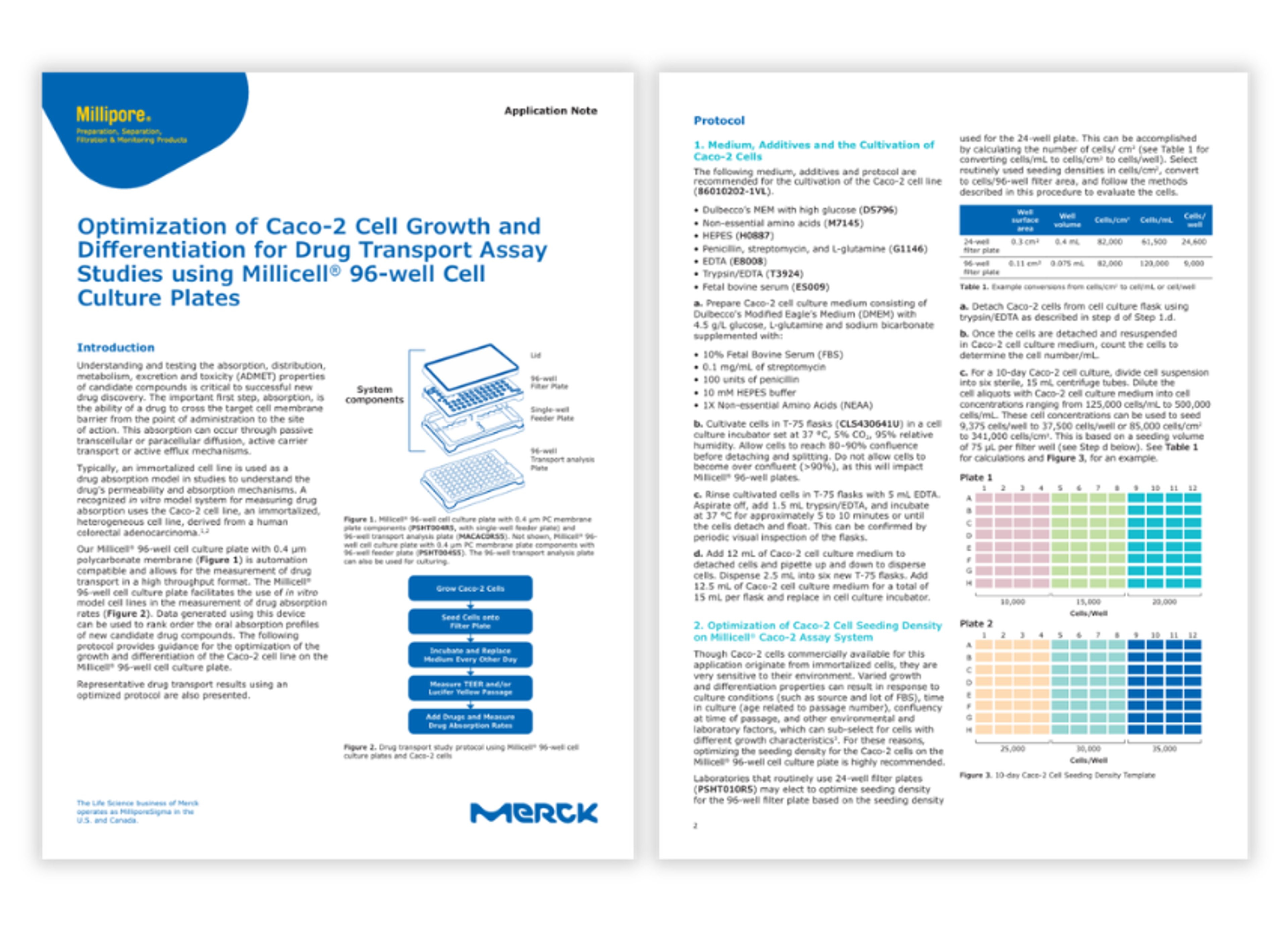
Optimization of Caco-2 cell growth and differentiation for drug transport assay studies using Millicell 96-well cell culture plates
This application note demonstrates how to optimize Caco-2 cell culture conditions for reliable drug transport and permeability studies using the Millicell 96-well plates. It outlines protocols for cell growth, seeding density optimization, and monolayer integrity assessment, alongside methods for measuring drug absorption rates. The workflow supports high-throughput screening of candidate compounds and provides reproducible in vitro data to inform drug discovery and ADME evaluation.

More like life: Microporous membrane-based culture systems
The value of cell culture experiments lies in how well they represent the native microenvironments of in vivo systems. In this application note, Millipore Sigma explores the advantages of using microporous membranes, compared to 2D plastic surfaces, to provide more in vivo-like cell growth environments for cell culture experiments.
More like life: Microporous membrane-based culture systems
Membrane-based culture systems foster a more in vivo-like cell growth environment and support a range of applications including primary and secondary screening, transport assays, toxicity screening, cell signaling, cell proliferation and ADME/toxicity drug studies. In this application note, Millipore details the features of the Millicell® cell culture product family and reveals how membrane-based cultureware can closely recapitulate in vivo conditions.