See Tecan’s broad range of automated laboratory systems at LabAutomation2008

10 Jan 2008

Product news

Tecan, one of the world’s leading players in the growing life sciences industry, will be demonstrating a range of its latest products for genomics, proteomics and drug discovery applications at LabAutomation, booth 305, 27-30 January in Palm Springs, California.

Visitors to LabAutomation will be able to see the Infinite® M1000, Tecan’s new multimode flagship microplate reader with premium quad4 monochromators™, bringing flexibility, sensitivity and speed in one high-end detection system to bridge the gap between research, assay development and screening. Tecan is also launching the Infinite 200 NanoQuant, the first microplate reader to be developed specifically for absorbance applications with low volumes. The Infinite M1000 and Infinite 200 NanoQuant join the existing Infinite 200 and Infinite 500 series of detection systems.

Also at the show will be Tecan’s new 384-channel head for the Freedom EVO® liquid handling workstations, designed to increase the efficiency and speed of pipetting processes for even better throughput and delivering a greater level of flexibility, and is a great asset for all your pipetting applications.

There will also be the opportunity to see Tecan’s new generation of liquid handling technology components, the new pump and the new robot. The new pump was developed to complement and extend Tecan’s current range of syringe pumps, including the Cavro® XCalibur and Cavro® XLP, combining increased standards of accuracy and precision with unbeatable longevity and a broader working volume range from a single syringe size compared to other similar pumps. The innovative new robot promises the same robustness and reliability that is characteristic of Tecan’s products, and is both easy to install and to operate, making it the ideal OEM robotics component choice.

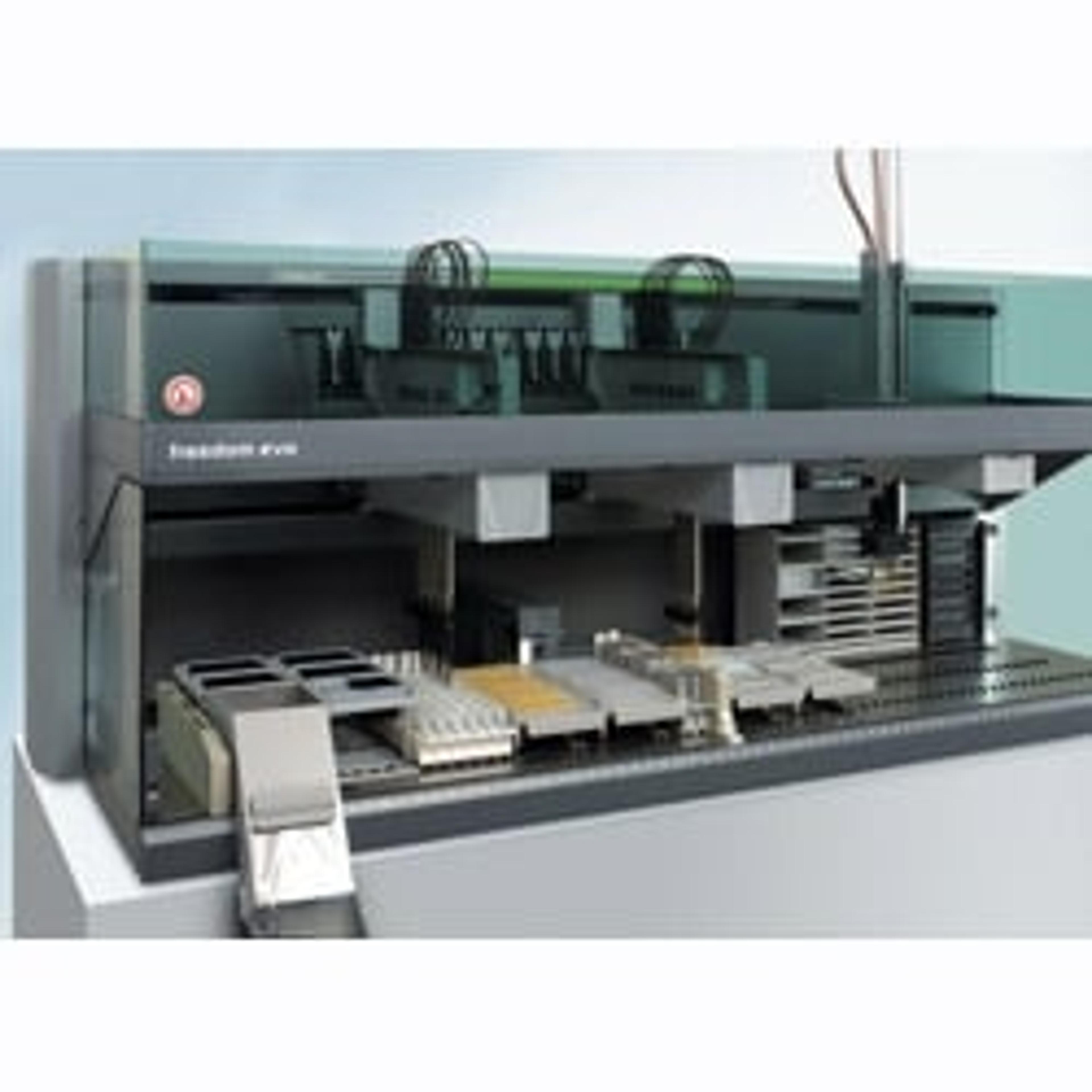
Tecan Freedom EVO® Workstation

Tecan

The Freedom EVO platform offers fully automated liquid handling and robotics for life sciences and diagnostics. This flexible system offers virtually unlimited options, which can be tailored to provide individual solutions.

(67)

Links

Tags

Genome AnalysisGenomics, the study of genomes, includes functional genomics, evolutionary genomics and comparative genomics. There are many genomic technologies such as DNA sequencing of whole genomes, computational biology and bioinformatics. DNA and nucleic acids must be isolated and concentrated from cells for analysis with kits, automated analyzers and software. Other useful technologies for studying genomics include PCR, microarrays and electrophoresis.Lab-on-a-ChipLab-on-a-chip (LOC) technology uses microfluidic chips, such as microarrays, to perform biochemical assays on a small scale. Benefits of lab-on-a-chip include the small volume of sample required as well as the speed of analysis. In selecting lab-on-a-chip devices consider the assay, cost, reliability, sensitivity and signal to noise ratio.ProteomicsProteomics is the systemic bioinformatics study of proteins and amino acids, including their structure, size, function and identification. Tools used in proteomics include chromatography, blotting and gels, protein arrays, mass spectrometry and ELISA and associated analysis software. Analyzers and proteomic systems should be sensitive, high resolution, fast and may be automated for high-throughput.Microplate Readers / DetectorsMicroplate readers are used to automate the detection and analysis of labeled or label-free components in microplates during assays or live-cell monitoring. Microplate readers are generally distinguished by their mode of detection. Types include absorbance, luminescence, fluorescence intensity, fluorescence polarization, TRF / FRET and multimode microplate readers. Microplate readers deliver a high throughput of samples by reading multiple wells simultaneously, with the 96-well format the most commonly used. As a result, microplate readers are often used in the drug discovery, bioassays, research and pharmaceutical industries for screening applications. Microplate loading can also be automated, with robotic microplate stackers to increase throughput. Find the best microplate readers in our peer-reviewed product directory: compare products, check customer reviews and receive pricing direct from manufacturers.
See Tecan’s broad range of automated laboratory systems at LabAutomation2008