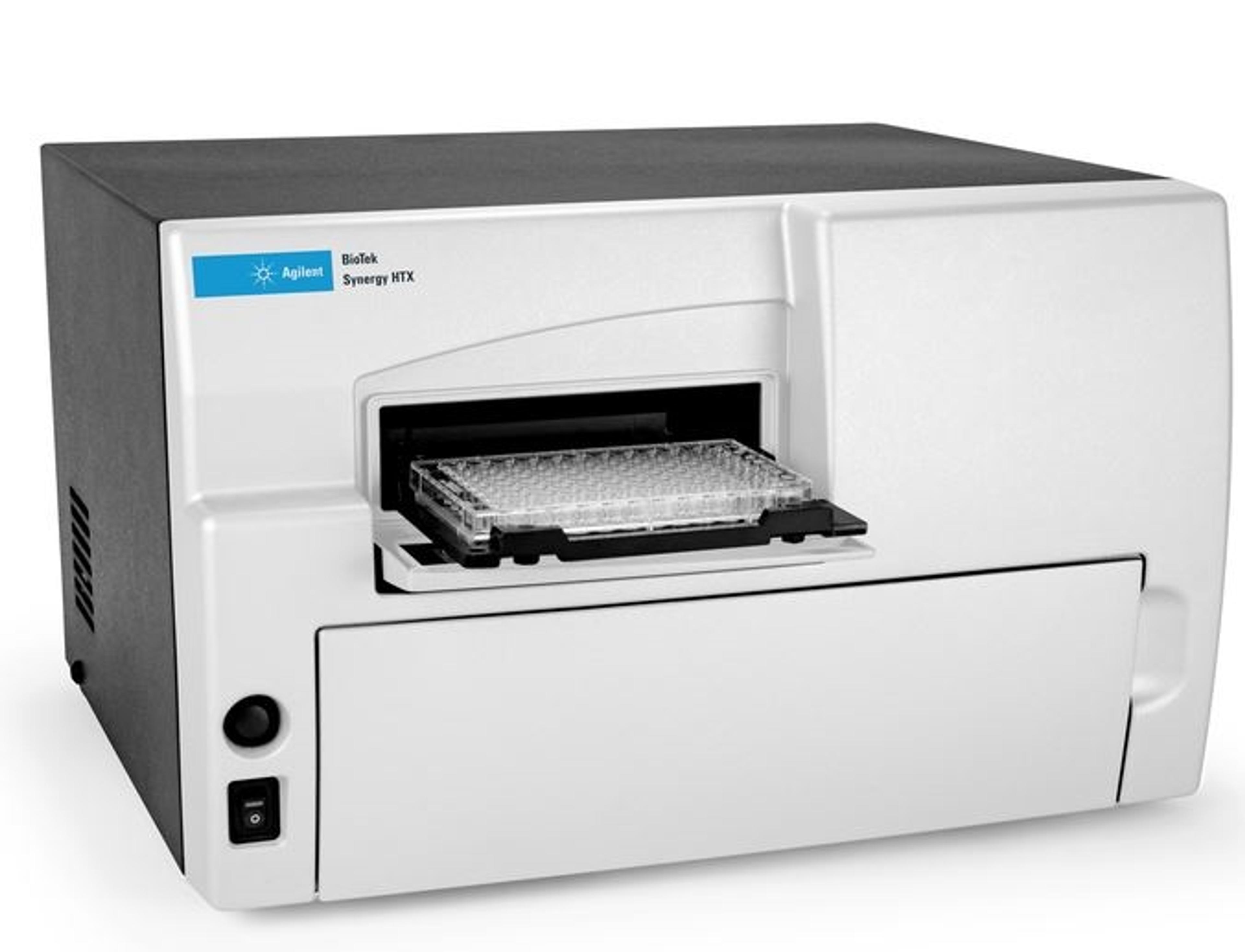
New Synergy™ HTX Offers Convenient, Flexible and Automated Microplate-based Detection

14 Oct 2014

Kathryn Rix
Administrator / Office Personnel

Product news

BioTek continues to set the standard in microplate instrumentation by designing practical functionality, user-friendly software, and affordable modularity as seen in the new Synergy™ HTX Multi-Mode Microplate Reader. This new system is offered as an entry-level multi-mode reader to automate UV-Vis absorbance, fluorescence, luminescence and AlphaScreen®/AlphaLISA® assays in 6- to 384-well microplates in 2 µL samples with BioTek’s Take3 Micro-Volume plates.

The unique dual-optics design results in superior filter based top and bottom fluorescence, luminescence and monochromator based absorbance measurements for maximum applications versatility. Synergy HTX’s modularity allows upgrading over time and BioTek’s powerful Gen5™ Software controls all functionality while providing data analysis for many applications within one powerful yet intuitive package.

Synergy HTX has linear and orbital shaking and 4-Zone™ incubation to 50 ºC with condensation control to minimize plate lid condensation. These features, plus an available dual reagent dispenser, make Synergy HTX an ideal platform for biochemical and cell-based applications like nucleic acid quantification, cell growth and toxicity assays, kinetic ELISA and inject/read assays. Workflows can be further automated with the BioStack™ Microplate Stacker or third-party automation.

Agilent BioTek Synergy HTX Multimode Reader

Agilent Technologies

The Agilent BioTek Synergy HTX is a compact, economical multimode reader for 6- to 384-well microplates and Take3 microvolume plates. The unique dual optics design provides superior performance for UV-Vis absorbance, fluorescence, luminescence, and AlphaScreen/AlphaLISA workflows. With incubation and shaking, plus a dual reagent injector module, the system will meet all your assay requirements now and in the future. Synergy HTX is controlled by the easy-to-use, yet powerful, Gen5 software for data collection, analysis, exporting and reporting.  

(26)

Links

Tags

Fluorescence SpectroscopyFluorometers and spectrofluorometers (also called fluorescence spectrometers) are used to measure the intensity and wavelength of fluorescent light emitted from a sample after excitation by illumination. Spectrofluorometers utilize monochromators to select the desired wavelengths, whereas filter fluorometers employ a set of filters. Spectrofluorometers for measuring steady-state fluorescence and lifetime fluorescence (or time-resolved fluorescence) are available, as well as fluorescence microscopes and microplate readers. Find the best fluorescence spectroscopy products in our peer-reviewed product directory: compare products, check customer reviews and receive pricing direct from manufacturers.UV-Visible SpectroscopyUltraviolet-visible (UV-Vis) spectrophotometers are used to measure the interaction of UV and visible light with a sample, including transmission, reflectance & absorbance. The two major instrument classes are single-beam or double-beam spectrophotometers. More specialized equipment includes colorimeters, spectroradiometers and refractometers. Portable and microvolume spectrophotometers are also available. For the modular spectroscopy lab, explore a range of light sources for combination with a spectrograph/spectrometer and optics. Find the best UV-Vis spectroscopy products in our peer-reviewed product directory: compare products, check customer reviews and receive pricing direct from manufacturers.Cell / Tissue CultureCell culture or tissue culture is used to study the biology of cells or tissues and to isolate cellular products in an environment which can be manipulated and well defined. Accurately control your culture environment with bioreactors or culture incubators, bind your cells to a surface or together with an extracellular matrix. Distinguish cell types with differential media or proliferate cells with certain characteristics using selective media. Enrich your media with supplements such as growth factors, sera and vitamins. Find the best cell and tissue culture products, kits and equipment in our peer-reviewed product directory: compare products, check customer reviews and receive pricing direct from manufacturers.MicroplatesMicroplates are multi-well plates used to increase the throughput of biological investigations. The number of wells microplates contain can range from 6 to 3243 wells, with the 96-well format being the most commonly used. Microplates can come tailored for a range of applications including cell culture, PCR, filtration, storage, non-binding surface, protein crystallization, as well as pre-coated, deep well and normal Standard microplates. Additionally, options for microplate colors include clear , black, white or black with clear bottom and white with clear bottom for absorbance microplate reader applications. Find the best microplates for your lab in our peer-reviewed product directory: compare products, check customer reviews and receive pricing direct from manufacturers.Microplate Readers / DetectorsMicroplate readers are used to automate the detection and analysis of labeled or label-free components in microplates during assays or live-cell monitoring. Microplate readers are generally distinguished by their mode of detection. Types include absorbance, luminescence, fluorescence intensity, fluorescence polarization, TRF / FRET and multimode microplate readers. Microplate readers deliver a high throughput of samples by reading multiple wells simultaneously, with the 96-well format the most commonly used. As a result, microplate readers are often used in the drug discovery, bioassays, research and pharmaceutical industries for screening applications. Microplate loading can also be automated, with robotic microplate stackers to increase throughput. Find the best microplate readers in our peer-reviewed product directory: compare products, check customer reviews and receive pricing direct from manufacturers.Cell-Based AssaysCell-based assays are used to monitor the presence, quantity and activities of a desired cellular analyte including drug molecules or biomarkers. This can reveal information on cell health (apoptosis, cytotoxicity, viability and proliferation assays), cell metabolism, cell migration and cell signaling mechanisms. Find the best cell-based assay products, kits and equipment with our peer reviewed product directory: compare products, check customer reviews and receiving pricing direct from manufacturers.Cell GrowthCell growth refers to the process by which cells increase in size and number. It is essential for tissue development, wound healing, and cancer research. Understanding and controlling cell growth is a fundamental part of cell biology and regenerative medicine. Browse our peer-reviewed product directory to find the best tools for studying cell growth, compare products, check reviews, and get pricing directly from manufacturers.Assay DevelopmentThe process of proving an assay to be sensitive with respect to the target is known as assay development. The assay should be able to characterize novel compounds and measure the potency of these compounds against a validated biological target.ToxicityToxicity is defined as the degree to which a substance can harm humans or animals. It is essential to study the toxicity of pharmaceutical products during the development process so that optimum dosage can be established for the administration of the drug.