
Robust Analysis of Polar Ionic Pesticides using Ion-Exchange Chromatography Coupled to Mass Spectrometry

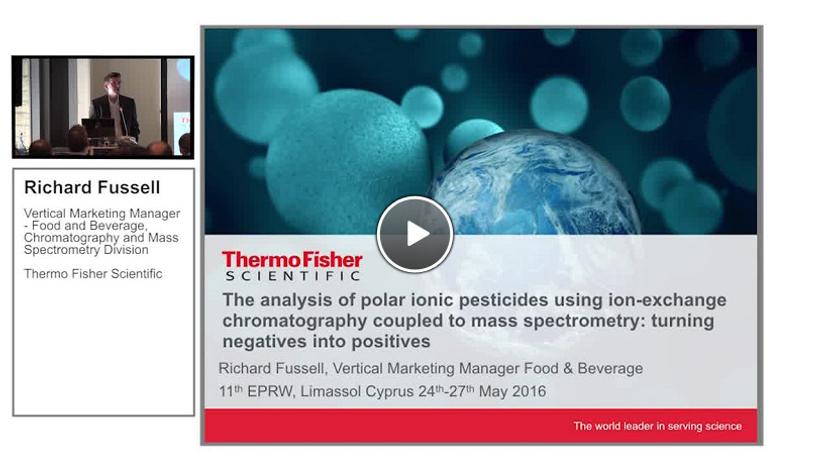
In a presentation recorded at EPRW, Richard Fussell, Thermo Fisher Scientific, described how IC-MS can be used to overcome the difficulties encountered with the use of conventional chromatographic methods for the analysis of polar ionic pesticides

11 Nov 2016

Finn Price
Administrator / Office Personnel

Editorial article


Polar ionic pesticides are widely used in agriculture. The frequent occurrence of residues in foodstuffs often generates heightened media attention, Richard explains. Ion-Exchange Chromatography Coupled to Mass Spectrometry (IC-MS), compared to conventional methods, offers a more effective option for the analysis of polar ionic pesticides.

The Quick Polar Pesticides (QuPPe) Method is a commonly used technique that allows for the simultaneous analysis of a number of highly polar pesticides in samples of plant origin, Richard explains. It is a generic extraction, using acidified methanol, without clean-up, before measurement by LC-MS. The method was developed in Stuttgart by the European Reference Laboratory (EURL) for Single Residue Methods. He describes that the method is not perfect, as ‘dirty’ extracts, containing a high concentration of sample co-extractives, contaminate the columns and MS systems relatively quickly. This in-turn causes variations in retention times, recoveries and precision. However, Richard also acknowledges that the QuPPe method is more cost effective than previous processes requiring derivatization, and has at least encouraged analysts to attempt the analysis of pesticides that were hardly ever monitored before.

How IC-MS/MS can help

Richard states that polar ionic pesticides, due to their charged nature, are difficult to extract and chromatograph using conventional techniques. To address this issue, Thermo Fisher Scientific partnered with Fera Science Ltd, UK, to develop an IC-MS multi-residue method for the analysis of polar pesticides in QuPPe extracts. Through this partnership, a study was conducted to evaluate the Thermo Scientific™ TSQ Quantiva™ Triple Quadrupole Mass Spectrometer in conjunction with the Thermo Scientific™ Dionex™ ICS-5000+. The use of new HPIC™ IC column technology combined with an ultra-sensitive triple quadrupole mass spectrometer, provided much improved results compared to those generated using older systems, he explains.

A noticeable advancement from previous methods is the reduction in amount of sample injected on-column. Furthermore, the chromatographic peak shapes at low concentrations, typically 10 ng/g, were better and hence the signal-to-noise ratio much improved. The smaller amount of sample injected on-column allowed more analyses to be carried out before the IC columns required cleaning, thus improving the efficiency of the whole workflow.

Richard reports that development is still under way, as the method has presently only been validated for 13 polar anionic pesticides, including glyphosate, glufosinate, ethephon, fosetyl aluminium and their metabolites, as well as chlorate and perchlorate. Also, he alluded to the fact that preliminary results for both, the analysis of cationic pesticides, and the use of IC coupled Orbitrap technology for the analysis of polar ionic pesticides, show much promise for the future.

Watch the presentation or visit the EPRW special feature to learn more.

Use this product for your research? Leave a product review today and help other scientists conducting research in your field.

Links

Tags

Ion ChromatographyIon chromatography, also known as ion exchange chromatography, is a high-performance liquid chromatographic technique used for the separation and identification of ions or polar molecules in a sample, including proteins, nucleotides and amino acids. Equipment includes ion exchange columns, ion exclusion columns, ion chromatography systems, pumps, and detectors. Find the best ion chromatography equipment in our peer-reviewed product directory: compare products, check customer reviews and receive pricing direct from manufacturers.LC-MSLC-MS (liquid chromatography-mass spectrometry) systems and equipment are used for separation and quantitative analysis of complex mixtures, combining liquid chromatography and mass spectrometry. Quantify proteins, contaminants, pesticides or screen for drug metabolites with a high level of sensitivity. LC-MS systems and equipment include reverse phase, normal phase and specialized columns integrated with various MS detectors such as time-of-flight (TOF), quadrupole, orbitrap or ion trap mass analyzers. LC-MS/MS instruments equipped with a qTOF or triple quadrupole analyzer give greater sensitivity and resolving power to your analysis. Find the best LC-MS equipment in our peer-reviewed product directory: compare products, check customer reviews and receive pricing direct from manufacturers.Mass SpectrometryMass spectrometry (MS) is a powerful analytical technique used to identify and quantify molecules based on the mass-to-charge ratio of gas-phase ions. It provides detailed information about the structure, composition, and properties of compounds and is widely used across fields such as environmental monitoring, materials science, drug discovery and development, food and beverage testing, and wider chemical research. Key MS techniques include tandem mass spectrometry (MS/MS), liquid chromatography–mass spectrometry (LS-MS) and inductively coupled plasma (ICP-MS). Choosing from these wide range of techniques and technologies can be a daunting task, so keep up to date with scientific applications, performance expectations, and customer reviews here all in one place. Visit our product directory to receive quotes direct from the manufacturer. Food and Beverage AnalyzersFood and Beverage Analyzers are commonly used to provide information about the chemical composition, structure and physical properties of food materials.Food and Beverage ProcessingFood and Beverage Processing involves the preparation of food products for further analysis. Typical instrumentation includes blanchers, color sorters, cookers, grinders, and refrigeration. These are used to replicate the processes commonly used in the commercial preparation of food and beverages.PesticidesPesticides are used to protect crops from diseases, pests and unwanted plants. They are classed as persistent organic pollutants (POPs) and can be harmful to humans. The Environmental Protection Agency (EPA) currently regulates the use of pesticides in the USA. Chromatography Method DevelopmentChromatography method development is the process of designing and optimizing chromatographic techniques to separate and analyze complex mixtures. This includes selecting appropriate stationary and mobile phases, determining flow rates, and optimizing detection methods. Successful method development is essential for high-quality results in fields like pharmaceuticals, food safety, and environmental analysis. Explore chromatography method development tools in our peer-reviewed product directory; compare products, check reviews, and get pricing directly from manufacturers.Food TestingFood testing refers to a variety experiments including PCR, mass spectrometry, processing, QuEChERS, analyzing and Kjeldahl.Food ContaminationFood contamination refers to the presence of harmful substances or pathogens in food, posing risks to human health. Contaminants can be biological, chemical, or physical, and their detection is crucial for ensuring food safety. Advanced testing methods like PCR, chromatography, and spectroscopy are used to identify contaminants in food products. Browse our peer-reviewed product directory to find the best solutions for food contamination detection, compare products, check reviews, and get pricing directly from manufacturers.WHOChemical Residues in FoodCarcinogensEPRW
Robust Analysis of Polar Ionic Pesticides using Ion-Exchange Chromatography Coupled to Mass Spectrometry