Ensuring Selectivity and Robustness in Pesticide Residue Analysis

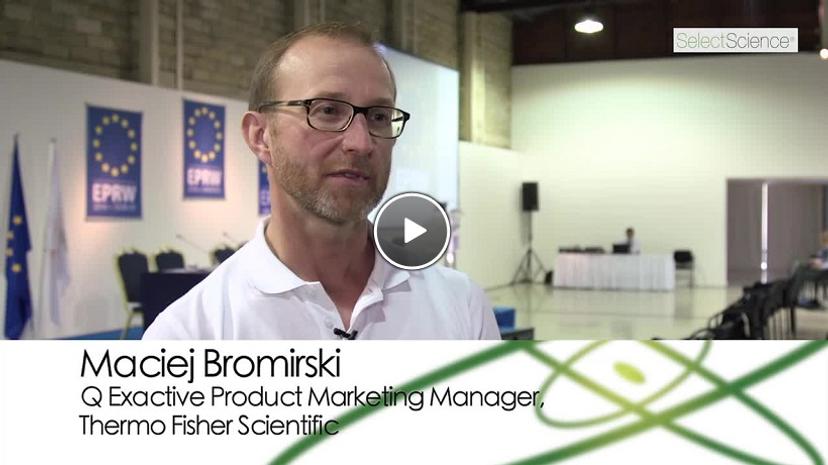
In an interview filmed at EPRW, Maciej Bromirski, Thermo Fisher Scientific, discusses the rise in uptake of Orbitrap technology

2 Dec 2016

Finn Price
Administrator / Office Personnel

Editorial article


The EPRW is the leading European meeting for the presentation of the latest concepts and developments, in the field of pesticide residue analysis of food and drink. It provides a platform for the exchange of information and experience in the field, and to bring together people from each of the relevant sectors.

In this interview, filmed during the European Pesticide Residue Workshop 2016 (EPRW), Maciej Bromirski, Q Exactive Product Marketing Manager at Thermo Fisher Scientific, discusses the rise in uptake of Orbitrap technology

To ensure safe and comprehensive pesticide residue analysis, Maciej explains that it is very important that scientists are able to detect different pesticides within different matrices. Effective analysis is important due to the widespread use of pesticides, but difficulties arise because these matrices can take many forms.

The Thermo Scientific™ Q Exactive™ Focus Hybrid Quadrupole-Orbitrap™ Mass Spectrometer uses unique technology that allows users to detect pesticides even in complex matrices, performing quantitation measurements in Full Scan, SIM and PRM modes. Maciej states that a key benefit of this technology is its “high linear dynamic range, good limit of detection and limit of quantitation”. The instrument has been built with stability and robustness in mind, capable of running for several days without the need for calibration and making it perfect for high throughput analysis.

Maciej explains that this technology is being employed by scientists around the world for a wide range of purposes, an example of which is pesticide residue analysis in food, at the European Reference Laboratory. With the increasing uptake of Q Exactive technology, and a number of publications scheduled for release in the near future, Maciej believes that more and more labs will take the opportunity to explore this technology further.

Watch the video interview or visit the EPRW special feature to learn more.

Use this product for your research? Leave a product review today and help other scientists conducting research in your field.

Links

Tags

Mass SpectrometryMass spectrometry (MS) is a powerful analytical technique used to identify and quantify molecules based on the mass-to-charge ratio of gas-phase ions. It provides detailed information about the structure, composition, and properties of compounds and is widely used across fields such as environmental monitoring, materials science, drug discovery and development, food and beverage testing, and wider chemical research. Key MS techniques include tandem mass spectrometry (MS/MS), liquid chromatography–mass spectrometry (LS-MS) and inductively coupled plasma (ICP-MS). Choosing from these wide range of techniques and technologies can be a daunting task, so keep up to date with scientific applications, performance expectations, and customer reviews here all in one place. Visit our product directory to receive quotes direct from the manufacturer. PesticidesPesticides are used to protect crops from diseases, pests and unwanted plants. They are classed as persistent organic pollutants (POPs) and can be harmful to humans. The Environmental Protection Agency (EPA) currently regulates the use of pesticides in the USA. Food TestingFood testing refers to a variety experiments including PCR, mass spectrometry, processing, QuEChERS, analyzing and Kjeldahl.Food ContaminationFood contamination refers to the presence of harmful substances or pathogens in food, posing risks to human health. Contaminants can be biological, chemical, or physical, and their detection is crucial for ensuring food safety. Advanced testing methods like PCR, chromatography, and spectroscopy are used to identify contaminants in food products. Browse our peer-reviewed product directory to find the best solutions for food contamination detection, compare products, check reviews, and get pricing directly from manufacturers.Chemical Residues in FoodSEMScanning Electron Microscopy (SEM) is a technique that uses a focused electron beam to scan a sample and create high-resolution images. It is widely used in materials science, nanotechnology, and biological research. Explore SEM systems in our peer-reviewed product directory; compare products, check reviews, and get pricing directly from manufacturers.EPRW
Ensuring Selectivity and Robustness in Pesticide Residue Analysis