Sample Preparation for High-Throughput Live Cell Imaging Using Thermo Scientific Wellwash Versa

23 Nov 2012

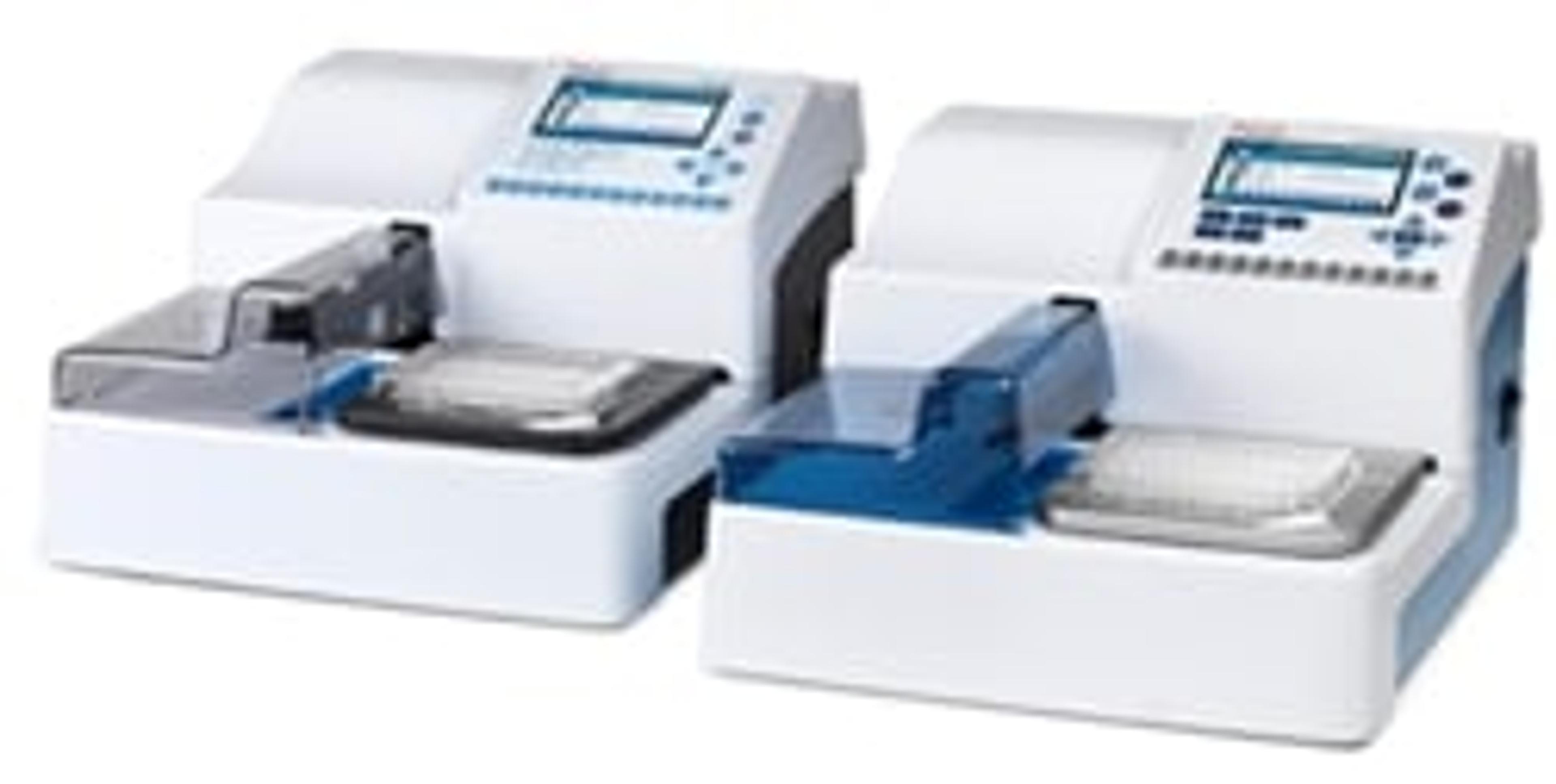
Cell-based assays using high-content analysis and high-throughput screening may require multiple wash steps and incubation of reagents. These steps can be extremely laborious when performed manually, thus it is preferable to automate these steps with a microplate washer. While using a microplate washer on fixed cells is generally straightforward, it can be quite problematic when working with live cells, especially for some loosely adherent cells. In this application note, the Thermo Scientific Wellwash® Versa, a microplate washer specifically designed for working with cells, was shown to be gentle enough for washing rat cerebellar granule neurons, which have a complex and fragile structure. Several tips for the creation and optimization of protocols for the Wellwash Versa are also presented in this note.

Thermo Scientific Wellwash and Wellwash Versa

Thermo Fisher Scientific

The Thermo Scientific Wellwash and Wellwash Versa microplate strip washers offer reliable, high quality performance for routine ELISA applications. The large color screen with graphical user interface (available in 9 languages) makes it easy to develop and run protocols with minimal training. Additional features like liquid level sensors in both the wash and waste bottles, automatic priming, and plate-recoginition sensor provide additional security. So you get reproducible results, every time.

(3)

Tags

MicroplatesMicroplates are multi-well plates used to increase the throughput of biological investigations. The number of wells microplates contain can range from 6 to 3243 wells, with the 96-well format being the most commonly used. Microplates can come tailored for a range of applications including cell culture, PCR, filtration, storage, non-binding surface, protein crystallization, as well as pre-coated, deep well and normal Standard microplates. Additionally, options for microplate colors include clear , black, white or black with clear bottom and white with clear bottom for absorbance microplate reader applications. Find the best microplates for your lab in our peer-reviewed product directory: compare products, check customer reviews and receive pricing direct from manufacturers.High-Throughput ScreeningHigh-throughput screening (HTS) is an automated drug discovery technique for identification of active compounds against a compound library. Use HTS readers and integrated assay preparation / analysis workstations to screen your compounds. Identify active compounds against various HTS libraries, including membranes, proteins and peptides and HTS cell lines. Find the best high-throughput screening products in our peer-reviewed product directory: compare products, check customer reviews and receive pricing direct from manufacturers.Washing EquipmentWashing equipment is more convenient than ever before with automated systems, integrated and multi-application systems available. For instance microplate washers can be programmable, combined with reagents dispensers and used for applications such as ELISA, multiplex assays and PCR clean up.Microplate Readers / DetectorsMicroplate readers are used to automate the detection and analysis of labeled or label-free components in microplates during assays or live-cell monitoring. Microplate readers are generally distinguished by their mode of detection. Types include absorbance, luminescence, fluorescence intensity, fluorescence polarization, TRF / FRET and multimode microplate readers. Microplate readers deliver a high throughput of samples by reading multiple wells simultaneously, with the 96-well format the most commonly used. As a result, microplate readers are often used in the drug discovery, bioassays, research and pharmaceutical industries for screening applications. Microplate loading can also be automated, with robotic microplate stackers to increase throughput. Find the best microplate readers in our peer-reviewed product directory: compare products, check customer reviews and receive pricing direct from manufacturers.Cell-Based AssaysCell-based assays are used to monitor the presence, quantity and activities of a desired cellular analyte including drug molecules or biomarkers. This can reveal information on cell health (apoptosis, cytotoxicity, viability and proliferation assays), cell metabolism, cell migration and cell signaling mechanisms. Find the best cell-based assay products, kits and equipment with our peer reviewed product directory: compare products, check customer reviews and receiving pricing direct from manufacturers.High-Content ScreeningHigh-content screening (HCS), also known as high-content analysis (HCA), is a high-throughput technique used in drug discovery to identify substances that alter the phenotype of cells. HCS uses fluorescent microscopic imaging and automated image analysis to investigate cellular events such as apoptosis, cell viability, GPCR activation, oxide production, neurite outgrowth, and cell signaling. Find the best fluorescent labeling reagents, cellular assays, and high-content imaging systems in our peer-reviewed product directory: compare products, check customer reviews and receive pricing direct from manufacturers.Robotic InstrumentsRobotic instruments can be used for high-throughput automation of many lab processes. Such processes use instruments for assays like cell based assays and ELISA, for sample preparation like shakers, centrifuges and incubators, and for analysis such as sequencing and western blot analyzers. Useful features of robotic instruments include speed, reproducibility, barcode readers, software and automation.Plate ProcessingAutomated plate processing is used in microplate technologies for high-throughput, speed and efficiency. Plate processing systems include microplate handlers for moving plates, heat sealers, stackers and carousels for storage, retrieval and delivery, microplate washers and piercers. Useful features of plate processors include walk-away automation, compatibility and easy integration with microplate systems.NeurobiologyNeurobiology studies the biology of the nervous system, including the structure and function of neurons, glial cells, and their interactions. It is a key field in understanding neurological disorders such as Alzheimer�s, Parkinson�s, and schizophrenia. Research in neurobiology is essential for developing therapies for these conditions. Browse our peer-reviewed product directory to find the best neurobiology research tools, compare products, check reviews, and get pricing directly from manufacturers.Cell AnalysisThe analysis of cells allows researchers to understand the factors which contribute to cell health and function. These influencing processes can then be predicted and altered, leading to the development of medication and disease treatments.Microplate WasherNeuronsNeurons are the fundamental units of the brain and nervous system, involved in transmitting information. Understanding neuron function is critical in neurobiology, neuroscience, and neurodegenerative disease research. Explore neuron research tools in our peer-reviewed product directory; compare products, check reviews, and get pricing directly from manufacturers.Cell Washing