
Tools and Equipment for Cell Culture, Molecular Biology and Drug Screening
21 Mar 2011Product news
As a leading developer, manufacturer and global supplier of scientific laboratory products for more than 90 years, Corning is the trusted partner of researchers seeking new approaches to increase efficiencies, reduce costs and compress timelines in the drug discovery process. Using our unique expertise in the combined fields of optics, materials science, surfaces, and biology, we provide a full range of innovative solutions that improve productivity and enable breakthrough discoveries.
In addition to being a global leader in consumable glass and plastic laboratory tools for life science research, Corning continues to lead the way with the development and production of the Corning Epic® System for label-free detection, the HYPERFlask® Cell Culture Vessel for increased cell yields, and novel surfaces such as Ultra-Low Attachment, and the Corning CellBIND® Surfaces for enhanced assay performance.
Corning and Axygen are actively engaged in developing automation consumables that are suited for biomolecular and genomics screening applications. Our robotic consumables range extends from liquid sensing tips to deep well plates, plates for all current assay formats, sealing options and DNA isolation kits for sample preparation. We are committed to meeting customers’ unique and changing needs with original solutions for today’s emerging life sciences technologies. Our dedication to quality, technology and innovation continues to enable us to produce the world’s most comprehensive line of drug discovery tools.
For more information, visit the Corning Booth no. 507.
Poster: Poster: 384 Well Microplate Analysis of BacMam Transduced HEK293 Cells Containing the LanthaScreen™ Fusion Gene GFP-Histone H3 in Corning HYPERFlask Cell Culture Vessel
(Pardo and Rothenberg, Corning Life Sciences; Gainer, Invitrogen Life Technologies)
Tutorial: Understanding The Dynamics Of Cell-Based Assays – From Designing The Assay To Finding Out What Went Wrong.
This tutorial will investigate the different steps involved in designing and troubleshooting cell-based assays. We start with understanding the importance of cell-based assay dynamics as well as discuss the various components of the cellular microenvironment. A discussion about design errors and various issues which could arise will also be included.
Mark E. Rothenberg Ph.D., Corning Life Sciences
Date: Wednesday, March 30
Time: 12:30 pm -1:25 pm (55 minutes)
Room: Tampa
Related products
Request Quote for All Products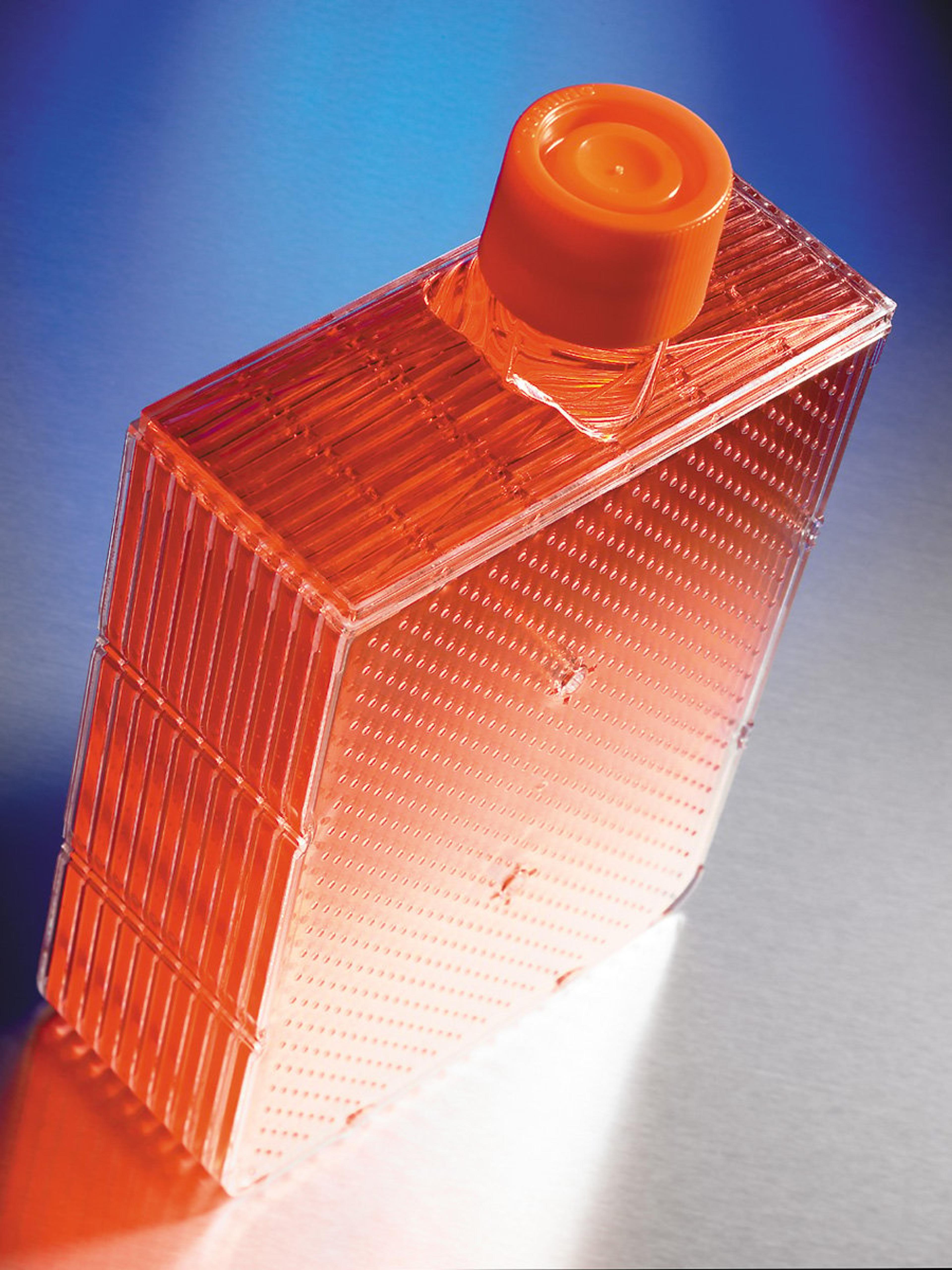
Corning® CellBIND® Surface HYPERFlask® Cell Culture Vessel
Corning Life SciencesThe High Yield PERformance Flask (HYPERFlask) cell culture vessel has 1720 cm2 available growth area on a polystyrene gas permeable surface. Treated for optimal cell attachment and gamma sterilized. Bar coded and compatible for use on Cell Culture Automation Platforms. Solid cap with liner on a straight neck designed for filling with growth medium. Made with USP Class VI Materials – molded and assembled in a Certified Class 100,000 clean room Sterile – gamma irradiated to sterility assurance level (SAL) 10⁻⁶ Clean Room Packaging – each pack is double bagged. Innovative 10Layer Design – 10 interconnected polystyrene growth surfaces Optimal Growth – Corning CellBIND® Surface treated gas permeable polystyrene for superior cell attachment and growth Increase Cell Yield – 10-fold higher cell yield increases productivity and capacity Time and Space Savings – Reduce processing time and incubator storage space by handling one flask compared to 10 traditional 175 cm2 flasks