
Analytik Reports on use of the CPS Disc Centrifuge System for Measurement of Size and Density of Nanoparticles by the Nanoanalysis Group at the National Physical Laboratory.
26 Nov 2013
Analytik, leading suppliers of innovative analytical instrumentation, report on use of the CPS Disc Centrifuge for ultra-high resolution nanoparticle size analysis by the Nanoanalysis Group of the National Physical Laboratory.
The National Physical Laboratory (NPL), the United Kingdom's National Measurement Institute, is well equipped with many means to characterize the size of nanoparticles1. These are complementary and are used in concert or alone depending on the type of materials being studied. Every particle sizing technique is based on a different physical principle and therefore measures a slightly different "size" of the nanoparticle. Take, for example, a gold nanoparticle stabilized with citrate molecules. Dynamic Light Scattering, DLS, will measure the hydrodynamic radius; that is the gold core, the molecular coating and every molecule of solvent that moves with the core. In contrast, transmission electron microscopy, TEM, measures the size of the metallic core, thus providing a size of the nanoparticle that is smaller than that measured by DLS.
The Group also uses the CPS Disc Centrifuge system from Analytik. This technique is based on differential centrifugal sedimentation. Describing this technique, Dr. Caterina Minelli says: "The CPS technique is very precise and produces particle size distributions with extremely high resolution. This means that when we attach antibodies to the surface of a nanoparticle, for example, we are able to identify and quantify not only the main population of well functionalized particles, but also the fraction of undesired particles that aggregate in doublets, triplets or larger aggregates. The CPS instrument thus provides us with a means to assess the quality of a surface fictionalization protocol and supports its improvement and refinement."
Continuing, Dr. Minelli says: "Another advantage of the CPS technique is that in combination with other techniques, or with careful experiments, we can measure both the size and the density of particles. This is because the instrument measures the particle sedimentation time through a medium, which depends on both the particle size and the density. If the size of the particle is known, for example by measuring it with an independent technique, the CPS can provide a direct measurement of the particle density. When we modify the surface of a nanoparticle, for example by coating it with molecules such as proteins, we change both its size and its effective average density. The ability to measure the change in the particle density means we have a tool to characterize the molecular coating surrounding the nanoparticles. This approach is useful to study engineered nanoparticles used in biosensing. Another application involves the study of how protein corona forms at the nanoparticles' surface as they enter a biological fluid such as blood or urine. The entity of the protein corona will determine the fate of the nanoparticles and has strong implications for nanoparticle toxicity, for example."
With a wide variety of materials and potential users for making routine analytical particle size measurements, the CPS is particularly popular because of its versatility and ease of use. From a research perspective, the main use of the CPS is to optimize the highly engineered biomolecular coating of nanoparticles used in biosensing systems or other medical applications. This experience enables the NPL's Nanoanalysis Group to offer contract analysis to external clients.
Related Products
Request Quote for All Products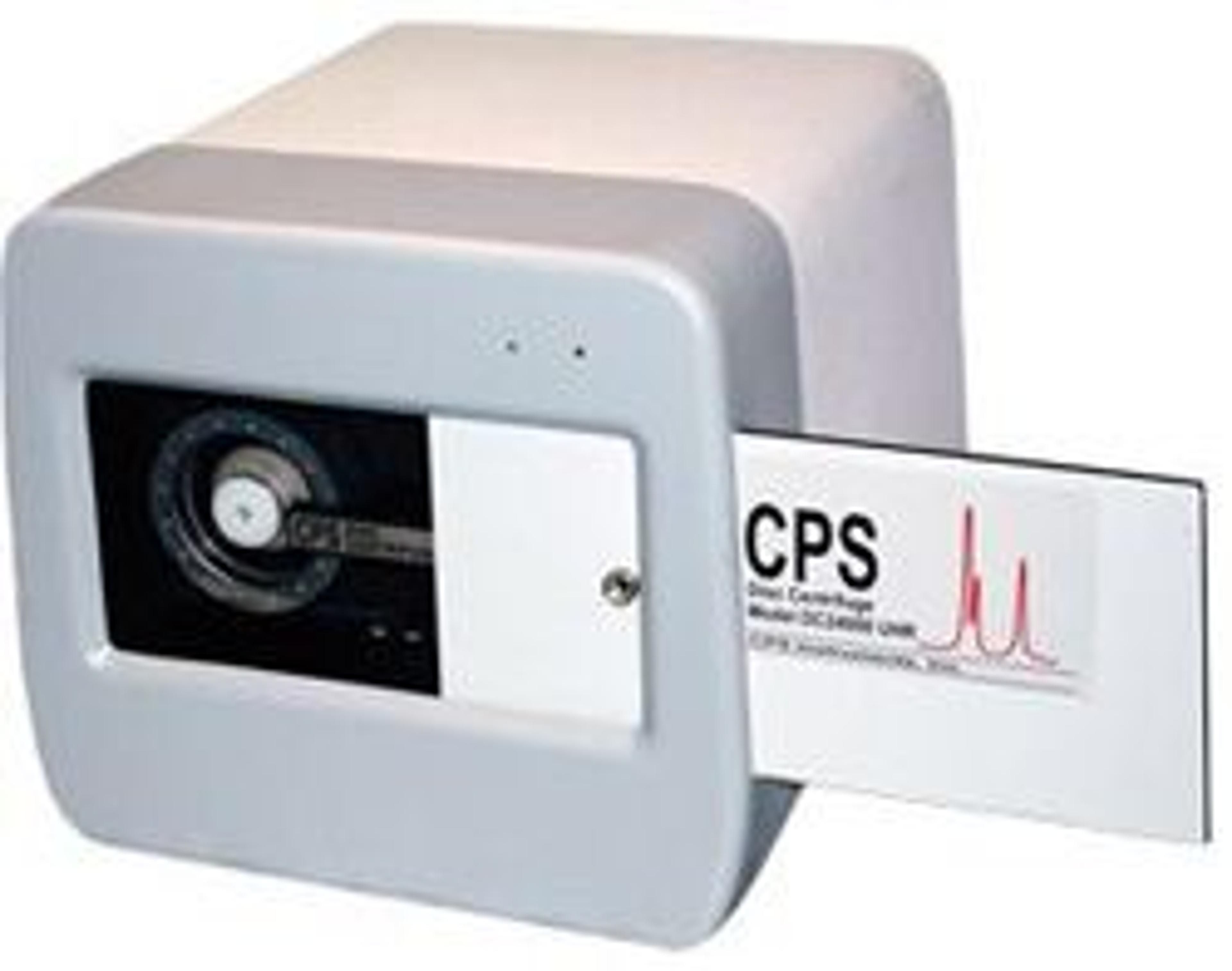
CPS Disc Centrifuge UHR Nanoparticle Size Analyser
Analytik LtdCPS DC24000 UHR nanoparticle size analyser is an effective analytical tool for ultra high resolution, high accuracy measurement of particle size distribution. Highly poly-dispersed particles can be measured in the size range of ~2.0nm to ~75 microns, at 2 to 10 times better resolution than any other particle sizing instrument, regardless of measurement technique.Utilising Differential Centrifugal Sedimentation (DCS), the CPS Disc Centrifuge UHR offers the unique ability to resolve very close multimodal particle distributions and to distinguish extremely small shifts in particle size. Rather than using a predictive algorithm, the instrument physically separates the nanoparticles and then measures them as they pass a light source detector - providing full characterisation in real time.CPS Disc Centrifuge UHR Nanoparticle Size Analyser Features: Ultra high resolution with clean separation of narrow peaks that differ in size by as little as 2% Able to detect and measure very small and subtle changes / differences in particle size Able to measure / monitor nanoparticle coating thickness Very high sensitivity; minimum detection limit below 10-8 gram active sample for narrow peaks Highly reproducible results Dynamic range capability >1000 for measurement of broad and multimodal distributions Measurement of particles of virtually any density Wide range of data presentation options, including multiple distribution overlays